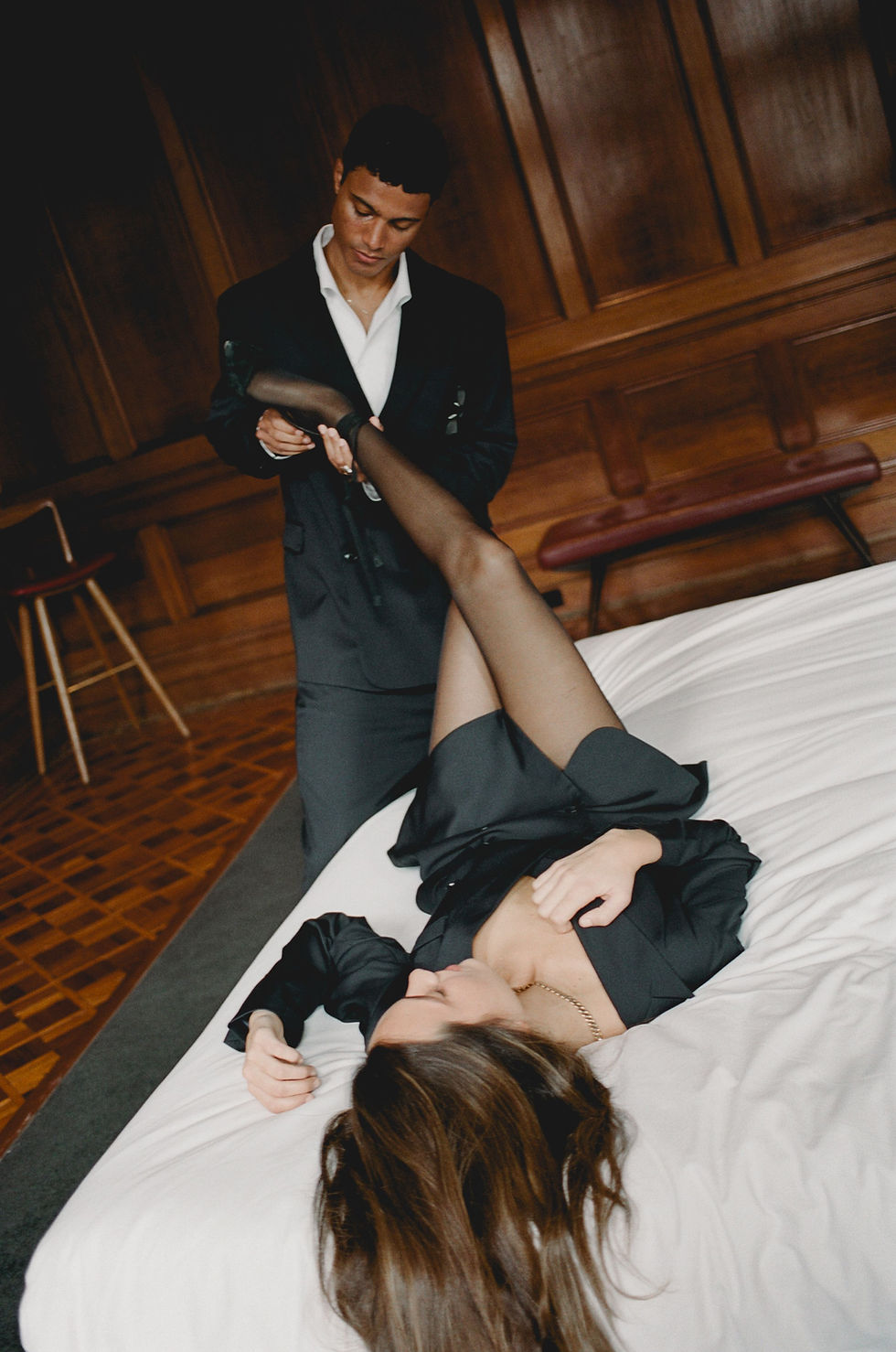
The Souvenir, Reconsidered: Mühlbauer's Spring / Summer Collection 2027.
There are few objects more optimistic than a souvenir.
You buy one believing, briefly and quite irrationally, that an object can do what memory cannot: Hold a place still. A shell from a beach. A miniature building. A postcard. Something handmade and “local”, preferably purchased after several glasses of something regional and considerably more persuasive than water.
Then you return home.
The souvenir is unpacked, admired and put somewhere safe. Usually so safe that it is never seen again.
The problem, of course, is that a souvenir is being asked to perform an impossible job. It is supposed to preserve an experience that was never really contained in the object in the first place. The sea was not in the shell. Venice was not in the miniature gondola. And the less said about fridge magnets, the better.

For Spring / Summer 2027, Vienna's Mühlbauer approaches the problem from a rather more intelligent direction: What if the souvenir wasn't something that reminded you of an experience, but something that became one?
For a hatmaker, it is an unusually appropriate question.
A hat is already a peculiar kind of memory device. It travels with its owner. It encounters weather, places and people. It appears in photographs. It is present for the lunch that became dinner, the train that was nearly missed and the evening that was supposed to be brief but wasn't. Unlike a postcard, it participates in the event.
And then there is the small matter of where it sits.
The head is an inconveniently visible place to put anything. A hat can alter a person's proportions, posture and apparent temperament in seconds. It can make someone look distinguished, eccentric, anonymous or as though they have recently inherited an estate in the country.
Mühlbauer has been making such interventions in Vienna since 1903. For Spring / Summer 2027, fourth-generation hatmaker Klaus Mühlbauer, working with designers Nora Berger and Selma Klima, has decided to look backwards - not in the usual fashion-industry manner of looking backwards, which generally involves declaring something “timeless” and hoping nobody asks exactly when it was made.
Instead, they went into the archive.
There they found the extended Mühlbauer family: Karl, Viktor and Marie, alongside favourites, forgotten models, stars and wallflowers. The archive is less a mausoleum than a rather well-stocked cupboard. The designers have taken some of its most compelling inhabitants and given them another lease on life.
This is not nostalgia in the conventional sense.
Nostalgia is an unreliable narrator. It remembers the beautiful afternoon but conveniently loses the uncomfortable shoes, the bad coffee and the person who wouldn't stop talking.
Mühlbauer is doing something more useful with the past. It is treating history as material.
Historic Mühlbauer logos and advertising slogans have been transformed into elaborate embroidered patches and badges. Graphics that once existed to persuade someone to buy a hat now become part of the hat's physical character. Yesterday's advertising becomes tomorrow's artefact.
There is something beautifully circular about it. Commerce becomes craft; marketing becomes memory.
The archive has swallowed its own advertising and, rather satisfyingly, made it wearable.
It also means the past isn't being reproduced with forensic reverence. These aren't museum pieces pretending the intervening decades didn't happen. They are old ideas with new lives.
Which brings us to one of the collection's most charming acts of disobedience: Felt and straw together.
Traditionally, the two materials know their place. Felt belongs to winter. Straw belongs to summer. Fashion, like the British class system, has historically had strong opinions about who should associate with whom.
Mühlbauer ignores the arrangement.
A particularly soft, lightweight felt crown meets a woven straw brim. Winter and summer are persuaded to share an address. It sounds slightly implausible. It looks remarkably convincing.
The collection continues in this spirit. Bao straw meets paper panama. Spagat straw encounters raffia. Cotton is paired with silk. Black and white are placed together without anyone needing to explain that, yes, technically they are opposites.
The point isn't novelty for its own sake. It is tension.
Different materials bring different histories, textures and expectations, and Mühlbauer lets them argue quietly with one another. The result is more interesting than simple harmony because nothing has been completely resolved.
Vienna is, perhaps, the ideal place to make this sort of trouble.
The city has spent centuries putting incompatible things next to one another and allowing them to become part of the same cultural conversation. Imperial grandeur and modernism. Freud and the waltz. Schiele and Sachertorte. High seriousness and the extraordinary Viennese capacity for understatement.
Mühlbauer understands the arrangement.
The hats are serious about craftsmanship without being terribly serious about themselves.
That distinction is of importance because every hat is still made by hand in the Vienna workshop. Craft here isn't nostalgia dressed in an apron. It is the means by which experimentation becomes possible.
Klaus Mühlbauer describes hatmaking as a “creative intervention on the head”. It is a wonderfully precise phrase. A hat is not simply an accessory placed on top of an otherwise finished person. It changes the composition.
A brim alters light across the eyes. A crown changes the apparent architecture of the face. Proportion changes attitude. Suddenly the same person appears more severe, more relaxed, more theatrical or simply more themselves.
It is almost portraiture in reverse.
The painter works around the person to reveal something about them. The milliner works on the person to alter what the rest of us see.
And because the intervention is handmade, it contains the small variations that industrial perfection tends to iron out. The material has to be persuaded. The shape has to be coaxed. The maker makes decisions that cannot always be reduced to a technical specification.
This is where Mühlbauer's relationship with tradition becomes interesting.
Tradition is not treated as a rulebook. It is a vocabulary.
You learn the grammar so that you can eventually say something nobody has said in quite the same way before.
That philosophy also explains why the souvenir is such a useful metaphor for the collection.
We tend to imagine memory as an archive. Put something away, retrieve it later, and there it is, hopefully in working order.
It doesn't work like that.
Henri Bergson regarded memory as something active and fluid, continually intersecting with perception and action. Our recollections are not simply retrieved; they are reconstructed. Which explains why the supposedly insignificant details of a trip often survive while the grand occasions disappear.
Years later, you may forget the museum but remember the blue of a tram at dusk. Forget the famous restaurant but remember the waiter. Forget the view but remember the smell of rain on stone.
Memory has dreadful filing discipline.
The best souvenirs understand this.
Eventually, they stop being souvenirs at all.
The thing bought in Vienna no longer has to represent Vienna. It becomes the thing you wore that afternoon. Then the next summer. Then at the wedding. Then, inexplicably, on a Tuesday when you needed something that made the day feel slightly less like Tuesday.
It acquires a history of its own.
That is the more interesting proposition behind Mühlbauer's Spring Summer 2027 collection. The brand isn't simply deciding which parts of its own past deserve to survive. It is making objects that might acquire entirely new histories in the hands and on the heads of their owners.
There is a wonderfully Viennese sentiment attached to the collection: “We'll never be this young again.”
It is funny because it is true, and useful because it doesn't particularly help to argue with it.
Time is going to continue regardless. The sensible response is therefore not to preserve everything, but to make a few things worth carrying forward.
Mühlbauer has opened the archive and invited its ghosts back out.
And somewhere between the workshop and the street, the souvenir undergoes its final transformation.
The old hat ceases to be an old hat.
It becomes yours.
Perhaps that is what the best souvenirs have always been: objects that begin by telling us where we've been, then quietly become evidence of who we were becoming.
The suitcase, mercifully, need only carry the hat.
---
Words by AW.
Photo courtesy of Mũhlbauer.