


Five By Flynn: Louie Collins on Style, Subculture and the Art of a Good Time.
A good shirt has a way of collecting stories. It might be worn to a festival, borrowed by a friend who never quite returns it, or rediscovered years later at the back of a wardrobe, carrying faint memories of a summer that seemed to last forever. The fabric may have faded; the recollection of the night it accompanied has probably improved. Clothes are rarely just clothes for very long. They become entangled with the people, places and small acts of mischief that give them a life beyond the hanger.
For Louie Collins, the story of Five By Flynn began with five shirts and a shortage of suitable alternatives. Working in Sydney's music and events scene, he wanted something to wear to festivals with his friends but couldn't find a cut or material he liked. Rather than settle for what was available, he decided to make his own. There is something refreshingly practical about this beginning. No grand pronouncement about changing the face of fashion, no painstakingly engineered origin myth. Just a problem with the wardrobe and the inclination to do something about it.
Of course, a shirt is only part of the equation. The rest comes from where it is worn and who is wearing it. Music has its uniforms, even when everyone involved insists they are not following one. The same goes for sport, nightlife and the assorted tribes that form around shared enthusiasms. These worlds have always influenced how people dress, often without anyone stopping to give the phenomenon a name. The best references tend to feel as though they belong there. The less successful ones have the unmistakable air of someone arriving late to the party and asking what everyone is supposed to be wearing.
That distinction is not unimportant in an industry that has become rather adept at turning cultural relevance into a line item on a marketing plan. A collaboration can bring together people with a genuine affinity, or it can amount to a logo-sharing arrangement with a launch party attached. Both may sell clothes. Only one is likely to leave anything worth remembering. The difference usually has less to do with the announcement than with the relationships and interests that existed before it.
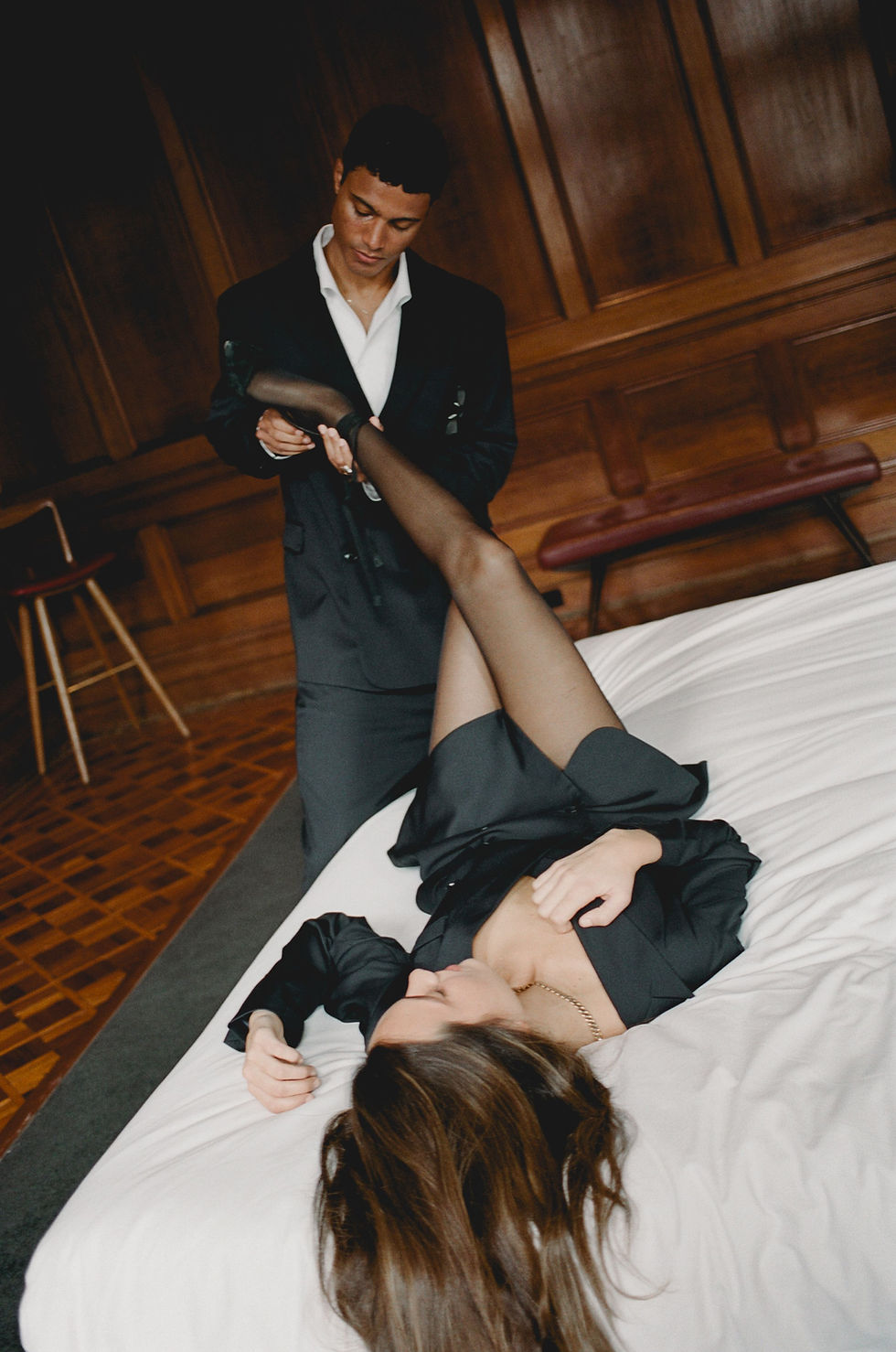
Five By Flynn grew out of a world where getting dressed is part of going out, not an occasion requiring a separate occasion. There is a certain freedom in that outlook. It leaves room for personal taste, for the unexpected combination, for dressing well without behaving as though one has just been admitted to a particularly exclusive club. Fashion can be an unnecessarily solemn business. A shirt, mercifully, does not know how important it is supposed to be.
Keeping that spirit intact becomes harder when a small idea starts to acquire a life of its own. New possibilities bring new expectations; the decisions that once belonged to one person begin to affect a team, a business and the people who have come to identify with the label. What worked at the beginning cannot necessarily be carried forward unchanged. Nor should it be. There is a difference between having a recognisable point of view and spending the rest of one's career repeating the opening chapter.
The more interesting creative journeys allow for a change of mind. Tastes shift, unexpected interests take hold, and other people bring ideas that would never have occurred to the person who started it all. That can be uncomfortable for anyone attached to the purity of an original vision. It is also how creative work stays alive. Otherwise, the founder risks becoming the curator of a very small museum dedicated to his former self, complete with a gift shop.
This is part of what makes Collins an interesting person to talk to. The story of Five By Flynn is not simply about putting clothes into the world; it is also about the influences that gather around a business, the choices that redirect it and the compromises that come with trying to make something last. Creative instinct and commercial reality are not always natural companions, though they do eventually have to learn to share a room.
We spoke with Collins about the ideas and experiences behind Five By Flynn, how his perspective has developed and what it takes to keep a growing label connected to the reasons it began. Rather than treating the brand as a finished statement, the conversation approaches it as something still in motion, shaped by the people involved and the world they inhabit. Five shirts were enough to get things started. The interesting part is what happens next.
You started Five By Flynn with five shirts, which feels almost deliberately understated given the world it has become. Before there was a collection, a store or a wider brand proposition, there was simply your eye and your instinct. What were you responding to at the time that you felt was missing?
Louie Collins: A big group of mates and I were going to a lot of music festivals, and there was this one camcorder shirt that became the piece we all wore. But I couldn't find a cut or material that I actually liked. I was already in the music scene, running events at the time, so I thought, instead of running events, I'd try to make something of my own. That's where Five By Flynn was born.
Your background seems to sit as much in culture, music, events and the social life around fashion as it does in clothing itself. How has that shaped the way you think about what a fashion brand can actually be?
Louie Collins: A fashion brand doesn't just sit in one world. Yes, we sell clothes, but music is a massive part of the business, and it's where I started my career. All these things intersect.
People in music and culture tend to be fashion-forward, and they're always drawn to the best brands, so it feels like a really natural combination. The overlap of music, culture and fashion is just part of the industry.
There is a certain nostalgia in Five By Flynn, but it never feels like nostalgia for nostalgia's sake. What are you really drawn to when you look backwards - the clothes themselves, the people who wore them, the rituals around them, or a particular attitude towards life?
Louie Collins: The brand has evolved in the same way I have, and in the same way the people closest to it have. My partner has been there from the start, and my sister works in the business. They're part of the fabric of the organisation.
A lot of it evolves with what we're interested in and the brands we're drawn to. The Red Bull F1 project is a good example. Five years ago, I wasn't really interested in F1, but over time I became more interested in it. Earlier this year, we ended up creating the Red Bull Pit Lane collection around the Australian Grand Prix. It's something I never would have thought about doing when we started Five By Flynn.
The brand honestly evolves as the team and I do. As the people closest to us grow up, meet new people and have new experiences, it gives us a new point of view.
You've collaborated with very different worlds, from PUMA and Porsche to Red Bull, while also creating your own experiences in Sydney, New York and Paris. What makes a collaboration interesting enough to become part of Five By Flynn rather than simply another brand association?
Louie Collins: Inevitably, it has to align with the brand, but the biggest thing for me is the people within it. I'm a massive believer that the people are what make up an organisation. They're your ambassadors.
With the brands we work with, we have strong relationships with a lot of the people behind them. That's what makes it authentic: we're working together in a genuinely collaborative process. Alongside that, it has to be something we're genuinely interested in.
Porsche is a good example. I love the cars and I'm growing a real interest in them, especially vintage ones. We've used vintage Porsches in some of our shoots, and it's a good reflection of what we're into.
There is an Australian ease running through the brand that feels instinctive rather than constructed. Has taking Five By Flynn overseas changed your understanding of that quality, or made you realise that what feels ordinary here can be quite distinctive elsewhere?
Louie Collins: One of the biggest things I've learned from going overseas is that brands in New York or Europe are on the other side of the world, so whatever feels natural to them and their culture is unique to them. That's really cool.
In terms of Australian ease, I personally like to think of myself as pretty laid-back, so hopefully that spreads through the brand and the people in it. We have to stay true to who we are and be proud of where we're from, which we really are.
We're fortunate to be from Australia. We're respected as a country, but there's also a bit of the unknown for the rest of the world, which works in our favour. People are always curious about what's going on here. I'm always conscious of being proud of where we're from and where the brand was built. It's an honour that we can show that off on a global scale in places like Paris and New York.
Five By Flynn has always had a certain freedom in how its clothes can be worn. With the new suiting, you're entering a category traditionally governed by rules, conventions and ideas of occasion. Did you approach tailoring by trying to loosen those rules, or by finding the freedom within them?
Louie Collins: The tailoring came from an actual need in the business. On a personal front, I have a lot of weddings coming up, and it's something I've always wanted to do, but we never had the capability or the business was never in the right position.
It's cool to be at a level now where we can try a new market. It's also given me a lot of respect and admiration for tailors and the amazing brands doing such incredible tailoring.
But our own perspective was always a baggy suit, laid-back, which is how we want to be as a brand. We tested the category and it's doing well, so hopefully it's something we can continue to build on for future seasons.
It also comes at an accessible price point, which I'm really happy about. I don't want to price people out, especially when some of our consumers are younger and don't have as much disposable income.
A suit can change the way we're seen, but it can also subtly change the way we carry ourselves. What interests you about that transformation, and what kind of person did you have in mind when you began developing Five By Flynn tailoring?
Louie Collins: I don't think changing the way you carry yourself is just about suits. I think any piece can do that. That's a massive goal of mine: to make people feel a certain way, feel part of something bigger and ultimately just feel good.
The person I had in mind was someone who wants to look sharp, but wants that laid-back, not-too-fitted feel to a suit, and at a great price point. Our consumers can be a bit younger, so I don't want to price them out. I want them to get a really good-quality, well-cut suit that they can afford.
As the brand moves towards a new Paddington flagship and a broader international presence, there is inevitably more infrastructure around the original idea. What have you become more protective of as Five By Flynn has grown?
Louie Collins: I'm most protective of our core: the people in the business. I want to build a really great work culture and make sure we protect everyone in there. We've got an amazing team right now, and I want to make sure they're all happy. That's imperative.
It's hard when you're growing quickly and there's a lot going on, but you want to keep that work culture. Even making sure I'm around as much as I can is important, because all of that feeds through to the team. That culture is ultimately what the outside world sees of the brand.
As the business gets bigger, it can get very serious. There are some big decisions being made right now, the store, for example. But I want to make sure we're still having fun through the process, because that's what people buy into.
I'm always conscious of not taking ourselves too seriously. Even in our tone of voice, I want us to stay a bit cheeky. We want to be recognised as the fun brand that we are.
You've now had enough distance from the beginning to see which instincts proved durable and which were simply products of the moment. Has building Five By Flynn changed your own taste or the way you look at clothes, people and culture?
Louie Collins: When I first started the business, I probably wasn't the most fashion-forward person. But being in and around it, I'm exposed to so many new products, and I'm always thinking about it.
I think we're meant to evolve. My style has inevitably evolved because I've grown up, I'm interested in different things and I'm exposed to a lot more new people and products. You still have an instinct for what looks good and what's bad. That sense of style and taste, even musical taste, just evolves over time, and hopefully I've got better at it.
But in the business, you also have to accept that not everything I want to do gets done. We sit somewhere between what the team and I want to do and a sense of commerciality, because at the end of the day we're here to run a profitable organisation. There's a sweet spot in the middle of those two things.
If the clothes, collaborations, stores and particular moments all disappeared and you were left with only the idea that sits underneath Five By Flynn, what would you want that idea to be?
Louie Collins: The pursuit of a good time. Full stop.
---
Words and questions by AW.
Answers courtesy of Louie Collins.
Photo courtesy of Five by Flynn.


