The Line That Refuses to Behave: Toni Maticevski on Movement, Contradiction and the Intelligence of Clothes.
Fashion has always been rather fond of boundaries. Couture and ready-to-wear. Archive and invention. Restraint and excess. The past behind us, the future somewhere ahead. Toni Maticevski has spent almost three decades making those distinctions feel less like rules than provocations.
Since establishing his eponymous label in 1999, Maticevski has developed a language in which cloth seems to possess a will of its own. A shoulder becomes architecture; a fold acquires the looseness of a brushstroke; volume appears simultaneously engineered and on the verge of escape. His clothes can be exquisitely controlled while retaining the sensation of something still becoming.
That tension is central to their fascination.
There is something almost Bergsonian in the way his garments resist being understood as fixed objects. They suggest duration rather than stasis: Form as a continuous act of becoming. The body is not a mannequin around which clothing is arranged, but an active participant in the final composition. Fabric responds to movement, posture and gravity; what appears sculptural at rest can become entirely different once inhabited.
It places Maticevski in conversation with a particularly interesting sartorial lineage. Not unlike Madeleine Vionnet, he understands the body as a geometry in motion. Like Balenciaga, he recognises the expressive power of volume. Yet neither comparison quite contains the work. His clothes possess their own peculiar equilibrium - romantic but unsentimental, dramatic yet edited, technically rigorous without becoming precious.
The house's description of Maticevski as artist, romantic, historian and futurist is unusually apt. His work can acknowledge fashion's past without embalming it, while looking forward without confusing novelty with progress. Ideas recur, but they are transformed rather than preserved. Memory is permitted to remain alive.
That restlessness has taken the practice well beyond the conventional fashion calendar.
From international presentations and New York to collaborations with dance and the Australian Ballet, engagement with the National Gallery of Victoria and the Dark Wonderland retrospective at Bendigo Art Gallery, Maticevski has consistently treated fashion as something capable of existing in dialogue with other forms of creative practice. The label has subsequently extended into couture, bridal, shoes, leather goods and children's collections, building an international presence while retaining an unmistakably personal vocabulary.
Yet these are not simply different categories of product. They are different territories in which the same question can be asked:
What can a line do to the body?

That question seems to sit beneath almost everything Maticevski makes. How far can fabric be pushed before it loses its softness? How much structure can a garment contain before it becomes rigid? When does embellishment become noise, and when does it become the final necessary gesture? And perhaps most intriguingly, how can a designer continue to develop a recognisable language without allowing recognition to become repetition?
There is also a refreshing resistance in Maticevski's approach to fashion's increasingly elaborate habit of explanation. His work does not seem to require a mythology before it can be experienced. The garment can arrive first as sensation - a silhouette, a tension, a movement - with interpretation left to the wearer.
It recalls Susan Sontag's warning against allowing interpretation to smother experience. Not everything needs to be decoded before it can be felt. Sometimes the most sophisticated response to an object is simply to look again.
Maticevski's clothes reward that second look.
They reveal themselves through proximity, through movement, through the physical intelligence of construction. A garment that appears extravagant from a distance can become remarkably precise up close. A seemingly effortless drape may conceal considerable engineering. What looks spontaneous may have been arrived at through relentless reduction.
Perhaps this is why his work has remained difficult to categorise without ever becoming difficult to recognise.
Its continuity is not a repeated silhouette or a fixed set of signatures. It is a way of thinking.
And at the centre of that thinking is movement.
Not movement as spectacle, but as possibility: the movement of cloth, the movement of a body, the movement of an idea from one collection to the next. The line is never entirely settled.
It is from that point - somewhere between structure and surrender, instinct and discipline, memory and invention - that our conversation with Toni Maticevski begins.
Maticevski has always felt like it operates slightly outside the rhythm of seasonal fashion - less about collection cycles, more about continuity of form. Do you see your work as evolving within fashion's calendar, or as something that quietly ignores it altogether?
Toni Maticevski: There's definitely a truth to that. I treat each collection, in some respect, as a nod and touch point to the very different versions of the women I dress. That can often confuse buyers and stores, who think continuity is sameness.
There are days when each person finds a need for something different in their dressing approach, and then there are times when they want an extension of an ongoing dialogue they have with the brand. But I always think of a collection, even within the confines of being placed seasonally, as something that should initiate an idea, simmer in existing ideas, and find resolution in ideas that have finally landed.
So when you look at a body of work, even with some revisited ideas, there is continuity without it ever feeling nostalgic. I can't help if some ideas land or align with other creatives, as we all absorb things that are happening around us, but it's never my intention to rely on that.
There is a very specific tension in your work between structure and softness - almost as if garments are holding themselves in place against collapse. Where does that tension begin for you: in the fabric, in the idea, or in the body you're designing around?
Toni Maticevski: Yes, I guess it does. I think about balance and contradiction often. In order for one part to be highlighted, the other steps back or moves forward. It caresses, holds and envelops.
Softness I always want to feel like it could dissolve or vanish. That lightness and air are important. And then there is the contrast with weight and control.
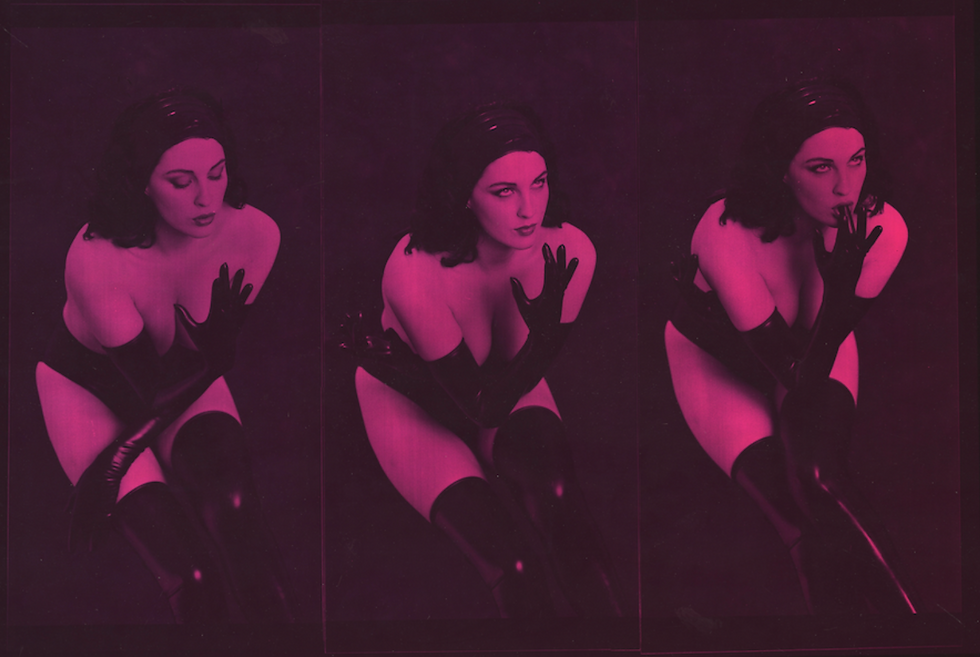
I really leaned into that idea after working with Dita Von Teese. Up until then, most of my work was very soft and almost completely structured by the cut. Then I really exploded the body form with fabric. It was quite a jump for me.
Your silhouettes often feel sculptural, but not in the static sense - more like something caught mid-transformation. Are you thinking of garments as resolved objects, or as moments suspended in motion?
Toni Maticevski: Movement in the body and movement in the fabric is magical. Fluidity and accidental movement is exciting. It's like freehand gestures in drawing.
Capturing that expressiveness through cloth and somehow having it feel like an extension to the body is a driver.
Maticevski pieces are often read as dramatic, but the construction itself is incredibly disciplined. Do you see drama as an outcome, or as something you actively design against in order to let form do the speaking?
Toni Maticevski: You know, I've had so many people criticise or make a point of the drama as a bad thing. Or elegance as weakness in design. I'd rather take drama in a piece of clothing than in person any day.
I am restrained in that drama deliberately, probably more than one thinks. I reduce and reduce to a simplified impact. I can't help that they may read as dramatic.
I don't want to design basic, repetitive ideas. The whole point is to have ideas and flex and risk them. I design with the intent to bend the notion of predictability and conformity.
There's a restraint in your use of embellishment - even when something is visually complex, it rarely feels decorative in the conventional sense. How do you decide when detail becomes essential rather than ornamental?
Toni Maticevski: True. Decoration for me is a statement. And often that statement is about impact through the overall piece.
I love creative decorative techniques with fabrics - a way of texturising a shape or enhancing a shape of the silhouette I want to bend. I love decoration, but I always hit a point where I can only go so far before it feels gimmicky to me.
So the restraint is about the core idea being finessed with a kiss.
Your work often sits in this space between couture logic and ready-to-wear pragmatism, without fully committing to either language. Has that ambiguity been a deliberate position, or something that emerged from how you like to build clothes?
Toni Maticevski: It has been something that I questioned early on. I love the notion of couture, but it's not realistic to me and the confines of it feel outdated.
But I love the focus and intensity of creating, pushing technique and ideas, and pushing the line of fashion. Because fashion is essentially a recalibration of lines. How many times can you reimagine the line on a body to feel unique?
Ready-to-wear is the industry that fashion exists for today. The sad part is that it's lumped into a cycle for all levels of clothes.
But for now, I sit in between the two.
Many designers speak about storytelling through collection themes. Your work feels less narrative and more architectural - almost as if each piece is an argument about proportion and tension rather than story. Would you agree with that reading, or is there an underlying narrative you work from that isn't immediately visible?
Toni Maticevski: I absolutely agree. I gave up narrative designing as soon as I finished my studies. It felt like I needed to justify a reference in order to validate an idea.
And it's what I really don't like about fashion now, because it trains people to talk about things and reference, but not the imagination. And somehow validates, for a person who has nothing to do with it, a means to be part of it instead of just appreciating ideas.
So much of my process is about pushing past what I feel comfortable with and creating a little unease. Overall, it's about a mood that I'm wishing to purvey. And that is all linked into my experiences and how I have responded to them.
Only after it's done do I see a narrative come through.
Fabric in your work often appears to behave beyond expectation - stretched, folded, engineered into unfamiliar volumes. How much of that is resolved in the drape versus refined in construction?
Toni Maticevski: So much happens in the draping stage. Seeing how far I can distort and push fabric is exciting. It does feel like sculpting.
And that tension, the push and pull, really does shape the body and give it the form it then takes into the wearer.
Maticevski has developed a very distinct visual language over time - recognisable without repetition feeling forced. How do you protect that language from becoming mannerism while still allowing it to evolve?
Toni Maticevski: You know, it's become a thing I have to visit and move through all the time. So many things I've explored over nearly 30 years have become mainstream and been picked up as staples in modern dress.
The thing I rely on to keep it my own is my deftness of touch. How you touch and hold fabric is something you learn only when working with it. Its flatness cannot be articulated fully through flat creation.
If you stripped everything back - silhouette, embellishment, staging - what do you think remains as the non-negotiable "Maticevski condition" in a garment?
Toni Maticevski: I think it would be an organic line. One which moves around the body.
---
Words and questions by AW.
Answers and photo courtesy of Maticevski.