How to Arrange a Soul: Karla Špetić’s COMPOSE and the Cartography of the Unfinished Self.
Fashion, at its most intellectually serious, has always been less concerned with novelty than with metaphysics. Beneath the industry’s choreographed appetite for “the new” lies a question as old as philosophy itself, one that preoccupied Heraclitus, Marcel Proust and Virginia Woolf in different idioms but with comparable urgency: by what hidden processes does a person come into form? How does one remain recognisably oneself while everything - memory, circumstance, desire, even the body - is in perpetual revision?
Few Australian designers have pursued that inquiry with the consistency, technical sophistication and intuitive intelligence of Karla Špetić. Since founding her label in 2008, the Dubrovnik-born, Sydney-based designer has occupied a singular position within Australian fashion: part engineer, part poet, part phenomenologist of the dressed body. Her garments do not simply adorn. They interrogate. They treat clothing not as surface embellishment but as a means of thinking through identity itself - how it is constructed, destabilised, edited and quietly reassembled.
Presented in the lucid stillness of Saint Barnabas Chapel during AFC Australian Fashion Week 2026, Špetić’s Resort 2027 collection, COMPOSE, emerged as one of the most intellectually coherent and emotionally resonant presentations of the week - a collection of uncommon formal discipline and rare philosophical depth.
The title is deceptively profound. To compose is to arrange disparate elements into meaningful relation, but also to recover equilibrium after disturbance. We compose a sonata, a photograph, a sentence, a face before entering a room. Embedded within the word is a tacit understanding that coherence is never innate; it is achieved. Elegance, in this sense, is not simplicity but complexity persuaded into temporary harmony.
That insight animated every look.
At a moment when much fashion is designed for instantaneous digital legibility - silhouettes calibrated to survive the velocity of the swipe and the ruthless compression of the thumbnail - Špetić proposed an altogether different temporality. Her garments were not fixed declarations but open propositions. They invited adjustment, hesitation and reinterpretation. Meaning did not announce itself at first glance; it accumulated slowly, like the significance of a poem whose architecture reveals itself only after repeated readings.
One thought of Paul Valéry’s observation that a work of art is never truly finished, only abandoned. COMPOSE seemed to refuse abandonment entirely. Each garment retained the possibility of further transformation, as though the act of design continued on the wearer’s body, extending beyond the atelier into lived experience.
Špetić returned to archival silhouettes that have shaped her visual language across nearly two decades, but the gesture felt less nostalgic than archaeological. Like Jorge Luis Borges revisiting one of his own labyrinths, she approached the archive as a living manuscript whose earlier meanings could be reopened and subtly rewritten.
Darts unfurled into elongated panels. Panels could be tied, cinched or left unresolved. Sleeves detached with the quiet inevitability of clauses changing tense. Collars vanished altogether. Blazers collapsed into waistcoats. Corsetry appeared intermittently, not as an emblem of restriction but as a form of architectural notation - visible syntax clarifying the logic of the silhouette.
The result recalled Umberto Eco’s concept of the “open work,” in which meaning is not dictated by the author but completed by the participant. These were garments that assumed an intelligent wearer, someone willing to become co-author rather than passive recipient.
Layering, long central to Špetić’s practice, became the collection’s deepest grammar.
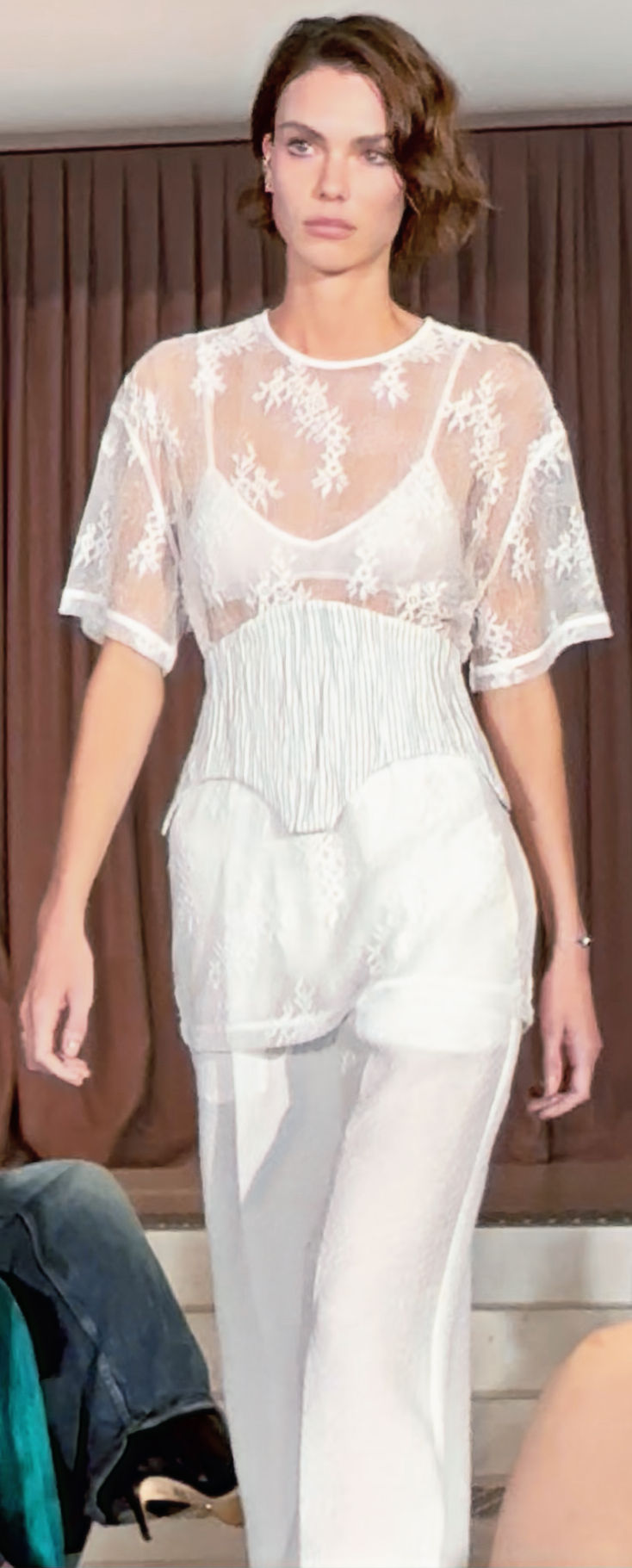
Sheer chiffon dresses floated over technical bodysuits and knitted foundations. Organza skirts hovered above sharply tailored trousers. Lace surfaced and receded like memory itself - fragmentary, elusive, intermittently lucid. Transparency and opacity were not opposites but alternating states of revelation.
This choreography of concealment and disclosure recalled In Praise of Shadows, in which Jun'ichirō Tanizaki suggests that beauty often resides not in exposure but in gradation, in the measured withholding that sharpens attention. COMPOSE understood this intuitively. Its most compelling gestures were rarely emphatic; they lingered at the threshold between presence and suggestion.
The setting intensified this sensibility. Saint Barnabas Chapel, with its ecclesiastical proportions and diffused light, lent the presentation the atmosphere of a secular liturgy. The models did not so much walk as process. The garments seemed suspended between object and icon, design and devotion. One thought of Piero della Francesca, whose paintings derive their extraordinary serenity from the conviction that geometry can become a vehicle for transcendence.
The palette - ivory, alabaster, nude, pearl grey and black - possessed an almost monastic restraint. By refusing chromatic spectacle, Špetić directed attention toward subtler matters: the argument of a seam, the memory held in a crinkled surface, the topography of cloth as it negotiated with light.
Fabric became the collection’s most eloquent language. Japanese textiles were selected for their minute irregularities and tactile intelligence. Crinkled chiffons appeared to retain the imprint of compression, as though the cloth itself remembered having been handled. Uneven georgettes introduced a softness that felt lived rather than manufactured. Sculptural organza offered volume without bombast, structure without heaviness.
Particularly arresting were the flocked organzas and cotton shirtings, where velvet-like florals and abstract linear forms hovered lightly above the surface. They resembled residues rather than decorations: botanical specimens pressed between pages, graphite dust on tracing paper, the ghostly cyanotypes of Anna Atkins. The garments seemed to carry not embellishment but evidence - traces of touch, memory and time.
The Japanese principle of wabi-sabi hovered quietly throughout, yet there was also an affinity with Louise Bourgeois, whose sculptures demonstrated that structure and vulnerability are not opposites but mutually sustaining conditions.
The live piano score by Cristof Slawomirski provided an inspired counterpart. Emerging first as distant harmonic vapour before resolving into recognisable motifs, the composition mirrored the collection’s own logic of gradual revelation. Claude Debussy famously suggested that music exists in the space between notes. COMPOSE located its deepest meaning in those same intervals - between panel and body, opacity and transparency, archive and invention.
And this, ultimately, is what distinguished Špetić’s work from so much contemporary fashion. She is not interested in garments as declarations, but as instruments of becoming. Her designs do not impose identity; they create the conditions under which identity may be revised, recalibrated and continuously authored.
In a cultural moment increasingly shaped by acceleration, algorithmic sameness and the pressure of immediate recognisability, COMPOSE felt almost quietly radical in its patience. It asked the viewer to slow down, to notice the intelligence of a fold, the rhetoric of proportion, the emotional consequence of restraint.
The collection proposed that style is not performance but composition.
That identity is less a fixed image than an endlessly annotated manuscript.
And that to compose oneself - in dress, as in life - remains one of the most intricate, exacting and elegant acts of authorship available to us.
---
Words and photo by AW.