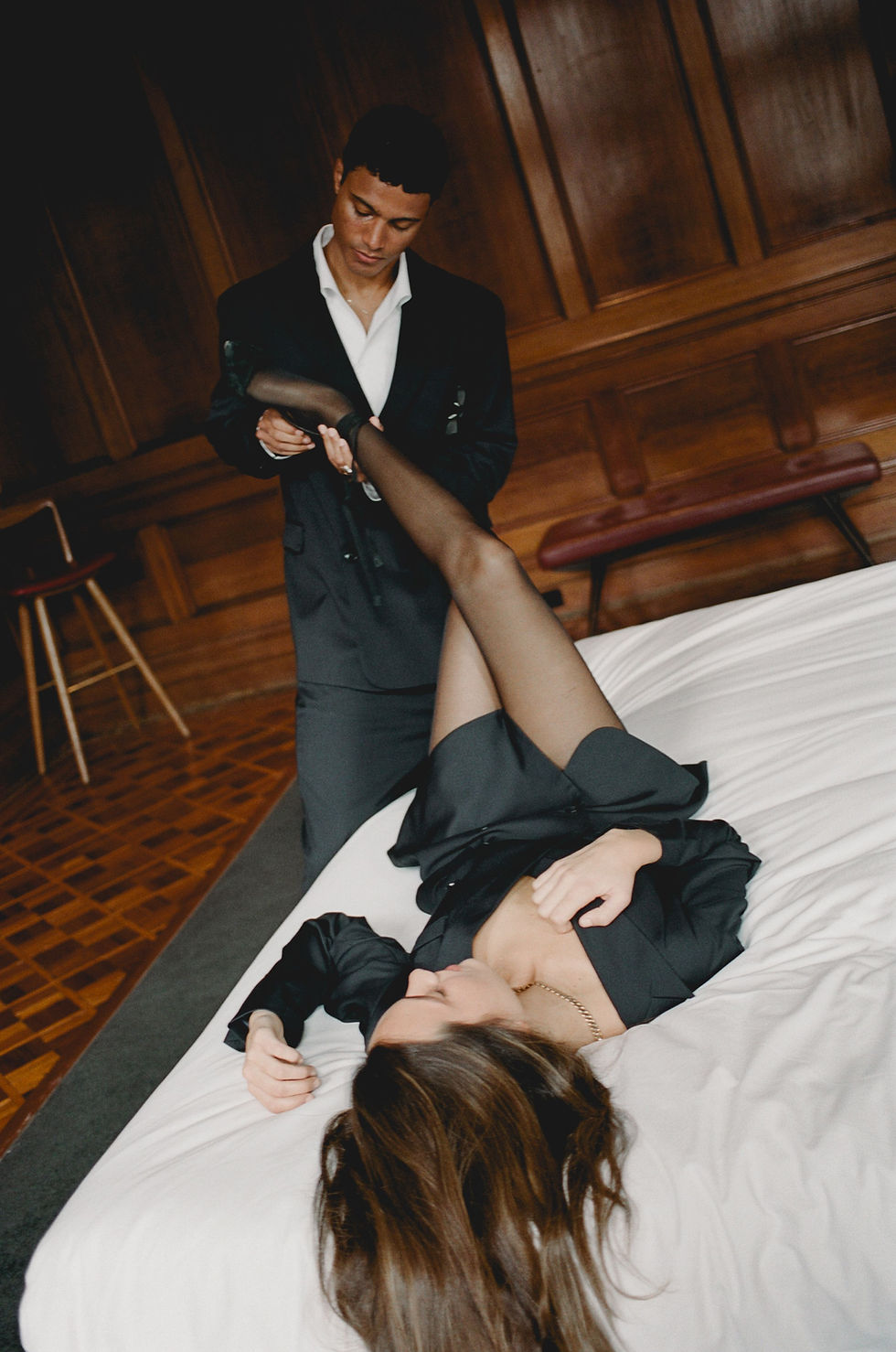
Where Structure Learns to Breathe: Maticevski at Australian Fashion Week 2026.
There are designers who produce collections, and there are designers who spend decades refining a single proposition until it begins to resemble a private cosmology.
Toni Maticevski has long worked in the latter register.
His return to Australian Fashion Week 2026 felt less like a seasonal unveiling than the continuation of a long, unfolding argument about what clothing can hold: tension without collapse, softness without surrender, structure without rigidity. In an industry increasingly governed by speed, visibility and instant legibility, Maticevski continues to operate according to slower and more exacting laws. His work does not submit to the calendar so much as orbit around its own centre of gravity.
This season, that orbit felt even more distilled. Winter 26 introduced a kind of quieting - not a reduction in ambition, but a refinement of frequency. The collection was framed by the idea of a woman moving “a little quieter”, yet with heightened intentionality: widened shoulders, sculptural hips, eyelash frills that catch rather than announce. She is composed, but never inert; controlled, but never closed.
Like a pearl dropped into a champagne flute, there is an effervescence that rises through the collection - delicate, continuous, almost internal. It is not spectacle for its own sake, but a kind of contained volatility, where restraint becomes its own form of ignition.

Maticevski’s work has always resisted the grammar of explanation, but this season’s logic was particularly clear: garments as calibrated emotional systems. Floating panels shimmered like morning dew caught mid-air. Sheer organza moved in wavering sheets, less fabric than atmosphere given structure. Tailoring coexisted with volatility; seams held discipline while silhouettes drifted toward release. In the most literal sense, these were clothes engineered for contradiction.
The opening looks established this immediately. White, sculptural forms arrived with widened shoulders and a near-architectural precision through the torso, only to dissolve into softer, drifting extensions that seemed to hover just beyond gravity’s permission. There was something almost meteorological about them - pressure systems held in cloth, where control and dispersion are constantly negotiating.
Throughout, the palette remained deliberately restrained: softened blacks, mineral whites, diluted metallics, blush tones that felt less chosen than sedimented into being. These were not colours as declarations, but as atmospheric conditions. One ivory silhouette suggested folded parchment repeatedly opened and re-pressed by time. A pale metallic shimmered with the muted ambiguity of light on water at dusk.
If earlier Maticevski collections often explored the dramatic threshold between architecture and botany, Winter 26 shifted that threshold inward. The language of armour remained, but it was softened - less defensive structure than personal fortification. Garments caged and protected the body even as they assimilated into irregular, organic movement. There was a sense of clothing learning to negotiate with nature rather than resist it.
One could think here of Gian Lorenzo Bernini’s Apollo and Daphne, where transformation is captured at the precise moment flesh becomes foliage. Maticevski’s silhouettes operate in a comparable suspension: never fully resolved, always becoming. A shoulder folds like a petal under pressure; a skirt expands with the inevitability of something opening from within.
What distinguished this season, however, was its tonal restraint. Where previous collections often carried overt tension between drama and control, Winter 26 allowed restraint itself to become expressive. Exuberance was not absent, but internalised - almost molecular. The garments did not demand attention; they calibrated it.
Maticevski has often spoken, in his own way, through construction rather than narrative, and this collection reaffirmed that position. Fabric was treated as a thinking surface. Organza behaved with unexpected authority; satin carried a tensile clarity more often associated with engineered materials; weightless layers still managed to suggest internal structure. Nothing felt incidental. Everything felt negotiated.
There is a quiet radicalism in this refusal of ornament as excess. Details operate instead as syntax - shifts in seam placement, calibrations of volume, subtle distortions in proportion that alter the entire emotional register of a garment. A fold at the shoulder recalibrates posture. A displacement of pleats changes tempo. Meaning is not added; it is redirected.
In this sense, the collection recalls W. G. Sebald’s literary architecture, where the placement of a comma can alter the emotional drift of an entire passage. Maticevski achieves something similar in cloth: a system where the smallest interventions become structural decisions.
The emotional register of Winter 26 is best understood through its central paradox: control as softness, and softness as a form of control. The garments suggested ease, even comfort, but always with an underlying compositional discipline. Nothing collapsed. Nothing resolved too neatly. Each look seemed to hover at the edge of a decision still being made.
This is where the collection becomes most compelling. It is not simply about silhouette or construction, but about posture as philosophy. The Maticevski woman is not defined by transformation alone, but by her ability to hold multiple states simultaneously - composed yet fluid, structured yet porous, restrained yet quietly expansive.
She moves through space with what might be described as considered ease. Floating panels respond to motion like slow atmospheric shifts. She does not announce herself; she recalibrates the room. There is intention in her stillness, and clarity in her movement.
At its core, Winter 26 proposes that elegance is not resolution, but negotiation. Between weight and lift. Between exposure and protection. Between the visible and the felt. The garments do not resolve these tensions; they sustain them.
As the final silhouettes passed and the space settled, what remained was not the memory of individual looks, but the sensation of having witnessed a system of thought rendered in fabric. Maticevski continues to treat fashion not as image production, but as a form of structural inquiry - one in which emotion is not illustrated, but engineered.
In an industry often preoccupied with novelty, he remains committed to evolution.
In an industry addicted to explanation, he preserves ambiguity.
And in an industry that too often mistakes surface for depth, he continues to build feeling directly into form.
This season, that feeling moved a little quieter. But it did not move less deeply.
---
Words by AW.
Photo courtesy of Maticevski.