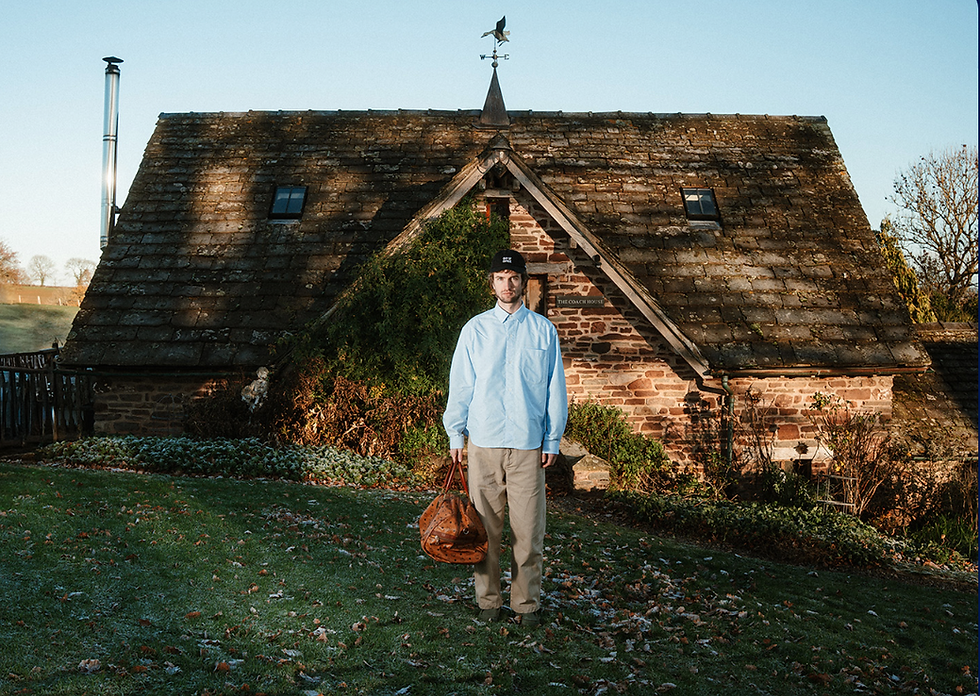
Objects With Weather Inside Them: Onguza's Dan Craven on Place, Craft and the Human Future of Making.
In 1958, the Italian writer Cesare Pavese noted that we do not remember days; we remember moments.
The same might be said of objects.
Very few possessions remain with us because of what they do. Most endure because of what they come to represent. A grandfather's watch. A battered leather chair. A hand-built table bearing the accumulated marks of family dinners, celebrations and disagreements. Their value lies not in function but in association. They become repositories for memory, evidence of lives lived rather than merely products consumed.
This is an increasingly unusual quality.
The contemporary economy is remarkably good at producing things and remarkably indifferent to permanence. Products arrive faster, perform better and disappear sooner. The language of innovation has become inseparable from replacement. We are encouraged to anticipate the next version before we have fully inhabited the current one.
In such a culture, longevity can feel almost subversive.
So can provenance.
For all the modern obsession with authenticity, many of the objects surrounding us seem curiously detached from origin. Designed in one place, manufactured in another, assembled somewhere else entirely, they arrive stripped of geography, disconnected from the conditions that shaped them. They belong to global systems rather than local realities.
Yet history suggests that the most enduring forms of design have always emerged from somewhere specific.
The bentwood chairs of Vienna could not have existed without Central European forests. Japanese joinery evolved through an intimate understanding of timber, earthquakes and impermanence. The architecture of the Mediterranean was shaped as much by sunlight as by stone. Good design does not merely occupy a landscape; it enters into a conversation with it.
Which raises an intriguing question.
What would happen if a bicycle were designed not simply for a place, but from one?
Not from market research, trend forecasting or aerodynamic modelling alone, but from the deeper realities of climate, distance, scarcity and culture.
The answer, in part, is Onguza.
Founded in Namibia, Onguza occupies an unusual position within contemporary design. On one level, it is a maker of meticulously hand-built bicycles. On another, it is a quiet argument for a different way of thinking about objects altogether.
Namibia is not an obvious birthplace for a global bicycle brand. It is a nation more readily associated with deserts than design studios, with vast horizons than manufacturing hubs.
Yet perhaps that is precisely the point.
Distance changes perspective.
In a country where roads seem to dissolve into infinity and resourcefulness is a daily necessity rather than a fashionable virtue, the relationship between people and objects becomes fundamentally different. Things are repaired rather than discarded. Durability is prized over novelty. Function and beauty are expected to coexist because there is little room for wasteful distinctions between them.
These values run through Onguza's work.

Its bicycles possess a clarity that feels increasingly rare. They are contemporary without being trend-driven, refined without being precious, deeply rooted in their place of origin yet capable of resonating far beyond it. Every frame carries traces of the environment from which it emerged - not only the physical landscape, but the cultural one as well.
There is a concept in phenomenology known as "being-in-the-world": The idea that human experience cannot be separated from the environments that shape it. We are not detached observers moving through space. We are formed by our surroundings, just as our surroundings are altered by us.
The most compelling objects seem to understand this intuitively.
They do not merely perform a function. They carry evidence of a relationship between people and place.
They contain weather.
Not literally, but emotionally. They absorb something of the climate, character and conditions that brought them into being.
This is what makes Onguza compelling far beyond the world of cycling.
Its bicycles are ultimately about larger questions. What does craftsmanship mean in an age of automation? Can local identity survive global markets without becoming caricature? Is growth always desirable? And what happens to our relationship with objects when the human hand disappears from their creation?
These are questions that reach far beyond the workshop.
To explore them, we spoke with Dan Craven - former professional cyclist, co-founder of Onguza and one of the most thoughtful voices working at the intersection of design, manufacturing and cultural identity today.
Our conversation began where all meaningful design stories ultimately begin: with place.
Onguza could have been founded almost anywhere with access to steel, welding equipment and technical expertise, yet it emerged in Namibia - a country more readily associated with vast landscapes than industrial manufacture. To what extent is Onguza a bicycle company, and to what extent is it an argument that place itself can become a design material?
Dan Craven: You're right. Very little consumer manufacturing occurs in Namibia.
When I retired from professional cycling, my family and I were living in Girona, the heartland of cycling in Europe. Neither my wife nor I wanted to enter the cycling industry, so we returned to my hometown in Namibia to do just that.
It came down to where we could actually have a positive impact on the world. In Europe we were just another ex-professional cycling family, but coming home to Namibia meant we could genuinely change a few lives.
Place remains a huge part of our identity. Namibia's landscape and climate are about as tough as it gets, and they influence both the engineering and visual design of every bicycle we make. But our responsibility goes beyond responding to the environment. We also want to place Namibian craftsmanship at the centre of the story.
Because so few consumer brands are exported from Namibia, and because we are still a relatively young nation, much of the world knows us only through images of landscapes and wildlife. We want to challenge that perception by showcasing the extraordinary talent, creativity and skill of the people who live here.
Your bicycles are made by hand in a period when manufacturing has become increasingly automated and geographically detached from the people who consume it. Do you see craftsmanship today as an economic decision, an ethical one, or perhaps even a cultural form of resistance against standardisation?
Dan Craven: Almost every top-end bicycle arriving on the market today is designed to outperform what came before it. The moment it's launched, you already know it will eventually be replaced by the next generation. In many ways, bicycles have started behaving like technology.
But there is a reason handmade watches, Damascus steel knives and other carefully crafted objects are passed from one generation to the next. They are made with extraordinary care, precision and attention, and people who value those qualities tend to form a different relationship with them.
We are trying to build bicycles that will last forever. To do that, we have to make them slowly, by hand and one at a time. Every bike carries traces of the people who built it.
I don't imagine we're heading back to a world without automation or artificial intelligence. Our bicycles are equipped with modern, high-performance components and we embrace contemporary technology where it makes sense. But I do believe people increasingly want handmade things in their lives. More importantly, they want experiences that still feel unmistakably human.
Today, simply knowing the name of the person who made your bicycle is, in its own small way, a beautiful act of resistance.
The philosopher Ivan Illich wrote that good tools should enlarge human freedom rather than dependence. When you design a bicycle, are you ultimately designing an object, or are you designing a particular relationship between rider, landscape and possibility?
Dan Craven: Our brand line is "Made Out Here."
For us, that phrase speaks to two realities. It refers to where our bicycles are made - in one of the toughest environments on earth - but it also reflects what happens to people when they're out there riding.
A bicycle has a way of shaping you. Your soul is made out there, or at least reshaped by long days in the saddle, difficult conditions and the experiences that unfold far from comfort.
We want people to develop a relationship with their bicycles. Not to see them as simple utilities, but as objects that carry stories - stories about where they came from and where they've taken you.
There is a fascinating tension within Onguza's work: The bicycles feel deeply rooted in Namibia, yet they resonate with riders across entirely different continents. How do you create something profoundly local without allowing it to become merely regional or folkloric?
Dan Craven: In my experience, most regional design doesn't go far enough. It's often afraid of its own voice. It tends to conform to a kind of algorithmic good taste rather than fully embracing what makes it distinct.
When we developed the Onguza brand, we deliberately leaned into our Namibian identity because we'd never seen another brand truly articulate what it means to come from Namibia.
That required some soul-searching. It meant embracing all the contradictions, rough edges and complexities that define contemporary Namibian culture.
At its core, Namibia is a place of resilience, joy and resourcefulness. Everything is far away. Everything requires effort. We celebrate rainfall. We celebrate small victories. Life happens on the road.
People around the world are hungry for new stories and new aesthetics. Rather than relying on predictable African clichés, we wanted to place contemporary Namibian visual culture at the centre of the brand - from the yellow cow-print inspired by Herero dresses to bright colours, hand-painted signs and everyday vernacular design.
We contrasted those elements against the starkness of the landscape itself.
Many brands seem uncomfortable celebrating the depth and complexity of contemporary African cultures. For us, that was exactly where we wanted to begin.
Luxury has increasingly become synonymous with scarcity, exclusivity and branding, yet the most compelling luxury often resides in provenance, patience and integrity of process. Has the market finally caught up with the values Onguza has always embodied, or are you still quietly swimming against the current?
Dan Craven: I think it's starting to happen.
We're still small and relatively unknown, but recently we received a major design award from Monocle for the best bicycle of 2026, which suggests that people are beginning to pay attention.
Because we're so geographically remote, Onguza has become more than a bicycle company. It's an experience. The journey, the place and the story all contribute to its value and uniqueness.
Looking closely at your frames, one senses a concern for proportion that feels almost architectural. Are there influences beyond cycling - architecture, sculpture, modernist furniture, even vernacular African craftsmanship - that have shaped the visual language of Onguza?
Dan Craven: We never look to the cycling industry for aesthetic inspiration.
I've always preferred understated forms and clean lines over complexity for its own sake. In fact, one of the reasons our frames became more affordable was because we stripped away everything that wasn't essential. In doing so, we actually improved the design.
There's a strong parallel with Shaker philosophy in that approach. Remove what is unnecessary and what's left often becomes more beautiful.
At the same time, we're deeply influenced by the growing global recognition of African art and design - particularly its playfulness, ingenuity and ability to juxtapose seemingly contradictory elements. Those qualities have had a significant influence on our aesthetic.
Namibia is a country defined by extraordinary distances and dramatic absences. The desert, after all, is less about what is present than what has been stripped away. Has that environment influenced your understanding of restraint in design, where removing something can be more powerful than adding it?
Dan Craven: Absolutely. Even our paint schemes are influenced by that tension.
Namibia is overwhelmingly arid, dusty and expansive, but scattered throughout the landscape are brightly painted homes, shops and shebeens that appear almost unexpectedly against the muted surroundings.
Those colours have such impact precisely because they aren't everywhere.
The absence amplifies their presence.
That contrast has become a fundamental part of how we think about design.
In many industries, growth is treated as an unquestioned virtue. Yet for a hand-built manufacturer, expansion can threaten the very qualities that created demand in the first place. How do you determine the point at which growth begins to compromise rather than strengthen the identity of the brand?
Dan Craven: I believe every company has a correct size.
There's a point where a business can remain highly profitable while preserving the quality, credibility and culture that made it valuable in the first place.
For us, owning our own manufacturing is essential. Handmade craftsmanship sits at the very centre of the brand.
We cannot outsource that without fundamentally changing what Onguza is.
That's where many companies compromise. It's not a path we're interested in taking.
Every handmade object carries evidence of human judgement, i.e. tiny decisions, subtle imperfections and accumulated experience that no algorithm can fully replicate. Do you think customers consciously recognise these qualities, or do they simply respond to them intuitively without necessarily understanding why?
Dan Craven: I think it's both. Some things are felt instinctively. People respond to them without necessarily being able to articulate why.
But people also love stories.
That's why we deliberately build storytelling into the bicycle itself. Every frame includes a hand-cut and stamped brass plate featuring the initials of every person who worked on the build, along with its unique serial number. Most customers also choose their own paint scheme from our palette.
The moment someone participates in the creation of their bicycle - even in a small way - they become invested in it differently.
The joy of being human lives in our quirks, our preferences and our individual decisions. We're trying to create space for those things.
Imagine that one of your bicycles is discovered a century from now, long after marketing campaigns, websites and social media have disappeared. What would you hope that object alone communicates about Namibia, about craftsmanship, and about the values that defined Onguza when it was made?
Dan Craven: Hopefully that happens.
We chose our cow-print motif because cattle remain one of the most culturally significant animals across Namibia's diverse communities.
More than anything, I would hope the bicycle communicates a sense of joy and playfulness. I hope it reflects a culture that values people, celebrates resourcefulness and respects resilience.
And, of course, I hope it still rides beautifully.
The way we build them, it should.
If the world goes completely off the rails, at least we'll have made bicycles capable of riding through it.
---
Words and question by AW.
Answers courtesy of Dan Craven.
Photo courtesy of Onguza.