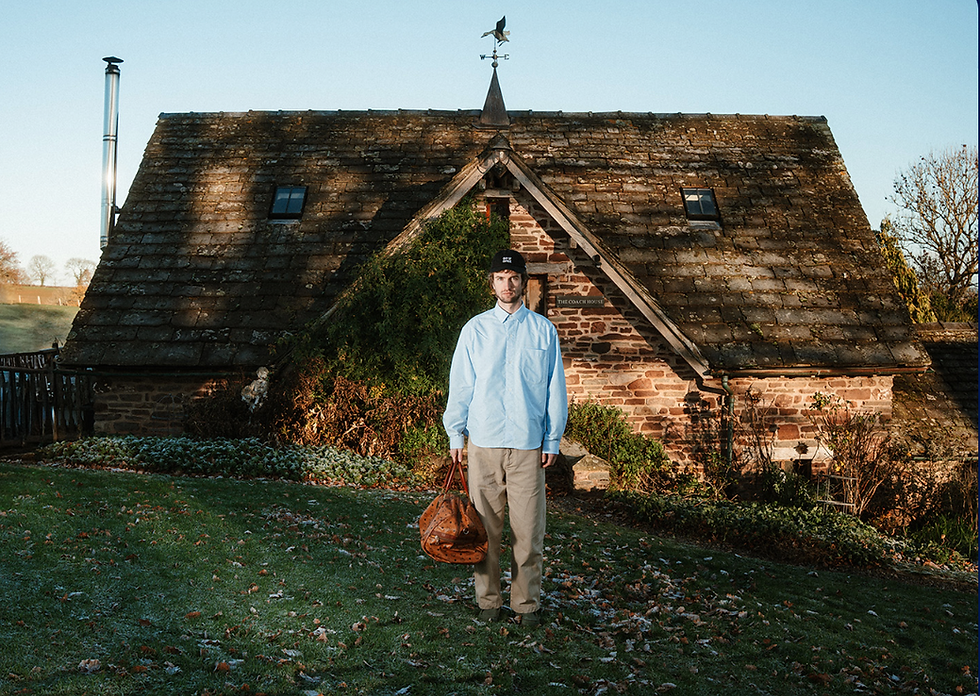
Before the Engine Starts: Inside Rolls-Royce Sydney's Alexandria Showroom and the Last Age of Commissioning.
The Renaissance didn't begin with artists. It began with patrons.
Michelangelo didn't simply wake up one morning and decide to paint a ceiling in Rome. Stradivari didn't build violins on spec and hope a buyer wandered in off the street. Before the brush touched the plaster, before the spruce was cut and steamed and bent into shape, there was a conversation - someone describing a thing that didn't exist yet, and a maker willing to spend years finding out what it was.
That kind of conversation has mostly gone missing from consumer life now.
We buy things that already exist, in colours a product team settled on eighteen months ago, for reasons a marketing brief decided on our behalf long before we walked in. Choice replaced commissioning. It's quicker. It's also, in a way almost nobody says out loud, thinner.
Standing in the newly redone Rolls-Royce Motor Cars Sydney showroom on O'Riordan Street in Alexandria, oddly, I kept circling back to that thought. Not thinking about cars at all, at first. The building had only opened that month, the first showroom in Australia to carry the marque's current global retail design in full rather than a local approximation of it, arriving a year or so after a sister space in Auckland. None of which explains why cathedrals kept coming to mind instead.
It would be simple enough to write the expected version of this piece. Walnut veneers, hand-stitched hide, the Pantheon Grille as threshold, the starlight headliner as private constellation, silence as engineering triumph. That article has been written a dozen times by a dozen visiting writers, and none of them are wrong exactly. They're just answering a different question.
Because the thing that separates this room, and the practice that happens inside it, isn't the walnut. It's that almost nothing in the building is trying to sell you anything. There are only three cars on the floor at any time, which in an industry built on showroom density feels almost like a statement in itself: Fewer things to look at, more time to actually look.

There's no countdown clock. None of the manufactured urgency that most luxury retail now runs on, a low current of anxiety dressed up as desire: Buy before it's gone, before the price moves, before somebody else gets there first. Scarcity has become the house style of an entire industry, and it works precisely because it borrows fear and calls it aspiration.
This showroom seems to have simply opted out. What's left in its place is patience, offered almost as a form of confidence. The room doesn't need to talk you into anything. It waits to find out what you already half know about how you want to move through the world, and only then does it start asking.
Which is the part worth sitting with.
Before a car is ever specified, somebody is listening.
Richard Sennett spent a good part of his career arguing that skill isn't really a manual thing at all, it's a relationship between hand and problem, refined slowly enough that judgement eventually turns into instinct. Strip the argument down and it comes to this: Craftsmanship is care, applied for long enough that it stops looking like effort. It's a useful thought to bring into the showroom's Bespoke Commissioning Atelier, because it explains why the whole process resists being sped up. You can't compress the decades a tree spent growing its own grain. You can't rush a client toward knowing what they want, only toward pretending they already do.
So what does a client actually bring with them on the first visit?
Rarely a finished idea, we'd guess. More often a fragment. A colour half-remembered from a coastline at a particular hour. The smell of a jacket their father used to wear. The hush of an early-morning drive before the rest of the city is awake. Nobody arrives with a completed sentence. They arrive with a feeling and no words for it yet, and the job of the room is to help them find the words without putting words in their mouth.
Keats had a phrase for the state a person needs to be in to let something take shape like that, without forcing it too soon into a fixed conclusion. Negative capability, he called it: The ability to stay inside uncertainty, doubt, mystery, without irritably reaching after fact. Usually that idea gets applied to poets sitting with an unfinished line. It fits a commissioning conversation just as well. The car doesn't exist yet at the start. Neither the client nor the designer fully knows what it's going to be. The temptation, for both of them, is to resolve that discomfort early and default to something off a shelf. The discipline is staying in the not-knowing a little longer than feels comfortable.
Then there's the question of what the materials are doing in that room, once you stop calling them materials.
Call a veneer sample a sample and you're missing what it does in that room. It behaves more like a prompt. Shown the exact same length of open-pore wood, one person sees their grandmother's writing desk. Another feels nothing much and moves along to the leather. The wood doesn't hold the meaning inside it, waiting to be released on cue. The meaning shows up with whoever's standing in front of it, and it shows up differently every single time.
That's close to what the Japanese aesthetic idea of shibui is getting at, a kind of beauty that doesn't announce itself and instead reveals itself slowly, to people paying close attention, rather than performing for everyone in the room at once. Jun'ichirō Tanizaki wrote about something adjacent to this, describing how traditional Japanese interiors worked with shadow instead of fighting it, letting an object earn its value through restraint rather than through spotlight.
Sydney is nowhere near Tanizaki's Kyoto, obviously. But the instinct rhymes. Australian taste has generally favoured the kind of understatement that only gives itself away on a second look, over the kind of confidence that announces itself the moment it enters a room. Sophistication here tends to mean being recognised by the right people, not being seen by everyone.
It isn't an accident, I don't think, that Australian Bespoke commissions tend toward that same quietness. Restraint chosen on purpose, rather than extravagance chosen by default because nobody thought to ask for anything else.
It's presumably why the showroom keeps a Cabinet of Curiosities tucked into one corner of the space, a small, changing collection of objects and references drawn from the Australian landscape rather than the marque's usual catalogue of European motifs. It functions less as decoration than as a kind of prompt in its own right, there to remind a client that a commission doesn't have to borrow its vocabulary from anywhere else.
Somewhere in the middle of all this it stops being about the showroom at all. What's being described, underneath the fittings and the floor plan, is an act of patronage, wearing the clothes of a retail experience because that's the only vocabulary contemporary life has left for it.
Historically people commissioned cathedrals. Portraits. Gardens laid out to be finished by someone else's grandchildren. Instruments built to outlive the person who ordered them.
The commissioner wasn't simply paying for an object. They were entering a working relationship with somebody whose judgement they trusted more than their own certainty, and whatever got made at the end of it, however extraordinary, stood mostly as evidence that the relationship had happened at all.
Spectre, the marque's first fully electric car, sits more naturally inside that lineage than it might look at first glance. Where most manufacturers have treated electrification as a rupture, something to sell as revolutionary and new, Rolls-Royce seems to have treated it as the fulfilment of an old promise instead. A century spent chasing silence and effortlessness, finally arriving at a form of propulsion that delivers both without the usual trade-offs. The philosophy didn't change. The engineering just caught up to it.
Silence, in that light, isn't a feature so much as a residue. It's what's left in a room once urgency has been stripped out of it, whether that room is a showroom, a design process, or a car.
The detail I keep coming back to from the visit, more than any veneer or grille or hand-finished seam, is how little the whole conversation resembled a sale. Nobody was steering me toward a conclusion. Nobody needed me to want anything specific by the time I left. The entire encounter was built on the assumption that wanting, if it's genuine, takes its own time to arrive, and that hurrying it along only ever produces the kind of object nobody actually ends up treasuring.
We usually measure civilisations by the monuments they leave behind. It might be a better measure to ask which conversations a civilisation still bothers having: About proportion, about patience, about doing something properly when doing it quickly would be so much easier and so much more profitable.
That particular conversation, in this case, happens to start in a quiet room in Alexandria, full of leather, veneer prototypes, colour schemes and good light and half-formed feelings nobody has named yet.
Everything that comes after it, the badge, the engine, the drive home, is transportation and not much else. The car was never the point. It was only ever the proof that the conversation took place at all.
---
Words and photo by AW.