Native Union Active Sport Loop - On Touch, Time, and the Disappearing Object.
There are objects that insist on being seen, and others that achieve something more elusive: they dissolve into the conditions of use. Not invisible, exactly - but absorbed so completely into the body’s routines that their presence is registered only in retrospect, in the subtle absence of friction.
This is the territory Native Union has been circling, almost stubbornly, since its beginnings. Not through spectacle, nor through the engineered drama of innovation-as-announcement, but through a quieter proposition: that even at the height of digital abstraction, the question of how we live with technology remains, irreducibly, a question of touch.
It is worth recalling that their origin point was not an attempt to outpace the device, but to re-situate it. When the first iPhone flattened communication into glass, the Pop Phone handset reintroduced weight, curvature, and the faint resistance of matter. It was, in hindsight, less a nostalgic gesture than a corrective - a suggestion that progress might be measured not by how much we remove from experience, but by how precisely we reintroduce it.
The years since have only intensified the stakes of that proposition. Interfaces have become smoother, faster, more anticipatory. Interaction collapses into gestures so minimal they verge on disappearance. And yet, the body does not follow. It remains stubbornly analogue - sweating, pressing, adjusting, fatiguing. The fiction of frictionless living holds only until it meets the surface of the skin.
The Active Sport Loop emerges within this tension, though it would be a mistake to call it an answer. It is closer to an accommodation.
At first glance, it resists interpretation. A woven nylon strap, ultralight, breathable, adjustable through a familiar hook-and-loop system. Its claims are almost disarmingly direct: comfort, durability, adaptability across movement. There is no rhetorical excess, no attempt to elevate itself beyond its category. But this restraint is precisely where its intelligence resides.
Because what the strap negotiates is not performance in the spectacular sense, but continuity - the ability to move without interruption.
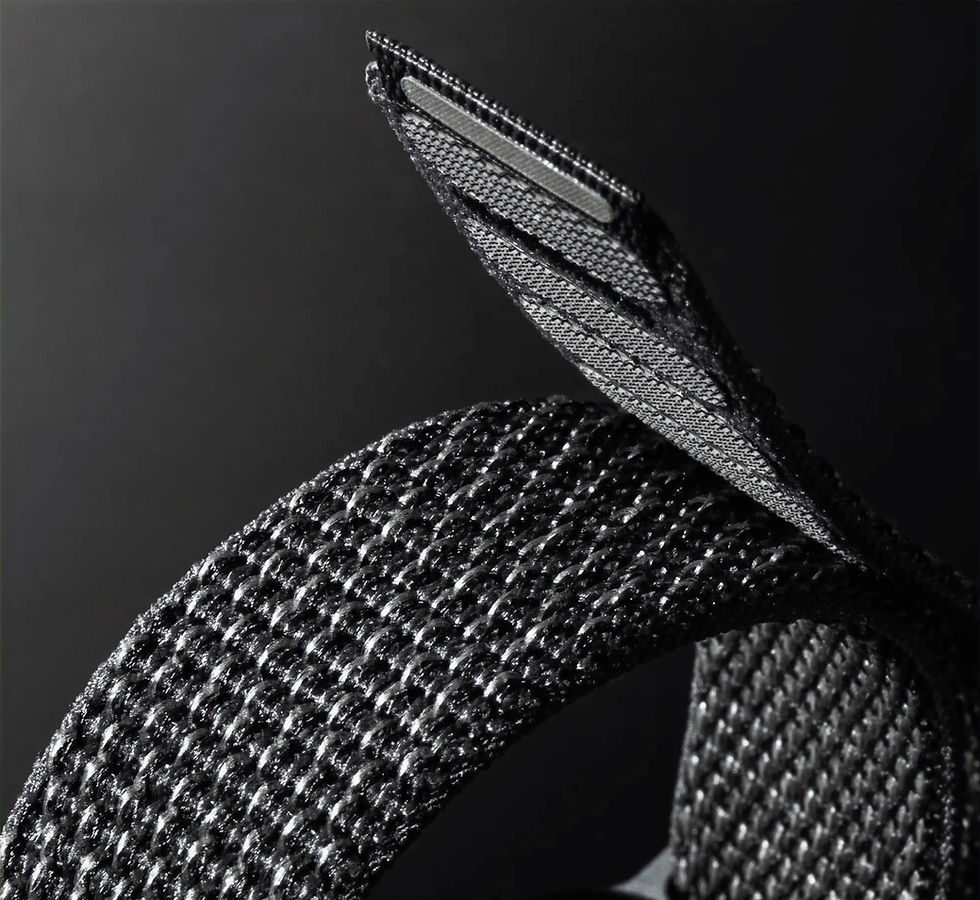
There is a passage in The Poetics of Space where Gaston Bachelard describes certain objects as expanding our sense of inhabitation not through scale, but through intimacy. The Active Sport Loop operates in this register. Its double-layer weave does not simply sit against the skin; it creates a narrow, almost imperceptible buffer - a space in which air circulates, heat dissipates, moisture is drawn away before it can accumulate into discomfort. The strap becomes less an accessory than a condition, a small and portable environment that travels with the body.
What is striking is how little of this is declared. There is no visible theatrics of engineering, no insistence on being read as innovation. The structure is embedded rather than displayed. In an ecosystem where design often performs its own complexity, this refusal feels almost anomalous.
This is the territory Native Union has been circling, almost stubbornly, since its beginnings. Not through spectacle, nor through the engineered drama of innovation-as-announcement, but through a quieter proposition: that even at the height of digital abstraction, the question of how we live with technology remains, irreducibly, a question of touch.
It is worth recalling that their origin point was not an attempt to outpace the device, but to re-situate it. When the first iPhone flattened communication into glass, the Pop Phone handset reintroduced weight, curvature, and the faint resistance of matter. It was, in hindsight, less a nostalgic gesture than a corrective - a suggestion that progress might be measured not by how much we remove from experience, but by how precisely we reintroduce it.
The years since have only intensified the stakes of that proposition. Interfaces have become smoother, faster, more anticipatory. Interaction collapses into gestures so minimal they verge on disappearance. And yet, the body does not follow. It remains stubbornly analogue - sweating, pressing, adjusting, fatiguing. The fiction of frictionless living holds only until it meets the surface of the skin.
The Active Sport Loop emerges within this tension, though it would be a mistake to call it an answer. It is closer to an accommodation.
At first glance, it resists interpretation. A woven nylon strap, ultralight, breathable, adjustable through a familiar hook-and-loop system. Its claims are almost disarmingly direct: comfort, durability, adaptability across movement. There is no rhetorical excess, no attempt to elevate itself beyond its category. But this restraint is precisely where its intelligence resides.
Because what the strap negotiates is not performance in the spectacular sense, but continuity - the ability to move without interruption.
There is a passage in The Poetics of Space where Gaston Bachelard describes certain objects as expanding our sense of inhabitation not through scale, but through intimacy. The Active Sport Loop operates in this register. Its double-layer weave does not simply sit against the skin; it creates a narrow, almost imperceptible buffer - a space in which air circulates, heat dissipates, moisture is drawn away before it can accumulate into discomfort. The strap becomes less an accessory than a condition, a small and portable environment that travels with the body.
What is striking is how little of this is declared. There is no visible theatrics of engineering, no insistence on being read as innovation. The structure is embedded rather than displayed. In an ecosystem where design often performs its own complexity, this refusal feels almost anomalous.
And yet, it would be wrong to describe the object as neutral. There is a distinct material sensibility at play - the fine-grained tactility of the weave, the controlled palette, the way the strap holds its form without stiffness. It recalls, obliquely, the logic of Japanese craft, where utility is not opposed to beauty but is the condition through which it emerges. One thinks, perhaps, of In Praise of Shadows, where Jun'ichirō Tanizaki lingers on surfaces that reveal themselves gradually, through time and use rather than immediate display.
And time is, quietly, the central medium here.
The strap does not improve in the conventional sense; it resolves. Fit becomes instinctive. Adjustment becomes unconscious. The object withdraws from attention, and in doing so, allows the body to come forward. What remains is not the awareness of design, but the absence of its failure.
This is a difficult quality to articulate, and perhaps impossible to market without distorting it. It sits uneasily within a culture that rewards interruption - the drop, the upgrade, the perpetual reintroduction of novelty. Against this, Native Union maintains a slower cadence. Their stated commitment to durability and lower-impact materials is not simply a sustainability gesture, but a temporal one: to make objects that persist long enough to justify their existence.
In this, their work begins to echo a broader philosophical unease with acceleration. Paul Virilio once suggested that speed, left unchecked, collapses experience into immediacy, eroding the very conditions that allow meaning to form. The answer, if there is one, is not to reject technology, but to recalibrate its tempo - to design for use rather than for attention.
The Active Sport Loop feels like an object shaped by that recalibration. It is not trying to be noticed. It is trying to keep up.
And perhaps this is where its particular form of sophistication lies. Not in complexity, nor in novelty, but in its capacity to disappear at precisely the right moment. To remain present only as long as it is needed, and no longer.
There is a line in Zen and the Art of Motorcycle Maintenance where Robert M. Pirsig describes quality as something that cannot be fully defined, only recognised in use. It is not a property of the object alone, but something that emerges in the encounter between object and user, across time.
By that measure, the Active Sport Loop succeeds in a way that is almost deliberately difficult to articulate. You do not notice it when you put it on. You notice it later, in the absence of irritation, in the ease of movement, in the quiet persistence of something that continues to function without asking to be acknowledged.
It does not transform the experience of technology. It recalibrates it, almost imperceptibly, back toward the body.
And then it gets out of the way.
And yet, it would be wrong to describe the object as neutral. There is a distinct material sensibility at play - the fine-grained tactility of the weave, the controlled palette, the way the strap holds its form without stiffness. It recalls, obliquely, the logic of Japanese craft, where utility is not opposed to beauty but is the condition through which it emerges. One thinks, perhaps, of In Praise of Shadows, where Jun'ichirō Tanizaki lingers on surfaces that reveal themselves gradually, through time and use rather than immediate display.
And time is, quietly, the central medium here.
The strap does not improve in the conventional sense; it resolves. Fit becomes instinctive. Adjustment becomes unconscious. The object withdraws from attention, and in doing so, allows the body to come forward. What remains is not the awareness of design, but the absence of its failure.
This is a difficult quality to articulate, and perhaps impossible to market without distorting it. It sits uneasily within a culture that rewards interruption - the drop, the upgrade, the perpetual reintroduction of novelty. Against this, Native Union maintains a slower cadence. Their stated commitment to durability and lower-impact materials is not simply a sustainability gesture, but a temporal one: to make objects that persist long enough to justify their existence.
In this, their work begins to echo a broader philosophical unease with acceleration. Paul Virilio once suggested that speed, left unchecked, collapses experience into immediacy, eroding the very conditions that allow meaning to form. The answer, if there is one, is not to reject technology, but to recalibrate its tempo - to design for use rather than for attention.
The Active Sport Loop feels like an object shaped by that recalibration. It is not trying to be noticed. It is trying to keep up.
And perhaps this is where its particular form of sophistication lies. Not in complexity, nor in novelty, but in its capacity to disappear at precisely the right moment. To remain present only as long as it is needed, and no longer.
There is a line in Zen and the Art of Motorcycle Maintenance where Robert M. Pirsig describes quality as something that cannot be fully defined, only recognised in use. It is not a property of the object alone, but something that emerges in the encounter between object and user, across time.
By that measure, the Active Sport Loop succeeds in a way that is almost deliberately difficult to articulate. You do not notice it when you put it on. You notice it later, in the absence of irritation, in the ease of movement, in the quiet persistence of something that continues to function without asking to be acknowledged.
It does not transform the experience of technology. It recalibrates it, almost imperceptibly, back toward the body.
And then it gets out of the way.
---
Words by AW.
Photo courtesy of Native Union.