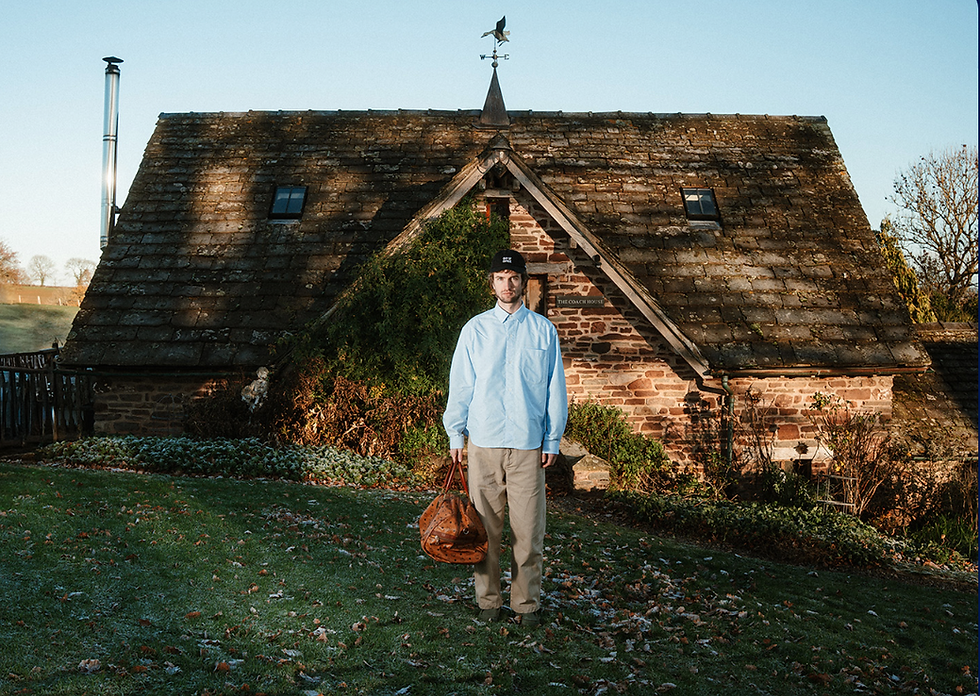
Orbitkey against the Jangle: Notes Toward a Minor Order.
There is a kind of disorder that doesn’t declare itself. It accumulates instead - softly, almost politely - in the margins of the day. Keys that insist on their own presence, jangling like an argument you didn’t mean to have. A bag that yields too easily, collapsing into formlessness the moment you look away. Objects that do not fail outright, but fail to cohere.
We tend to overlook this register of experience because it lacks drama. Yet it is precisely here, in the low hum of the infra-ordinary, that the texture of living is set. Georges Perec understood this better than most: the true site of inquiry is not the spectacular event but the overlooked detail, the repetition that becomes structure through sheer persistence. What we carry, and how we carry it, belongs to this category - a choreography so familiar it slips beneath notice, until something interrupts it.
Orbitkey begins with such an interruption. Not invention in the grand sense, but a refusal: the refusal to accept that keys must announce themselves, that disorder is a given rather than a decision deferred. The original organiser does not aestheticise or disguise; it edits. It takes a small, unruly cluster and introduces sequence, tension, silence. What was once noise becomes interval.
It is tempting to read this through the lineage of modernist reduction - the quiet severity of Dieter Rams, perhaps, or the disciplined subtraction of Donald Judd. But that would be slightly off the mark. There is nothing doctrinaire here, no insistence on purity for its own sake. The intelligence lies elsewhere, in calibration rather than elimination.

Consider the micro-adjustable hardware: a mechanism that doesn’t simply hold, but modulates. Each increment of tension is accompanied by a soft, affirmative click - not so much a sound as a form of feedback. It is a small but telling gesture, suggesting that use is not a fixed state but a dialogue, a series of minute negotiations between hand and object. The integrated spring extends this logic further, absorbing what would otherwise be loose or external into a continuous system. Nothing dangles, nothing drifts. Everything resolves into relation.
There is, in this, an echo of Gilbert Simondon’s idea of technical objects as evolving entities - not static things, but processes that move toward greater internal coherence. A well-designed object, in this sense, is one in which components no longer feel assembled but inevitable.
From here, the project expands, though “expands” may be the wrong word. It doesn’t proliferate so much as unfold. A duffel that exists in two states at once: latent and extended. Folded, it occupies almost no space; opened, it assumes a capacity that feels disproportionate to its prior form. It behaves less like a container than like a proposition about contingency - what if you needed more, suddenly? What if volume could appear without warning, then disappear again without residue?
There is something quietly metaphysical about this elasticity. Henri Bergson wrote of time not as a series of discrete units but as duration - a continuous unfolding in which potential and actuality are not separate states but interwoven. The foldable duffel seems to inhabit this condition. It is not one thing or another, but both, depending on when and how it is encountered.
The tote, by contrast, operates through immediacy. It refuses the small rituals that so often accompany compact design - no intricate folding sequence, no need to “learn” the object. It collapses and expands with a kind of casual fluency, as if it had anticipated the hand before the hand arrived. There is a humility here that borders on the philosophical: the best interface is the one that doesn’t announce itself as such.
Even the pencil case, that most modest of forms, participates in this quiet reordering. It stands upright, not as a novelty but as a principle. It divides its interior not to compartmentalise excessively, but to allow coexistence without collapse. Pens, cables, fragments of daily work - each is given a place, not in isolation but in relation. It is a small architecture of attention.
And attention, here, is the operative word. Not attention as spectacle, but as discipline. “Better than yesterday” reads almost too simply, but its implications are exacting. It suggests a commitment to iteration rather than reinvention, to refinement over replacement. An ethic of accumulation, where each adjustment, however minor, participates in a longer trajectory.
This orientation toward time extends into material choice. Leather that holds its form, nylon that resists wear, structures reinforced not for excess but for endurance. Sustainability, in this context, is less a declaration than a consequence of design decisions made carefully, repeatedly, over time. To make something that lasts is to resist a certain velocity - the speed at which objects are produced, consumed, discarded.
The organisation itself mirrors this distributed sensibility: a network of makers and thinkers across Melbourne, Sydney, Queenstown, Jakarta, Cebu, Shenzhen, Madrid. A geography not of centralisation but of relation. The “village” they invoke is not nostalgic; it is operational. A recognition that coherence can emerge from dispersion, provided the connections are precise enough.
What is striking, ultimately, is how little these objects ask of you. They do not perform. They do not insist. Their ambition is, in a sense, to disappear - to become so integrated into the rhythms of use that they no longer register as separate entities. Martin Heidegger would have called this readiness-to-hand: the state in which a tool withdraws from attention precisely because it functions so completely within it.
And yet, disappearance is not the same as absence. With Orbitkey there is a presence here, but it is diffused - distributed across gestures, across moments, across the small corrections that accumulate into a different way of moving through the world.
To organise, then, is not merely to arrange objects. It is to recalibrate relations: between things, between actions, between intention and execution. It is to reduce friction without eliminating texture, to allow for complexity without succumbing to it.
The ambition is modest, almost deliberately so. But modesty, in this context, is not limitation. It is precision. A refusal to overstate, to overproduce, to overcomplicate. A commitment to the minor key.
And perhaps that is the point. Not to transform life in any grand, declarative sense, but to adjust its syntax. To take the small, persistent irritations that structure the day and render them, if not invisible, then at least resolved - quiet enough that something else might come into focus.
---
Words by AW.
Photo courtesy of Orbitkey.