The Golden Years - A Kind of Guise and the Poetics of What Lingers.
Some brands design clothes. Others, more rarely, assemble conditions - loosely held worlds in which garments are not declared so much as permitted to emerge. A Kind of Guise sits comfortably in the latter register. Founded in Munich in 2009 by brothers Yasar Ceviker and Susi Streich, the label has, from the outset, resisted the procedural logic of seasonal acceleration, opting instead for a slower, observational tempo in which clothing is treated less as output than as a form of attentional practice.
There is a quiet refusal at work here - not oppositional in any overt sense, but closer to what Blanchot might have called a withdrawal from spectacle: a decision not to compete with visibility on its own terms. Production remains deliberately proximate, distributed across a small network of European makers, where continuity of craft is privileged over scale.
Materials are often drawn from what industrial time leaves behind - deadstock, overproduction, surplus - though never framed as compromise. Rather, they are approached as already-inscribed matter, bearing the sediment of prior intentions, previous economies, forgotten possibilities.
In this sense, fabric is not a blank surface but a palimpsest. One might think of Benjamin’s insistence that objects retain a kind of afterlife beyond their original conditions of production, or even Bergson’s notion that duration is never neutral but accumulative, thickened by everything that has already passed through it. Design, then, becomes less an act of imposition than a form of listening: a way of drawing out what is already latent rather than asserting what is new.
What emerges is not a system of aesthetic control but a discipline of restraint—an ethics of not overwriting. The clothes do not insist on erasure of origin; they work, instead, with what has already arrived.
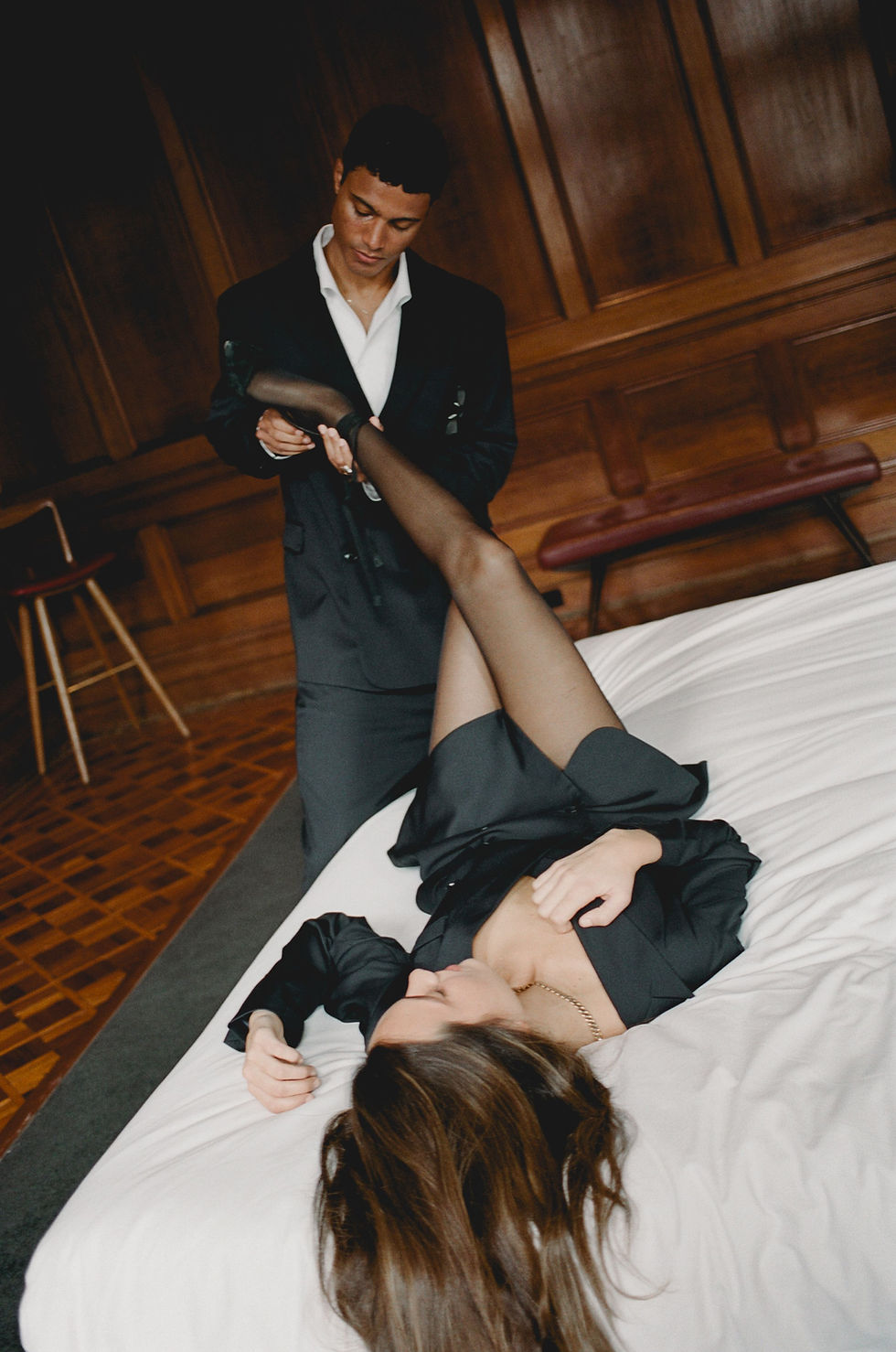
What has emerged over time is not just a recognisable aesthetic, but a way of seeing. AKOG’s Threads of Destiny series captures this most clearly. It’s ostensibly a sequence of campaigns, though that word feels slightly misplaced. Each instalment unfolds more like a fragment of a longer story - part documentary, part fiction - where the cast appears less like models and more like participants in an ongoing, loosely scripted life. There are always gatherings, always a suggestion of occasion, but the emphasis is never on the event itself. Instead, the focus drifts toward what surrounds it: the pauses, the gestures, the fleeting alignments between people.

In The Golden Years, the third chapter, that gathering takes place at a seaside taverna in Greece. Eleven friends assemble under the loose premise of a golden anniversary. But as with all convincing scenes, what matters is not the reason for being there, but the way it unfolds. Nothing is overstated. The light shifts. Glasses are refilled. Conversations fragment and reform. It feels less like a celebration than a continuation - something already in motion before we arrive, and certain to persist after we leave.
There is a particular kind of intelligence in choosing Greece without leaning on its mythology. No grand gestures toward antiquity, no borrowed gravitas. If anything, the setting feels closer to Cavafy’s sensibility than to Homer’s: a place where meaning resides not in origin stories, but in the accumulation of lived moments. The taverna becomes a kind of informal stage - open, porous, suspended between the private and the public - where time loosens just enough for something unforced to take shape.
The clothes follow that same logic. Tailoring anchors the collection - double-breasted suits, kimono-inspired blazers, finely made shirting - but nothing feels rigid or overdetermined. The cuts are assured without being strict, allowing the garments to move, to settle, to adapt. There’s a softness to the structure, as if each piece has already been worn into itself.
It is in the marginalia of the garment that the collection quietly begins to deviate from itself. A bow set where a cleaner resolution might have been expected; a trace of lace that surfaces almost as an afterthought, as though it had refused full assimilation into the logic of the seam. These are not accents in any conventional sense, but slight refusals - points at which form hesitates, and in hesitating, discloses its own contingency. One might think here of Derrida’s supplément: that which appears secondary yet subtly reorganises the whole, unsettling any illusion of completeness from within.
Barthes’ punctum offers a partial lens, though even that feels too conclusive. The detail does not simply pierce; it lingers, reroutes, unsettles the eye’s hierarchy of attention. Perhaps closer is Simondon’s sense of individuation - not as arrival at form, but as continuous modulation, where coherence is never granted but constantly negotiated. In this reading, tailoring is no longer the imposition of order onto material, but a sustained negotiation with its resistances.
What emerges is a striking indifference to the idea of context as anchoring device. These garments do not depend on occasion so much as orbit it, lightly, without obligation. A wedding might briefly accommodate them, but it does not explain them. They seem more attuned to what surrounds such moments - the preamble that thickens before anything formally begins, the dispersal that follows once attention has loosened its grip. There is something almost Proustian in this orientation: meaning lodged not in event, but in the porous intervals where nothing is declared and yet everything is already shifting.
The loosened jacket, the shirt left fractionally undone, the refusal of over-definition - these are not stylistic cues so much as propositions about temporality. A kind of composure that refuses finality. One thinks here less of spectacle than of duration as lived condition: Bergson’s durée, where time is not segmented but thickened, experienced as continuity rather than sequence.
Seen in this light, The Golden Years resists the grammar of celebration altogether. It is less about the event than about what exceeds it without contradiction: the aftertone of conversation, the unclaimed interval between gestures, the way attention disperses without fully dissolving. Memory, as Benjamin might suggest, is not a record of the moment but its afterlife - what persists once the frame has stopped insisting on itself.
What remains, ultimately, is not the scene but its atmospheric residue: the slow settling of fabric, the soft recalibration of proximity, the sense that meaning has not arrived so much as continued - quietly, almost imperceptibly - beyond the point at which it was supposed to end.
AKOG has always been good at resisting the obvious. Here, that restraint feels particularly well judged. The collection doesn’t push for attention; it accumulates it. It leaves space - for the wearer, for the setting, for time to do its work.
Threads of Destiny: The Golden Years arrives this weekend without much insistence. It doesn’t need to. The point isn’t to capture a moment at its peak, but to stay with it as it unfolds - gradually, almost imperceptibly - until it becomes something else entirely.
---
Words by AW.
Photo courtesy of A Kind of Guise.