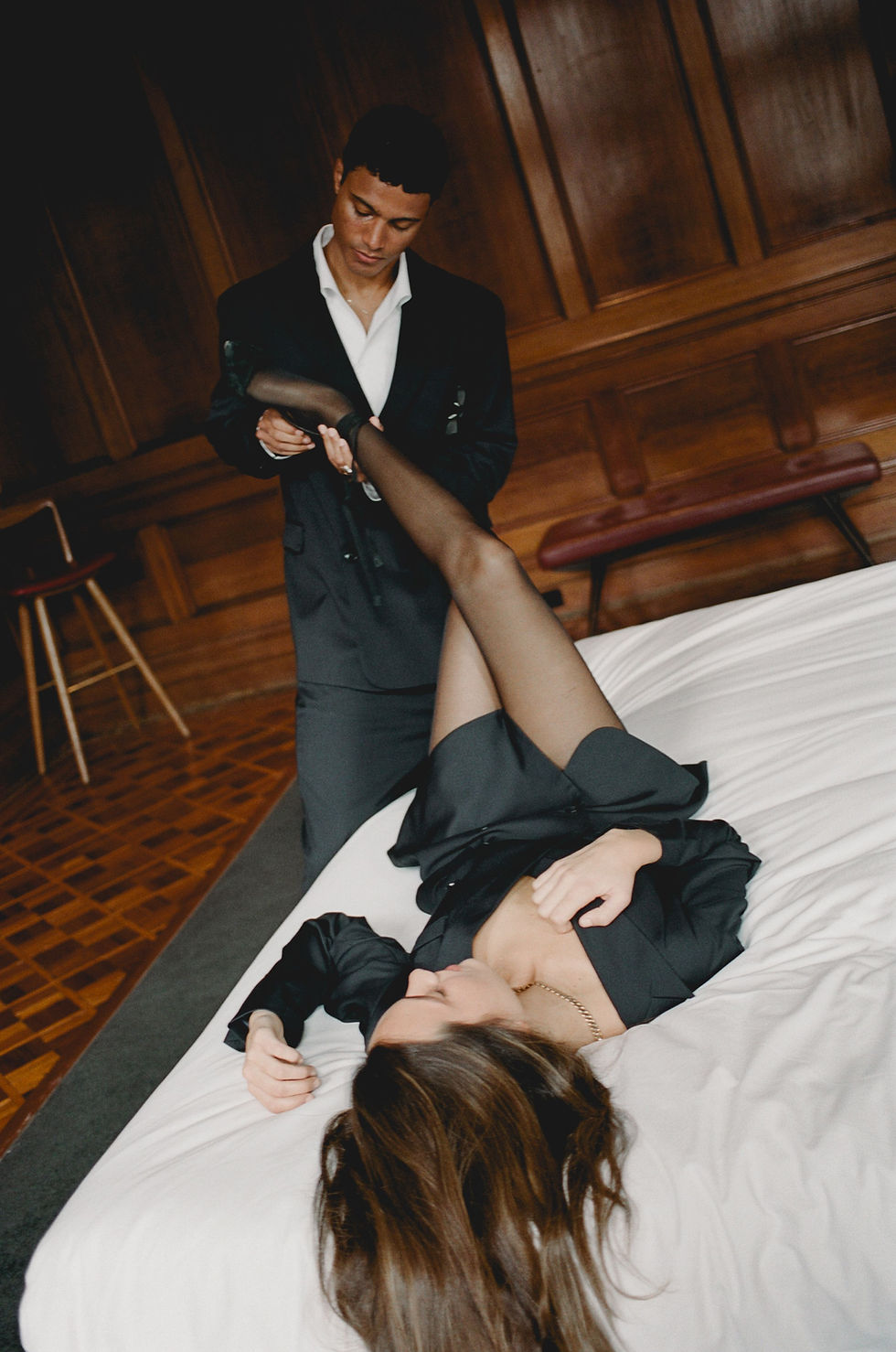
Maison Hellard: An Elegy in Linen and the Art of the Unresolved.
There are fabrics that obey, and fabrics that negotiate. Linen has always belonged to the latter - not unruly, exactly, but unwilling to be fixed in a single state. It carries time too visibly. It records the day in faint topographies: the crease at the elbow, the soft collapse at the knee, the quiet memory of a chair left hours ago. It does not aspire to permanence. It prefers evidence.
Most clothing works hard to conceal this. It offers the illusion of stasis - garments that appear unchanged despite the body that moves within them. Linen refuses such theatre. It shifts, responds, relaxes into its own temporality. To wear it is to accept a certain incompleteness, a refusal of the final image.
This is where Maison Hellard situates itself - not as a corrective to linen, but as an interpreter of its temperament.
Founded by Nathan Hellard, the house emerges without the weight of inherited codes that typically govern textile firms. Its origins are neither romantic nor conventional: a background shaped by military precision, followed by an immersion in some of the industry’s most established mills, before a decisive turn toward something more self-determined. What results is not a rejection of tradition, but a selective reassembly of it - an approach that feels less like lineage and more like authorship.
If there is a unifying idea, it lies in the notion of the “in-between.”

Geographically, the cloth begins in Normandy, where flax is cultivated in conditions that have, over generations, proven quietly ideal. It then travels to Italy, where it is spun, dyed, and woven with a technical fluency that is difficult to replicate elsewhere. The result is neither wholly one nor the other. It carries the restraint of its origin and the refinement of its finishing without collapsing into either identity.
Texturally, it occupies a similar middle ground. Irish linen, with its firmness and dryness, has long been associated with durability; Italian linen, by contrast, often leans toward lightness and fluidity. Maison Hellard’s cloth resists this binary. It is neither crisp nor overly soft, but calibrated somewhere between - a fabric that holds its line just long enough before yielding.
This calibrated ambiguity extends to colour. Where linen is frequently pushed toward brightness - an easy shorthand for summer - Maison Hellard pulls it back into something more muted, more interior. The palette draws less from the Mediterranean postcard than from the quieter registers of the French countryside: soil after rain, the subdued greens of undergrowth, the washed blues of uniforms left too long in the sun. These are colours that do not perform immediately.
They take time.
There is something cinematic in this restraint. One thinks less of spectacle and more of atmosphere - of scenes that unfold slowly, where the light is never quite fixed and the edges of things remain slightly unresolved. The collection titled Heures Bleues gestures toward this sensibility: that fleeting interval between day and night when forms soften and distinctions lose their urgency. It is not a moment one can hold onto, only one that can be noticed, briefly, before it passes.
To translate such a condition into cloth requires a particular kind of patience. The development of Maison Hellard’s yarn-dyed colour system - each shade tested, adjusted, reconsidered - speaks to this. It is a process that resists shortcuts. Colour is not applied but constructed, thread by thread, so that even the simplest weave carries a degree of internal variation.
The introduction of two-ply yarns complicates this further. By twisting together strands of different colours, the fabric acquires a depth that is difficult to articulate but immediately perceptible. It is not pattern in the conventional sense, but something more granular - a field of minute differences that shifts with light and distance.
And yet, for all this attention, the cloth remains resolutely unprecious. It is designed to be worn, and in being worn, to change.
This is where the philosophy of the house becomes most apparent. There is no attempt to stabilise linen into a perfected state. Creasing is not engineered out; it is accommodated. The fabric is finished to feel complete at the moment it leaves the loom, but it is understood that this completeness is provisional. The real work begins once it enters the world.
Such an approach requires a certain acceptance - from both maker and wearer - that control has its limits. In a culture that increasingly privileges predictability, this can feel counterintuitive. But it also opens up another way of thinking about clothing: not as a fixed object, but as something that evolves in relation to use.
The structure of Maison Hellard itself reinforces this perspective. It is a small, family-led operation, where decisions are made in close proximity to the material. Cloth is handled, inspected, adjusted without the distance that often separates design from production. This proximity allows for a different tempo - one in which ideas can be pursued without immediate pressure to scale, and where revisions are not signs of failure but of attention.
It also allows for a certain responsiveness. A vintage textile discovered in passing can become the basis for a new cloth within months, translated into linen with subtle shifts in weight and tone. The past is not reproduced but reinterpreted, carried forward in a form that acknowledges its origins without being bound by them.
There is, inevitably, a romantic dimension to all of this. Not in the sense of nostalgia, but in the belief that objects can still carry meaning beyond their function - that a piece of cloth can embody relationships, decisions, and time. To wear such a fabric is to engage, however lightly, with that accumulation.
But romance, here, is tempered by discipline. The work is precise, measured, attentive to detail without becoming ornamental. It does not seek to overwhelm. It seeks, instead, to align.
Linen, with all its contradictions, becomes the ideal medium for this alignment. It is at once ancient and immediate, simple in construction yet complex in behaviour. It resists finality, and in doing so, invites a different kind of engagement - one that unfolds gradually, over days, over seasons, over repeated wear.
Maison Hellard does not attempt to resolve these tensions. It inhabits them.
And in that space - between firmness and softness, between structure and release, between what is made and what is lived - something quietly compelling takes shape.
Not a reinvention, but a recalibration.
Not an answer, but a way of continuing the question.
---
Words by AW.
Photo courtesy of Maison Hellard.