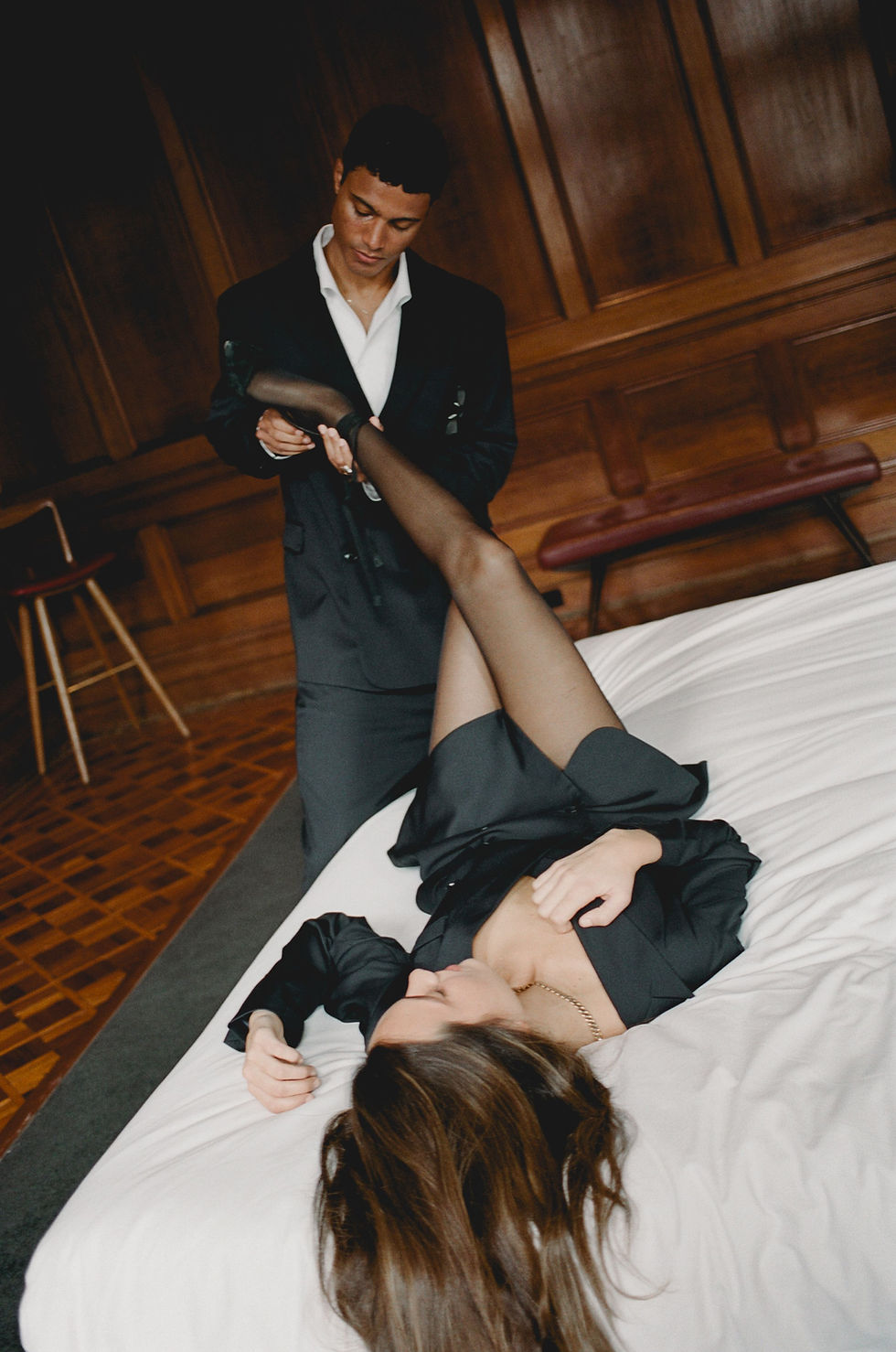
Farage Forward: The Suit, Reassembled.
The suit has been declared dead so many times that it has acquired the resilience of an old building.
Every few years, fashion holds another funeral for tailoring. The office becomes casual, the tie disappears, some new species of sweatshirt is briefly promoted to heir apparent. Then the suit turns up again, largely untroubled by the obituary.
Farage has never seemed especially interested in attending the wake.
For Spring Summer 26/27, Farage Forward takes the suit somewhere more useful. Rather than trying to rescue it from irrelevance, the collection loosens some of its old rules and sees what remains.
Quite a lot, as it happens.
A greige pinstripe suit is worn with a collarless shirt and turquoise polka-dot scarf. Grey tailoring is layered almost to the point of abstraction. Utility pieces sit alongside more conventional suiting. Eveningwear allows colour into a territory that has traditionally preferred black, midnight blue and the occasional nervous experiment with velvet.
The clothes still look like Farage.
They simply have more room to move.
That has much to do with Joe Farage's longstanding view of what tailoring is supposed to achieve. His instruction is disarmingly direct, i.e. make the client look good. Trend comes second.
It is a deceptively radical position in an industry that spends an extraordinary amount of time trying to persuade people that last season was a mistake.
For Farage, the wearer remains the fixed point. The clothes can change around them.

That philosophy has produced a wardrobe rather than a uniform. A jacket can be separated from its trousers. A scarf can alter the character of a suit. A collar can disappear. A formal silhouette can borrow something from military clothing without looking as though its wearer has recently been promoted.
There is practical experience behind that flexibility.
Farage has supplied clothing to the Australian Defence Force, including Woolmark-certified General Duty garments, and has worked with sporting and corporate clients including the Sydney Swans. Such clothing has to survive contact with reality. It needs to move properly, withstand use and remain presentable when the excitement of a new collection has long since evaporated.
That kind of discipline is difficult to fake.
It also explains why utility appears so naturally in Farage's wider wardrobe.
Once the original purpose of a military or performance garment is stripped away, what remains can be remarkably elegant: Proportion, protection, economy, good pockets. There is no reason those qualities should stop at the barracks.
The materials tell another part of the story.
Australian Merino sits close to the centre of Farage's identity, but the brand has never treated geography as a reason to work in isolation. Italian cloth is an important part of the picture, including fabrics from Vitale Barberis Canonico, one of Italy's oldest and most respected woollen mills. Other Farage fabrics come from Biella, while garments are made in Portugal. Japanese technical fabrics and membrane technology have also found their way into tailored pieces.
One current Farage jacket combines Australian Merino with Japanese technical backing in a three-layer construction designed to resist wind and rain. Elsewhere, traditional Italian woollen cloth is given a very different role - allowed to retain its character while being cut into clothing intended for contemporary life.
It sounds like the sort of thing that should require a spreadsheet.
On the body, it simply feels like a good jacket.
That compression of complexity into something apparently effortless is one of the more interesting things about Farage.
There are Scandinavian echoes in the restraint, Japanese thinking in the precision and treatment of technology, and a German-like respect for function and construction. These are influences rather than costumes. They do not announce themselves with a national flag sewn into the lining.
The Italian contribution is similarly practical. Vitale Barberis Canonico brings centuries of textile knowledge and a particular understanding of wool; Portugal brings highly developed garment-making expertise; Japan contributes technical ingenuity; Australia supplies the Merino and the context.
The parts come from different places.
The clothes do not feel as though they do.
Internationalism in fashion can become little more than a list of prestigious addresses. Farage is more interesting when those different capabilities disappear into the finished garment.
The wool does its job.
The cloth falls properly.
The construction holds.
The technology stays quiet.
And someone looks good.
That last point is easy to underestimate.
Attention to detail is often discussed in fashion as though it means adding more detail. In tailoring, the opposite can be true. The best work often involves making dozens of decisions that the wearer never consciously notices.
The width of a lapel. The balance of a trouser. The way a cuff sits. The amount of ease through a shoulder. The behaviour of a cloth when the wearer actually moves.
Farage's European manufacturing relationships and Italian fabrics matter because of what they allow the garment to do, rather than because they make an impressive sentence in a press release.
The same thinking extends into eveningwear.
Farage's formal pieces retain the architecture of black tie while giving it a little less solemnity.
Colour appears. Double-breasted shapes return. Details become slightly more relaxed without becoming careless.
One tuxedo shirt combines a German-fussed cutaway collar with Swiss Marcella detailing and Egyptian cotton woven in Italy before being handmade in Australia.
It is an improbable itinerary for a shirt.
It is also rather typical of Farage.
The sophistication lies in the editing. Nothing needs to look international. The influences have already done their work by the time the garment reaches the wearer.
This is perhaps why Farage Forward feels more convincing than the usual argument about making tailoring “modern”. The word has been doing a lot of unpaid labour in fashion lately.
Modernity, in this case, is simply the recognition that people no longer live in one category of clothing.
A jacket might have to survive a meeting, a flight, dinner and a walk home. A suit might be worn without its matching trousers. A technical coat might be more useful than an overcoat. Eveningwear need not behave as though it has been summoned by a royal summons.
Clothes have become less obedient.
Farage has adjusted accordingly.
There is a parallel in Farage House, the brand's Darlinghurst headquarters. Occupying the former Watters Gallery, the space retains the character of the original building while introducing concrete, blackened steel and a restrained, gallery-like interior. Woods Bagot and Greg Natale were brought into the project, creating a setting that sits somewhere between atelier, showroom and contemporary art space.
It is an apt home for the brand.
The architecture respects what was already there without becoming nostalgic about it. The same instinct runs through the clothes. Heritage is useful when it gives you something to work with. It becomes less interesting when it becomes something you are expected to worship.
Farage is now established enough in Australia that its familiarity can obscure the amount of thought beneath it.
There is a tendency to see an Australian tailoring house as a local proposition with an international supply chain attached.
Farage suggests something more reciprocal.
The Australian identity is not merely where the company happens to be based. It is the starting point from which Australian fibre, European cloth and construction, Japanese technology and a broader international design vocabulary are brought into conversation.
Joe Farage has spoken before about the peculiar irony of Australian wool leaving the country, being transformed overseas and returning as finished cloth or clothing. His response has never been to pretend the rest of the world does not exist. It has been to work out what happens when Australian material meets expertise from elsewhere.
That question feels increasingly relevant.
The boundaries between tailoring, workwear, technical clothing and leisurewear have become porous. Farage does not need to announce their disappearance. It simply makes clothes that cross them.
A military reference becomes civilian.
Technical fabric becomes tailoring.
A pinstripe becomes playful.
Australian Merino travels through Italy and Portugal and emerges as something that still feels unmistakably Farage.
The individual ingredients are impressive.
The achievement is that they stop behaving like ingredients.
They become a whole.
That may be the deeper lesson in Joe Farage's deceptively simple instruction.
Making someone look good is not really about fashion. It is about judgement - knowing what to add, what to remove and, perhaps most importantly, when to leave something alone.
After 28 years, Farage hardly needs to prove that it knows how to make a suit.
Farage Forward asks a more interesting question: What is the suit for now?
Its answer is refreshingly uncomplicated.
For work, when work calls for it.
For dinner.
For travel.
For occasions.
For whatever else the day happens to become.
The suit survives because it is useful. It survives because, at its best, it can absorb change without losing its shape.
Farage understands that.
It also understands something fashion periodically forgets: Clothes are not monuments.
They are meant to be worn.
Even, occasionally, with a turquoise polka-dot scarf.
---
Words and photo by AW.