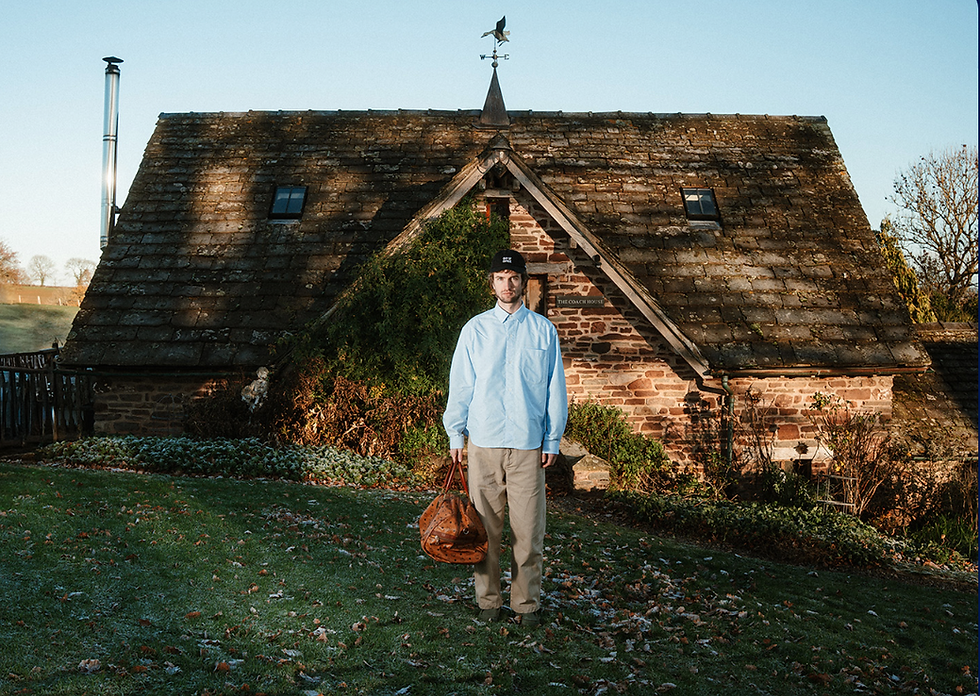
C.O.F. Studio - Where Denim Becomes a Circle of Friendship, Craft, and Time.
There is a line in Italo Calvino’s Six Memos for the Next Millennium in which he praises the virtue of exactitude - not as sterility, but as a form of moral clarity. Certain objects seem to embody this principle. They possess a quiet authority that comes not from spectacle, but from the elimination of everything extraneous until only intention remains. C.O.F. Studiobelongs to this rare category.
To describe C.O.F. Studio simply as a denim label is technically accurate in the same way that calling a Morandi painting a study of bottles is technically accurate. The statement is true, yet it overlooks the deeper subject. What the Stockholm-based brand is really engaged in is an inquiry into provenance, continuity and the possibility that clothing might retain the imprint of the relationships that brought it into being.
The name itself is the first indication that something more considered is taking place. Circle of Friends is not a slogan but a philosophy of production. It suggests a worldview in which mills, hardware makers, cutters and wash houses are not treated as interchangeable suppliers, but as long-standing collaborators whose expertise is visible in the finished garment. In an industry that often depends on obscuring origin, this insistence on attribution feels almost quietly radical.
At the centre of this vision is Per Fredriksson, whose relationship with denim is rooted less in trend than in cultural anthropology. His early fascination with American workwear introduced him to garments that derived their authority from function and endurance rather than ornament. Subsequent immersion in Japanese selvedge culture deepened his understanding of denim as a material capable of recording time with unusual eloquence.
Japan contributed a reverence for process and discipline; Sweden brought restraint and lucidity; Italy offered technical sophistication and an enduring belief that utility and beauty need not be opposed.

That Italian chapter is especially significant. Fabrics are sourced from Candiani Denim, the family-owned mill near Milan founded in 1938 and widely regarded as one of the most accomplished denim producers in the world. Portuguese ateliers - many family-run and steeped in generational know-how - transform these textiles into garments with an uncommon degree of precision. YKK Group Italy supplies the hardware. The acclaimed Rivetto d’Oro, awarded to a select group of makers who exemplify exceptional standards in denim construction, appears on C.O.F. Studio pieces as a discreet seal of trust rather than a decorative flourish.
Even the smallest details reflect an unusual intellectual honesty. Buttons and rivets are engraved with the names of the companies that made them, an understated but telling gesture. Where many brands erase the evidence of production in order to preserve the illusion of singular authorship, C.O.F. Studio leaves these signatures intact. The garment becomes less a finished object than a visible ledger of collaborations.
This is where the brand begins to distinguish itself from much of contemporary menswear. Its achievement lies not in invention for its own sake, but in alignment. Swedish clarity, Japanese discipline, Italian textile intelligence and Portuguese craftsmanship coexist without competing for attention. The result is clothing that feels deeply resolved, as though each component has been edited until nothing remains that does not serve a purpose.
The editing is rigorous, but never austere. Fredriksson understands that restraint is not the absence of emotion; it is emotion held in reserve. Like the furniture of Børge Mogensen or the photography of Hiroshi Sugimoto, the garments reveal themselves gradually. Their virtues are cumulative rather than immediate.
Denim, in this context, becomes a medium of duration. Indigo is not treated as a surface effect but as a substance that records use with the fidelity of a diary. The fading at the cuff, the whiskering at the hip, the subtle softening across the knees - these are not signs of wear so much as annotations of a life lived attentively. In the Japanese aesthetic tradition, there is the concept of wabi-sabi, the beauty that emerges through impermanence and use. C.O.F. Studio embodies this principle without ever resorting to cliché.
What makes the brand especially resonant today is its implicit critique of acceleration. Fashion increasingly rewards novelty, compression and disposability. C.O.F. Studio moves in the opposite direction. It asks what happens when garments are designed to remain in one’s life long enough to develop character. In this sense, its true subject is not denim but time.
That temporal dimension gives the clothes a philosophical weight unusual in contemporary apparel. They are built on the belief that value is not exhausted at the point of purchase, but deepens through repeated use. Ownership becomes a form of collaboration between maker, material and wearer.
This, ultimately, is what sets C.O.F. Studio apart. It does not rely on spectacle, mythology or contrived scarcity. Its distinctiveness lies in a rarer quality: coherence. Every decision, from the choice of Candiani denim to the acknowledgement of each manufacturing partner, reflects a consistent conviction that the finest garments are those in which nothing has been hidden and nothing has been overstated.
In the end, C.O.F. Studio offers a quietly persuasive proposition. Clothing can be an act of transparency rather than theatre. Craft can be relational rather than anonymous. And a pair of jeans, made with enough intelligence and care, can become something more than a garment - a durable record of trust, time and the human hands that shaped it.
---
Words by AW.
Photo courtesy of C.O.F. Studio