


Bob Carlos Clarke: The Last Dolls and the Trouble with Beautiful Things.
A beautiful photograph can be dangerous.
It can persuade us that looking is a passive act. We see something beautiful, recognise it as such and carry on with our day.
Bob Carlos Clarke had other plans.
His photographs are seductive, theatrical and exquisitely controlled, but rarely comfortable.
Women in latex stare from deep black-and-white prints. Bodies become sculptures, machines and dolls. A pair of legs assumes the logic of architecture. Even a fork, in Carlos Clarke's hands, can acquire an unsettling degree of sexual confidence.
Twenty years after his death, The Last Dolls at London's Atlas Gallery revisits the photographer's particular brand of trouble, bringing together rare and unique prints, previously unseen collages and works from Love Dolls Never Die, the final major series he made.
The obvious words are erotic, fetishistic, controversial.
They are all true.
They are also rather inadequate.
Carlos Clarke's photographs are really about what happens when something designed to be looked at begins to look back.
He did not initially intend to become a photographer. As a student, he became infatuated with a woman who worked part-time as a model and offered to photograph her. The seduction apparently succeeded. They married a few years later.
The camera remained.
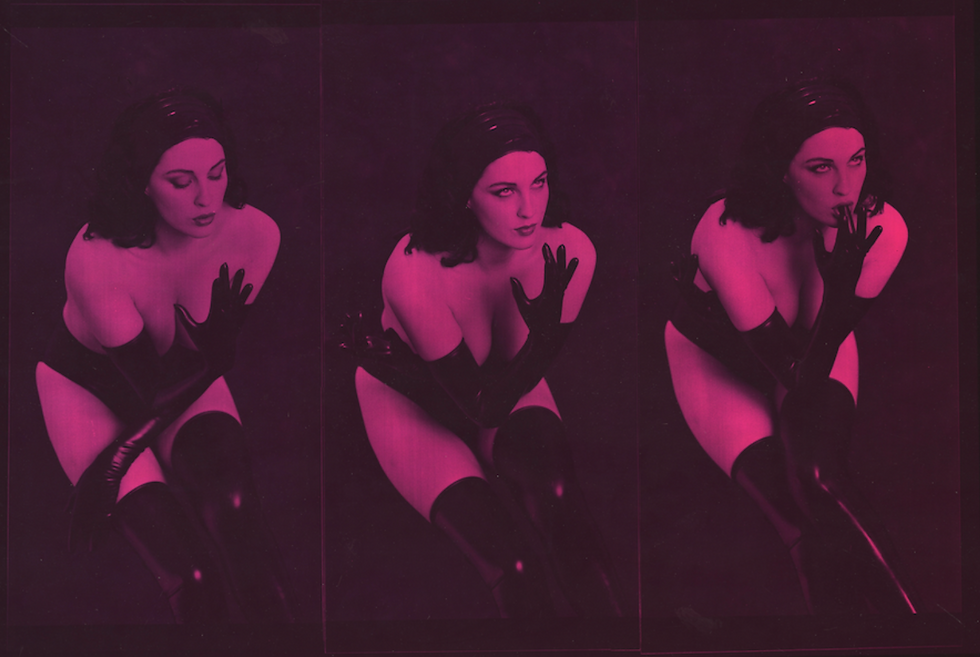
It gave him access to women, fashion, celebrity, advertising and the subcultures that existed beyond polite taste. His career moved easily between commercial work and more personal obsessions, taking in portraits of figures such as Keith Richards and Marco Pierre White alongside campaigns for Levi's and Smirnoff.
But it was his erotic work that established the mythology.
His women are frequently turned into objects, sometimes literally. They acquire switches and wind-up keys. Latex becomes a second skin. Bodies are posed with the precision of sculpture.
There is an obvious history of objectification here, and the feminist criticism surrounding Carlos Clarke's work is neither incidental nor something that can be wished away by admiring the craftsmanship.
Yet the photographs contain a curious resistance to their own premise.
The women rarely seem entirely possessed by the camera.
They look back.
In Trenchcoat, the figure appears less like an object awaiting inspection than someone who has entered the room to inspect everyone else. The photograph remains unmistakably erotic, but the power relationship has become slippery.
Carlos Clarke had little interest in conventional casting. According to his daughter Scarlett, he was drawn to “wild, slightly dangerous characters”, looking for intensity and unpredictability rather than a polished agency ideal.
That makes sense.
A perfectly compliant subject would have produced a perfectly compliant photograph.
Carlos Clarke wanted something with teeth.
His fascination with latex began during his student years, after meeting an older man known as The Commander, a former Royal Navy frogman whose interest in rubber grew from his experience with diving equipment. The Commander published an underground magazine devoted to rubber and introduced Carlos Clarke to a fetish culture far removed from conventional fashion photography.
Rubber was an almost suspiciously appropriate material for him.
It resembles skin without being skin. It shines rather than absorbs light. It stretches, constricts and protects while making the body appear confined.
At the Royal College of Art, Carlos Clarke became friends with Allen Jones, whose sculptural representations of women would provoke their own arguments about sexuality and objectification.
Jones turned women into furniture.
Carlos Clarke turned them into photographic constructions.
But photography adds a useful complication.
A sculpture cannot look back.
A photograph can make you feel that it has.
That sensation runs through Carlos Clarke's work, although it is never quite explained.
Nor should it be.
The word “obsession” followed him throughout his career. It was the title of his 1981 book and an accurate description of his working habits. He was an obsessive printer, spending long hours in the darkroom experimenting with colour, montage and photographic processes. He bought up remaining supplies of Kodalith paper to make his distinctive montages.
The photographs may look spontaneous.
They weren't.
Their apparent abandon was constructed with extraordinary precision.
Lighting, surfaces, poses and expressions were worked until the image reached the point he wanted. Desire, in other words, was not merely photographed. It was designed.
There is something almost comic about the severity of that enterprise.
Flesh is notoriously uncooperative. It ages, sweats, bruises, moves and refuses to hold still. Carlos Clarke spent hours persuading it to behave.
And then the photograph misbehaved instead.
The quietest works in The Last Dolls reveal how much larger his fascination was than the female body.
Among the exhibition's photographs are grainy still lifes of cutlery and found objects he collected along the Thames at low tide.
At first they seem to belong to another chapter.
Then you look again.
Forks intertwine. A knife becomes faintly threatening. Metal catches the light like skin. An iron and a kitchen utensil acquire the atmosphere of characters in a private drama.
Carlos Clarke could make an object feel alive without making it cute, which is harder than it sounds.
These things have already had a life.
They have belonged to somebody, performed some mundane domestic function, been lost and eventually returned by the river. Unlike the immaculate bodies of his studio photographs, they have history written into them.
The difference is telling.
The erotic photographs manufacture fantasy.
The Thames photographs find something compelling in what fantasy leaves behind.
They also suggest that Carlos Clarke's real obsession may have been less with sex than with transformation, i.e. the moment a thing stops being merely a thing.
A fork becomes suggestive.
A knife becomes intimate.
A doll becomes threatening.
The photograph becomes the accomplice.
Carlos Clarke died in 2006, aged 55, before photography became the near-instantaneous, infinitely reproducible activity it is now. He also missed the moment when images began to exist without cameras or even human sitters.
His daughter Scarlett has suggested that the rise of digital and AI imagery is making analogue processes newly desirable.
Carlos Clarke's work makes the case rather elegantly.
His photographs are physical objects. Paper, chemistry, grain, light and time are part of their existence. The darkroom was not an inconvenience standing between the photographer and the image. It was where the image became something that could be held.
Today, a picture can be generated, edited, duplicated and distributed before anyone has had time to become attached to it.
Carlos Clarke had to stand in the dark and make decisions.
Then live with them.
There is something almost luxurious about that now.
His biography inevitably casts a shadow over the work. He experienced depression and professional anxiety and was fascinated by the mythology of artists who died young. In Shooting Sex, published in 2002, he wrote about the supposed importance of an early death to artistic deification.
It is tempting to read the photographs backwards through his death.
That would be a mistake.
The darkness does not need an explanation.
Perhaps the more revealing detail is the school report that described the young Carlos Clarke as insufficiently clever and advised him to spend less time on girls and guitars.
He ignored the advice about girls.
He also ignored the career advice.
Photography was presumably grateful.
Carlos Clarke produced six books during his lifetime, including Obsession, White Heat, Shooting Sex and Love Dolls Never Die. His work entered collections including the National Portrait Gallery in London, the National Media Museum, Crawford Art Gallery and the Rock & Roll Hall of Fame, as well as major private collections.
But institutional approval is not why the photographs continue to matter.
They remain gloriously inconvenient.
They belong to a period when erotic photography could be extravagant, specific and unapologetically strange. Yet their central question has barely aged
.
What happens when looking becomes a form of possession?
What happens when the thing being looked at refuses to remain an object?
And what happens when the person who made the image loses control of it altogether?
Carlos Clarke never answered.
He spent his life making the question more beautiful.
The Last Dolls by Bob Carlos Clarke runs at Atlas Gallery, 49 Dorset Street, London, from 5 to 26 September 2026, in partnership with The Little Black Gallery and curated by Brandei Estes.
---
Words by AW.
Photo courtesy of The Estate of Bob Carlos Clarke.


