


Aster's Golden Age and Vivid Sydney: On Occasion, Atmosphere and the Luxury of Anticipation.
There was a time when an evening arrived with a certain gravity.
Not importance.
Weight.
The distinction matters.
Importance is often assigned retrospectively, through photographs, invitations and recollections. Weight exists beforehand. It gathers quietly throughout the day. It accompanies the reservation made weeks earlier, the decision of what to wear, the journey across a city that already feels subtly altered by the prospect of where one is going.
The finest evenings still possess this quality. They begin long before the first glass is poured and linger long after the final one has been finished.
Increasingly, however, they feel like artefacts from another age.
The language itself has changed. We speak of activations, concepts, experiences and offerings. Somewhere along the way, the notion of an occasion became unfashionable.
Which is perhaps why Aster's Golden Age, created for Vivid Sydney 2026, feels unexpectedly refreshing.
Positioned atop the InterContinental Sydney, Aster occupies one of those rare vantage points from which the city appears to reveal its underlying logic. The harbour opens outward in every direction. Ferries move across the water leaving fleeting ribbons of light behind them. The Opera House hovers at the edge of perception, alternately asserting itself and dissolving into the harbour's shifting theatre of light, weather and reflection. At times it appears monumental; at others, improbably weightless, as though it has drifted loose from the shoreline altogether.
Yet for all the seduction of the panorama, the view is not the evening's true subject.
Sydney has never struggled to produce beauty.
Atmosphere is the rarer achievement.
What it increasingly lacks is atmosphere.
Marcel Proust understood that atmosphere operates differently from beauty. Beauty announces itself immediately. Atmosphere accumulates. It emerges through rhythm, anticipation, memory and association. It cannot be manufactured directly. At best, one creates the conditions in which it might decide to appear.
The Golden Age succeeds because it understands this distinction.
Nominally, the evening unfolds across three acts, borrowing the structure and language of classical cinema. Such a premise could easily collapse into themed nostalgia: A handful of Sinatra references, a martini deployed as shorthand for sophistication, decorative gestures masquerading as concept.
Instead, the cinematic framework functions as something far more useful.
A pacing mechanism.
The opening scene arrives with Perrier-Jouët Grand Brut and a kingfish blini cured in Papa Salt gin, finished with beetroot gel and Murray cod roe. The Champagne possesses that distinctive interplay of freshness and generosity that great non-vintage Champagne can achieve: citrus and white fruit gradually yielding to notes of baked pastry and toasted almonds. The blini follows with remarkable precision. The kingfish is delicate without disappearing, carrying the faint botanical imprint of the gin cure. Beetroot contributes depth rather than sweetness, while the roe punctuates each bite with flashes of salinity that sharpen everything around it.
What lingers is not complexity but proportion.
Nothing reaches beyond itself.
Nothing demands attention.
What distinguishes it is an almost disappearing act: a sense of completeness so unforced that memory takes hold without resistance or persuasion.
Not unike the opening pages of a well-written novel, it establishes mood before plot.
Elsewhere, contemporary hospitality often appears anxious about holding attention. Menus arrive accompanied by explanations. Courses are introduced as though they require interpretation. Every detail strives to become a talking point.
Aster resists this impulse.
It trusts anticipation.
The second act offers a choice between two wines from Nick O'Leary or the aptly named Golden Margarita. The 2024 Tumbarumba Chardonnay carries the cool precision for which the region has become increasingly admired, its citrus and white stone fruit framed by a taut mineral backbone and discreet oak influence. The 2023 Heywood Shiraz moves in a different direction entirely: savoury, pepper-laced and elegantly restrained, favouring structure and spice over sheer power. The cocktail, meanwhile, may well be the evening's quiet triumph. Código Rosa tequila is layered with jasmine, litchi and lime in proportions that allow each element to remain visible. Fragrant, floral and finely balanced, it avoids the sweetness into which lesser versions might easily drift.
Alongside arrives mountain pepper-spiced beef with asparagus, samphire and Aster's signature sauce.
The dish demonstrates a confidence increasingly uncommon in contemporary dining. The richness of the beef is repeatedly refreshed by the saline brightness of the samphire. Native pepper introduces warmth without overwhelming the meat's character, while the asparagus contributes freshness and texture. Individually, the components are straightforward.
Together, they become curiously addictive.
One reaches for another bite without entirely intending to.
Then another.
The plate empties almost unnoticed.
Which, in its own way, is a form of praise.
The evening advances with the assurance of something that understands both sequence and restraint. Not every scene needs to be climactic. Not every moment requires emphasis. Some experiences derive their strength precisely from knowing when to hold something back.
The final act arrives almost imperceptibly.
A trolley emerges from the far side of the room.
Conversation softens.
Not because anyone has been instructed to lower their voice, but because certain rituals possess an authority that predates explanation.
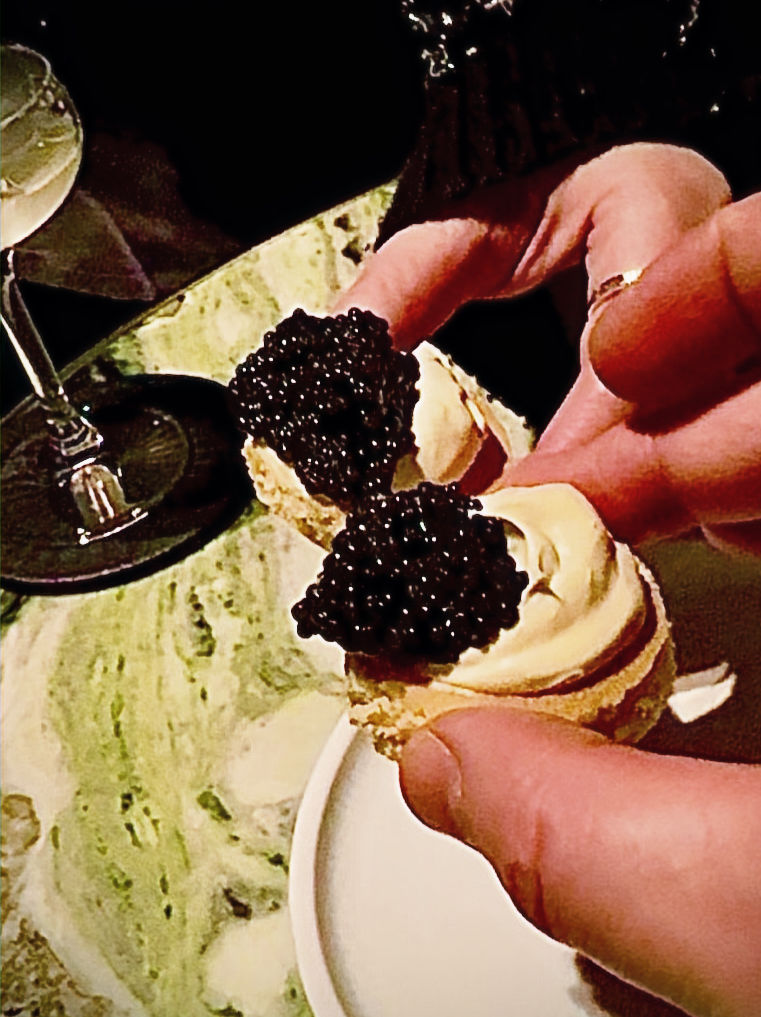
Caviar is served tableside alongside its traditional accompaniments, followed by a miniature Reset Martini built around Absolut Elyx vodka and bespoke tinctures. The presentation is undeniably theatrical, though not in the contemporary sense. There are no flourishes designed for social media. No exaggerated gestures. No attempt to transform service into spectacle.
Instead, the ritual derives its power from familiarity.
For more than a century, caviar has occupied a peculiar position within the cultural imagination. It belongs simultaneously to grand hotels, ocean liners, diplomatic receptions, opening nights and late-night suppers. One encounters it repeatedly throughout the literature and cinema of the twentieth century, appearing wherever societies sought to stage their own idea of elegance.
Whether one likes caviar is almost beside the point.
What matters is what it signifies.
A continuity of ritual.
A refusal of haste.
An acknowledgement that certain moments deserve framing.
The caviar itself is superb: cool, briny and faintly buttery, releasing successive waves of salinity and richness that seem to expand rather than overwhelm the palate. The martini infused with tinctures arrives with equal precision, its icy clarity providing a perfect counterpoint to the luxurious depth of the roe.
Together they create something unexpectedly rare.
Not indulgence.
Resolution.
The evening's title, The Golden Age, ultimately reveals itself as less a reference to old Hollywood than to an older understanding of hospitality. An era in which anticipation was considered part of pleasure. When an evening was expected to build towards a conclusion rather than simply continue until everyone left.
Outside, Vivid Sydney continues its annual performance.
The harbour flickers.
Ferries trace luminous paths across the darkness.
The city glows with all the confidence of a place accustomed to being admired.
From this height, however, Sydney begins to resemble something stranger. The roads become rivers of light. The ferries become moving brushstrokes. The skyline dissolves into abstraction. One is reminded of Italo Calvino's Invisible Cities, where places reveal themselves not as geography but as states of mind.
For a few hours, Sydney becomes unfamiliar again.
Not because the city changes.
Because perception does.
The lights eventually dim.
The Champagne is finished.
The martini reaches its final sip.
The harbour returns to darkness.
Yet what remains is a sensation increasingly difficult to find in contemporary life: The feeling that an evening has reached its proper ending.
Not concluded.
Completed.
And perhaps that is the real luxury being offered here.
Not Champagne.
Not caviar.
Not even one of the finest views in Sydney.
But the possibility that, for a few hours, an evening might once again feel worthy of its own occasion.
---
Words and photo by AW.


