Against the Season: Takakiyo Hiramatsu on AN, the Virtue of Making Less and Why the Future of Design May Resemble the Past.
Fashion has become remarkably efficient at solving a problem it largely created for itself.
Every six months, it declares the present insufficient. New silhouettes replace old ones, trends chase trends, and garments begin ageing almost as soon as they arrive in stores. The industry measures success through velocity, yet velocity has an unfortunate philosophical consequence: nothing is ever allowed to become familiar enough to acquire meaning.
The sociologist Hartmut Rosa describes modern life as existing in a condition of perpetual acceleration, where technological progress paradoxically leaves us with less time rather than more. The same could be said of contemporary consumption. We buy faster, replace faster and forget faster. The object no longer accompanies a life; it merely passes through it.
AN proposes something almost heretical.
Founded in Japan, the brand has quietly removed itself from many of the assumptions that underpin modern fashion retail. There is no wholesale network. There are no conventional seasonal collections. Products are presented through travelling order exhibitions - known simply as "Cases" - where customers encounter the objects directly and place an order before anything is produced. Nothing is manufactured speculatively. Nothing waits anonymously in a warehouse hoping to find an owner. Production follows intention rather than prediction.
It is, in many respects, a remarkably old idea disguised as a remarkably contemporary one.
Before industrialisation, this was simply how things were made. A cabinetmaker built a table because someone needed a table. A tailor cut cloth because a wearer already existed. The twentieth century inverted that relationship, asking manufacturers to imagine demand before it materialised. The twenty-first has largely perfected the art of overproduction.
AN quietly reverses the equation.
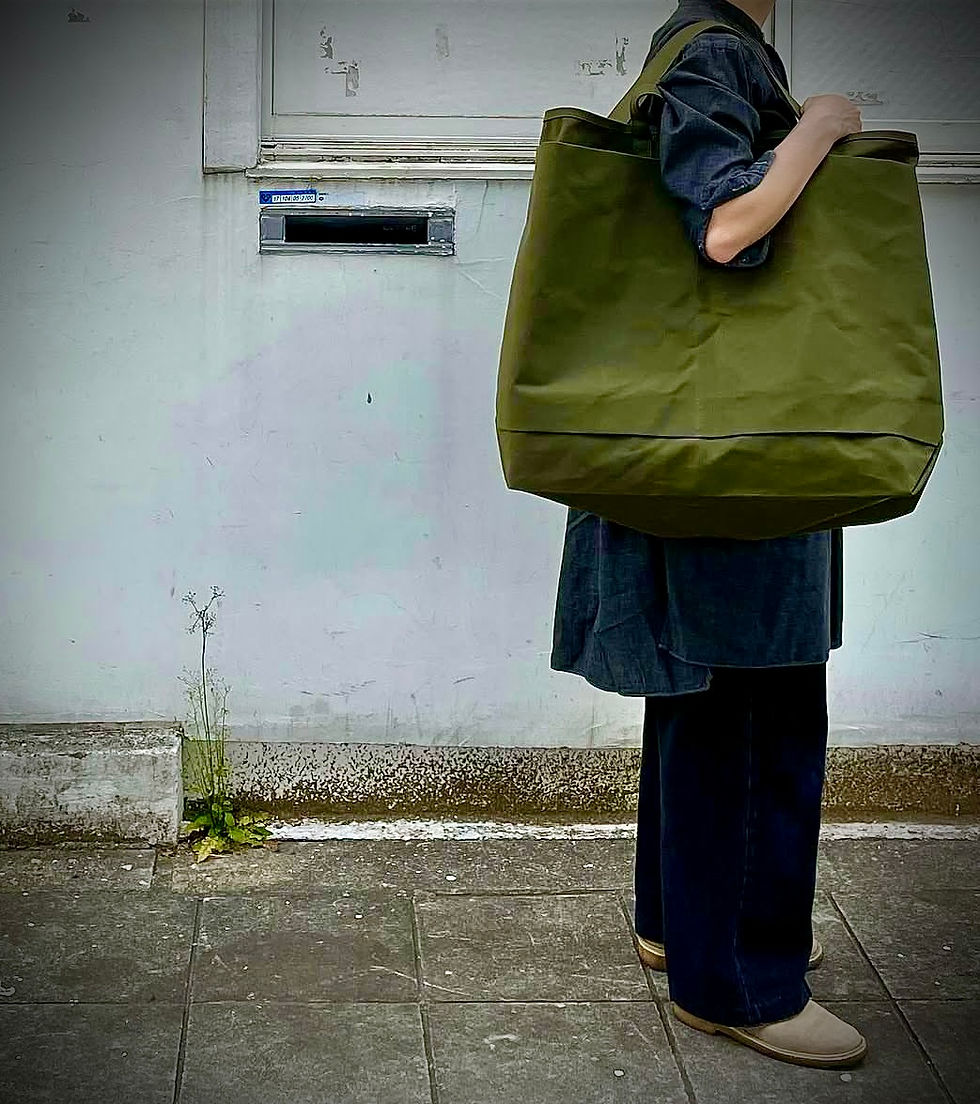
Its philosophy is equally evident in the objects themselves. The bags are neither expressive nor anonymous, neither minimal nor ornamental. They occupy that elusive territory where reduction becomes a form of sophistication. Their construction relies upon a continuous folded structure that unifies body and pocket into a single architectural gesture, producing a design language that evolves through refinement rather than reinvention.
One is reminded less of fashion than of Donald Judd's insistence that repetition can generate difference, or of Mies van der Rohe's conviction that discipline liberates rather than constrains. Even the Japanese concept of shokunin - the lifelong pursuit of mastering a single craft through incremental improvement - seems to echo quietly through the work.
Instead of producing endless new ideas, AN appears committed to exhausting the possibilities of one good one.
Perhaps this explains why its presentations are called "Cases" rather than collections. The term feels closer to an architect's study or a philosopher's proposition than to a commercial season. Each becomes another chapter in an ongoing investigation rather than another excuse to begin again.
In an era where scarcity is often manufactured through marketing, AN creates rarity through patience. The customer is not merely purchasing a product but entering into a relationship with its making. Ownership begins before production itself.
It is a surprisingly radical proposition.
Not because it promises more, but because it deliberately promises less.
We spoke with Takakiyo Hiramatsu, Brand Director of AN, about resisting the seasonal calendar, refining a single design language, and why making only what is needed may ultimately be the most progressive form of luxury.
Your products are often presented through numbered "Cases" and exhibitions rather than fixed collections. How does this structure influence the way individual garments are conceived and released?
Takakiyo Hiramatsu: As mentioned earlier, because we do not engage in wholesale, there is no need to follow a seasonal system. Instead, we present what we want to make when we feel it is ready, rather than according to a predetermined production cycle.
For us, "Cases" have become a unit of expression. They allow us to communicate our evolving intentions at a particular moment rather than conforming to an industry calendar.
In doing so, we are trying to resist the cycle of constant consumption. We believe this approach helps prevent unnecessary production and allows us to remain focused on making only what is truly needed.
Many of your pieces appear to prioritise adaptability. How do you design objects that can move across different contexts without losing their integrity?
Takakiyo Hiramatsu: When styling, we aim to ensure that a bag never disrupts the integrity of the overall appearance. We therefore treat it primarily as a functional tool for carrying belongings rather than an object that demands attention through unnecessary decoration.
Our focus is on essential, purposeful design.
There is a remarkable consistency of silhouette and proportion across your work. What governs those decisions when each piece is not tied to a seasonal narrative?
Takakiyo Hiramatsu: We have a model called the "Base Tote," which represents the brand and what we believe could become a new format for bags.
Its defining characteristic is a distinctive construction in which a single continuous piece of fabric is folded at specific points, creating an integrated structure where the body and pockets are connected as one.
Because we apply this same construction across different models, it naturally creates consistency throughout the collection. Rather than introducing entirely new designs every six months, we prefer to continually refine a single design language.
How do you approach construction so that your pieces improve through use rather than simply endure it?
Takakiyo Hiramatsu: A bag is designed to carry things, so its form will inevitably change through use.
However, we do not think of it as becoming complete only after being worn in. We believe it should already exist as a finished form at the point of production.
At the same time, we mainly work with natural materials such as cotton fibres and leather, both of which naturally change over time.
Fabric selection feels deliberately restrained. What determines whether a material is appropriate for inclusion within your system?
Takakiyo Hiramatsu: For tool bags, we take inspiration from traditional materials such as 100% cotton canvas, which has long been associated with this category.
One of our criteria is whether the bag can stand confidently as an object in its own right.
Presenting your work through temporary exhibitions suggests a different relationship to consumption. How does this affect the way customers engage with your creations?
Takakiyo Hiramatsu: Because we do not engage in wholesale, many people are unfamiliar with the brand and have never encountered our products in person.
Today, information is available everywhere through social media and most products can be purchased at any time. Against that backdrop, our exhibition-based approach often feels new to people.
For customers who are tired of constant availability, these events become something they can anticipate each year. There is also a sense of exclusivity in knowing that the product is being made specifically for them.
Finally, how do you recognise when a product is complete? What tells you that it has reached its final form within an otherwise open system?
Takakiyo Hiramatsu: We consider a product complete when it has been refined through repeated iterations and ultimately reaches its final form.
---
Words andd questions by AW.
Answers courtesy of Takakiyo Hiramatsu.
Photo courtesy of AN.