


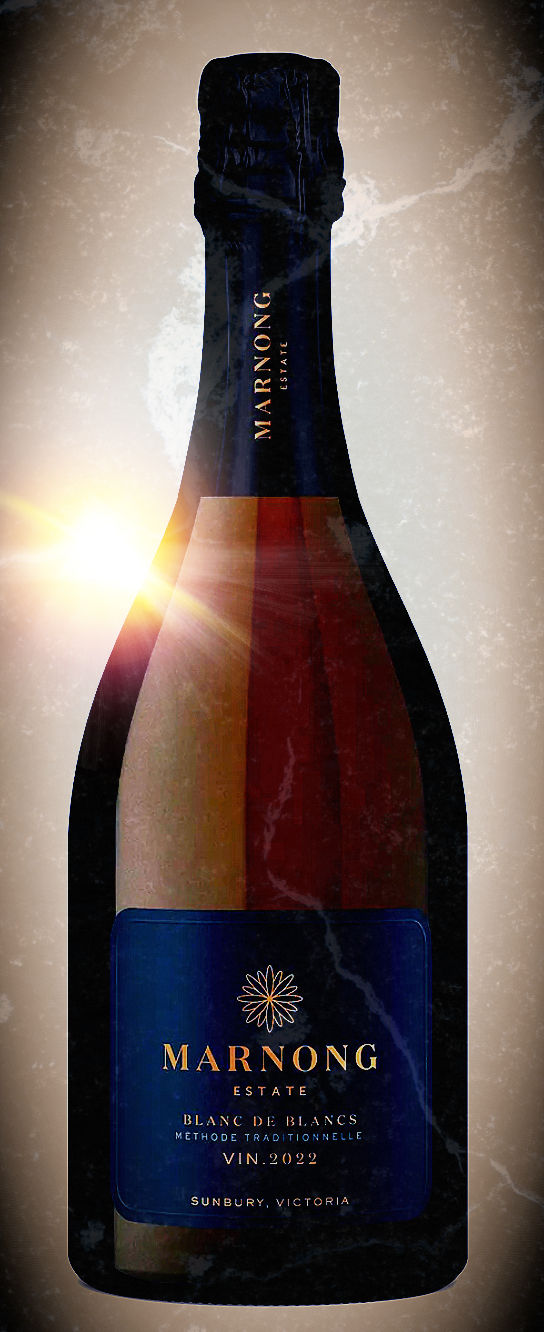
The Geometry of Ease - Marnong Estate’s 2022 Reserve Blanc de Blancs.
There are places where wine is made, and then there are places where wine feels inevitable - where the land seems to have been waiting for it, even as it passes through other lives, other uses, other names. Marnong Estate sits in that rare category.
Long before rows of Chardonnay traced their measured lines across the landscape, this was Woiworung country, where murnong - the yam daisy - sustained a different rhythm of life altogether. Later came the pastoral era, with its appetite for scale and ownership, its blunt geometry imposed on something older and more patient. What’s striking is not simply that Marnong endures, but that it seems to have absorbed these layers rather than erased them. The estate today feels less like a vineyard in the conventional sense and more like a living archive - agricultural, architectural, atmospheric. A place where cultivation is still, in some quiet way, a negotiation.
That sense of negotiation carries into the wine.
The 2022 Reserve Blanc de Blancs does not present itself as a product so much as a proposition - an argument about restraint, about time, about how much can be said with very little. Blanc de Blancs, at its most interesting, has always been less about Chardonnay as fruit and more about Chardonnay as a kind of thinking. Not abundance, but line. Not flourish, but intention.
There is a particular stillness that gathers before the first pour - a suspended moment, as if the room itself is waiting to see how things will unfold. This wine enters there. Not with force, but with adjustment. Light sharpens. Edges soften. Something aligns.
The fruit is immediate but not simple. Citrus and apple, yes, though rendered with a kind of tensile precision that resists easy pleasure. Lemon feels stretched, almost filament-like. Green apple sits on the cusp of becoming something else - cut, exposed, already shifting. Gilles Deleuze once wrote about the “event” as something that hovers between states, never fully settling into identity. That’s what the fruit here feels like - not fixed, but in motion.
The method behind it reads like a series of refusals. Hand-picked fruit. Whole-bunch pressing. Only the free-run fraction retained. A quiet rejection of force, of extraction, of anything that might blur the outline. Fermentation moves between stainless steel and oak, with just a trace of new French barrels - a kind of bilingualism, one voice speaking in clarity, the other in echo. Neither dominates, and the wine is better for it.
Some places make wine. Others just quietly wait for you to notice.
Some places make wine. Others just quietly wait for you to notice.
Long before rows of Chardonnay traced their measured lines across the landscape, this was Woiworung country, where murnong - the yam daisy - sustained a different rhythm of life altogether. Later came the pastoral era, with its appetite for scale and ownership, its blunt geometry imposed on something older and more patient. What’s striking is not simply that Marnong Estate endures, but that it seems to have absorbed these layers rather than erased them. The estate today feels less like a vineyard in the conventional sense and more like a living archive - agricultural, architectural, atmospheric. A place where cultivation is still, in some quiet way, a negotiation.
That sense of negotiation carries into the wine.
The 2022 Reserve Blanc de Blancs does not present itself as a product so much as a proposition - an argument about restraint, about time, about how much can be said with very little. Blanc de Blancs, at its most interesting, has always been less about Chardonnay as fruit and more about Chardonnay as a kind of thinking. Not abundance, but line. Not flourish, but intention.
There is a particular stillness that gathers before the first pour - a suspended moment, as if the room itself is waiting to see how things will unfold. This wine enters there. Not with force, but with adjustment. Light sharpens. Edges soften. Something aligns.
The fruit is immediate but not simple. Citrus and apple, yes, though rendered with a kind of tensile precision that resists easy pleasure. Lemon feels stretched, almost filament-like. Green apple sits on the cusp of becoming something else - cut, exposed, already shifting. Gilles Deleuze once wrote about the “event” as something that hovers between states, never fully settling into identity. That’s what the fruit here feels like - not fixed, but in motion.
The method behind it reads like a series of refusals. Hand-picked fruit. Whole-bunch pressing. Only the free-run fraction retained. A quiet rejection of force, of extraction, of anything that might blur the outline. Fermentation moves between stainless steel and oak, with just a trace of new French barrels - a kind of bilingualism, one voice speaking in clarity, the other in echo. Neither dominates, and the wine is better for it.
Then comes time, which in this case behaves less like accumulation and more like erosion. Thirty-five months on lees does not add weight so much as remove excess. The autolytic notes - brioche, almond, a measured smokiness - emerge gradually, like something uncovered rather than constructed. There is even, at certain angles, a faintly feral edge to it, that slightly rubbery flicker that some might try to smooth away. Here, it remains. A small insistence on truth over polish.
What holds everything together is the structure, though even that feels like an insufficient word. There is a line running through this wine that feels continuous, almost calligraphic, as if drawn without lifting the pen. The acidity is taut but not severe, carrying the wine forward with quiet insistence. Fine phenolics - chalk, dust, something gently abrasive - give it contour, a sense of edge without closure. You don’t just taste it, you trace it.
And beneath it all, something saline. Not loudly maritime, not theatrical, just a low, persistent suggestion of oyster shell and air that has travelled over water. It feels less like a flavour than a condition. Édouard Glissant’s idea of relation comes to mind again - identity formed not in isolation but through contact, through exchange. The wine seems open in that way, porous to its surroundings.
It changes as it sits. At first, brightness - citrus, apple blossom, quince. Then a slow deepening - salted cracker, almond meal, pastry just beginning to colour. A flicker of preserved lemon bitterness appears at the edges, giving shape, preventing drift into prettiness. Everything remains in tension, but it is a living tension, constantly recalibrating.
What is most disarming is how easily it carries all of this. There is no sense of effort, no weight pressing down. Castiglione’s sprezzatura lingers here - the difficult made to look inevitable, the studied dissolved into the natural. You could analyse it indefinitely, but the more convincing response is simply to keep drinking.
On a day like Mother’s Day, that quality becomes something else entirely.
Because this is not a wine that performs celebration. It creates the conditions for it. It moves quietly through the table, sharpening oysters into something almost luminous, lifting fried calamari into clarity, allowing gougères to echo its softer, autolytic register. Nothing is overwhelmed, nothing competes. Instead, everything seems to find its place.
There is, slowly, a shift in tempo. Conversation stretches. Laughter lands more lightly. The day opens out. What arrives is not indulgence, but a kind of grand ease - the feeling that things are exactly as they should be, without needing to be declared as such.
And perhaps that is where the wine returns, quietly, to the place it comes from. A landscape shaped by use, by time, by care that is often invisible but always present. Not pristine, not untouched, but held together through attention.
What lingers, in the end, is not a set of tasting notes but a sense of coherence. Fruit, acid, time, place - each element in proportion, none overreaching. A wine that does not insist, does not strain, does not attempt to impress.
It simply holds.
And in that holding, something rare happens - not just pleasure, but a brief, lucid sense that everything is in alignment, even if only for the length of a glass.
Then comes time, which in this case behaves less like accumulation and more like erosion. Thirty-five months on lees does not add weight so much as remove excess. The autolytic notes - brioche, almond, a measured smokiness - emerge gradually, like something uncovered rather than constructed. There is even, at certain angles, a faintly feral edge to it, that slightly rubbery flicker that some might try to smooth away. Here, it remains. A small insistence on truth over polish.
What holds everything together is the structure, though even that feels like an insufficient word. There is a line running through this wine that feels continuous, almost calligraphic, as if drawn without lifting the pen. The acidity is taut but not severe, carrying the wine forward with quiet insistence. Fine phenolics - chalk, dust, something gently abrasive - give it contour, a sense of edge without closure. You don’t just taste it, you trace it.
And beneath it all, something saline. Not loudly maritime, not theatrical, just a low, persistent suggestion of oyster shell and air that has travelled over water. It feels less like a flavour than a condition. Édouard Glissant’s idea of relation comes to mind again - identity formed not in isolation but through contact, through exchange. The wine seems open in that way, porous to its surroundings.
It changes as it sits. At first, brightness - citrus, apple blossom, quince. Then a slow deepening - salted cracker, almond meal, pastry just beginning to colour. A flicker of preserved lemon bitterness appears at the edges, giving shape, preventing drift into prettiness. Everything remains in tension, but it is a living tension, constantly recalibrating.
What is most disarming is how easily it carries all of this. There is no sense of effort, no weight pressing down. Castiglione’s sprezzatura lingers here - the difficult made to look inevitable, the studied dissolved into the natural. You could analyse it indefinitely, but the more convincing response is simply to keep drinking.
On a day like Mother’s Day, that quality becomes something else entirely.
Because this is not a wine that performs celebration. It creates the conditions for it. It moves quietly through the table, sharpening oysters into something almost luminous, lifting fried calamari into clarity, allowing gougères to echo its softer, autolytic register. Nothing is overwhelmed, nothing competes. Instead, everything seems to find its place.
There is, slowly, a shift in tempo. Conversation stretches. Laughter lands more lightly. The day opens out. What arrives is not indulgence, but a kind of grand ease - the feeling that things are exactly as they should be, without needing to be declared as such.
And perhaps that is where the wine returns, quietly, to the place it comes from. A landscape shaped by use, by time, by care that is often invisible but always present. Not pristine, not untouched, but held together through attention.
What lingers, in the end, is not a set of tasting notes but a sense of coherence. Fruit, acid, time, place - each element in proportion, none overreaching. A wine that does not insist, does not strain, does not attempt to impress.
It simply holds.
And in that holding, something rare happens - not just pleasure, but a brief, lucid sense that everything is in alignment, even if only for the length of a glass.
---
Words and photo by AW.


