


Time, Temperament and a Windmill: Two Tasmanian Drams That Know Exactly When to Speak.
There are whiskies that ask to be tasted, and others that insist on being understood in context. Callington Mill belongs firmly to the latter. To encounter its single malts without reckoning with where they are made, and why, is to skim the surface of a far more considered proposition.
Set along Tasmania’s Heritage Highway in Oatlands, Callington Mill operates within the restored precinct of a nineteenth-century windmill, once one of the southern hemisphere’s most ambitious industrial flour mills. This is not heritage as ornamentation. The site carries its own internal logic: grain, wind, labour, time. Distilling here feels less like an act of invention than one of continuation. The mill once converted harvest into sustenance; now it converts time into spirit. The mechanics differ, but the philosophy holds.
Tasmania’s climate quietly enforces discipline. Cooler temperatures slow maturation, stretching interactions between spirit and oak, favouring integration over intensity. Callington Mill does not attempt to override this. Instead, it allows the environment to set the tempo. The resulting whiskies are not hurried, nor are they theatrically expressive. They are composed.
Two recent releases illustrate this sensibility with particular clarity. The Festive Cask Single Malt and the Pedro Ximenez Single Malt could not be more different in temperament, yet they speak fluently to one another. One is outward-facing and generous, the other inward-looking and precise. Together, they outline a philosophy rather than a range.
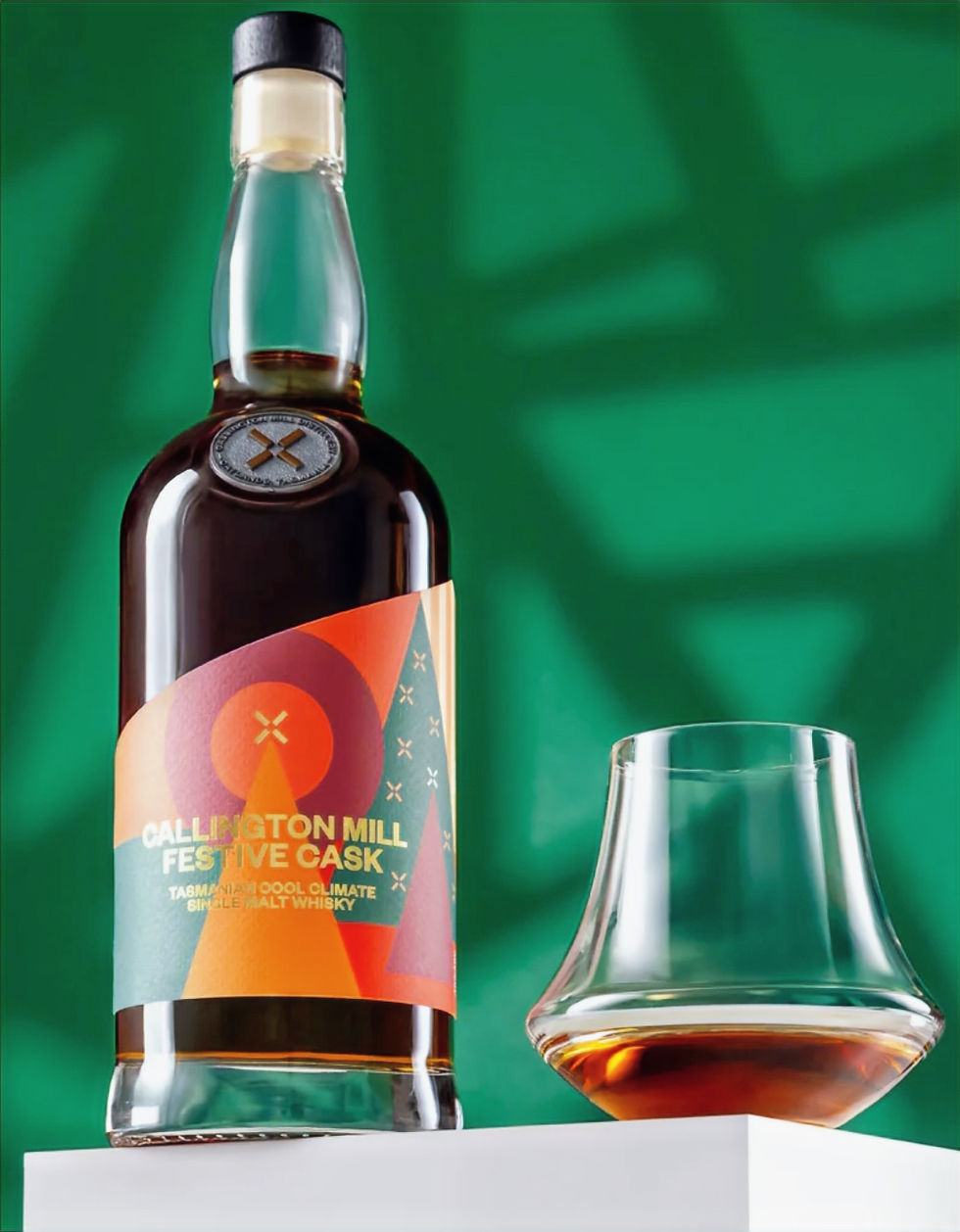
The Festive Cask is, unapologetically, about gathering. At 46% ABV and matured in a carefully judged combination of sherry and port casks, it presents a deep mahogany hue that signals intent before the glass reaches the nose. Aromatically, it leans into seasonal memory rather than novelty: spiced sultanas, dried prunes, marzipan, candied orange peel. There is warmth here that recalls baked apple and brandy butter, but it remains measured, never saccharine.
On the palate, the whisky demonstrates restraint where excess would be easy. Dried fruits arrive first, followed by dry spice and oak structure. Nutmeg, clove, espresso bitterness and dark chocolate are counterbalanced by a faint tannic edge that keeps the sweetness in check. This is a festive whisky that understands boundaries. The finish is long and assured, moving from jammy fruit toward festive spice, aged tobacco and fruitcake, lingering without overstaying its welcome.
What distinguishes the Festive Cask from seasonal pastiche is its pairing. Each bottle is accompanied by a handcrafted Traditional English Christmas pudding made with Australian vine fruit, macerated for seven days in Callington Mill whisky. This is not a flourish.
Historically, spirits and puddings shared purpose: preservation, celebration, ceremony. Here, the dialogue is genuine. The whisky sharpens the pudding’s richness; the pudding reframes the whisky’s spice and warmth. Together, they restore a sense of ritual that contemporary whisky often forgets it once had.

If the Festive Cask thrives in company, the Pedro Ximenez Single Malt is more introspective. Matured entirely in first-fill ex-Pedro Ximenez casks, it reflects a willingness to commit fully to a single idea. The influence of the cask is not applied at the margins but allowed to shape the whisky’s entire evolution. It is a risk many distilleries hedge against. Callington Mill does not.
The colour is a rich golden brown, the nose slow to unfold. Honeycomb, caramel and vanilla emerge first, followed by sweet plum, toffee and toasted oak. The palate is defined as much by texture as flavour. Oily and composed, it delivers fig jam, dates, dark chocolate and cinnamon in measured sequence. Coffee bitterness and a gentle charred oak note provide ballast, while a fleeting hint of Asian spice adds tension without distraction.
The finish is quietly persuasive. Sweet but controlled, it closes on notes of Biscoff warmth, toasted nuts and fig. There is no crescendo, no demand for attention. It simply concludes. This composure may explain its international recognition. In a judging landscape increasingly allergic to excess, balance has become its own form of luxury.
Beyond the liquid, Callington Mill’s broader significance lies in how it frames whisky as lived experience rather than isolated product. The Oatlands precinct is immersive without being performative, blending audiovisual storytelling with guided and serendipitous tastings that respect the intelligence of the visitor. Its Hobart presence extends this ethos into a more social register, situating whisky alongside food, conversation and landscape rather than placing it on a pedestal.
In a global whisky culture often driven by scarcity narratives and volume, Callington Mill offers something more durable. Coherence. Its whiskies are not designed to shout, nor to chase trends. They are designed to hold attention over time, to reward return visits, to deepen rather than dazzle.
Taken together, the Festive Cask and the Pedro Ximenez articulate a distinctly Tasmanian position. Whisky as ritual and reflection. As gathering and solitude. As something to be shared generously, or considered quietly, depending on the moment.
Time, after all, behaves differently in places that listen to it.
---
Words by AW.
Photos courtesy of Callington Mill Distillery.


