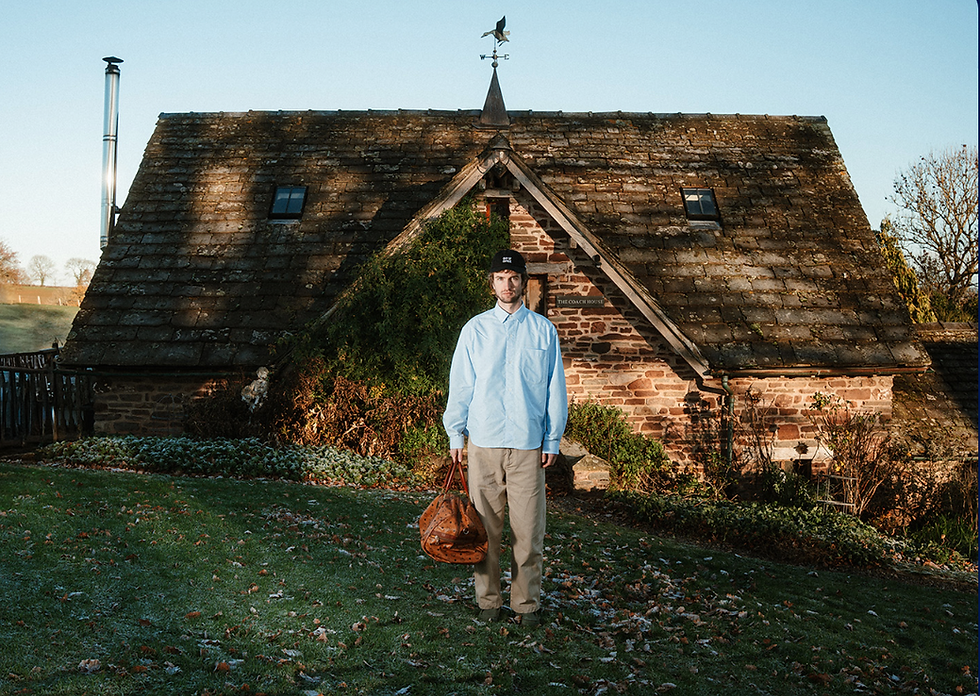
The Things That Last: Will Farrow on Yarmouth Oilskins, Craft and the Life of a Garment.
The sea is an excellent editor.
It removes whatever is unnecessary. It has no particular regard for fashion, and even less for the distinction between something that looks good and something that works. On the eastern edge of England, where the River Yare meets the North Sea, this has been understood for rather a long time.
Yarmouth Oilskins began in Great Yarmouth in 1898, when Yarmouth Stores was established to outfit a working port. What grew from it was considerably larger than the name might suggest: Oilskins, smocks, uniforms and protective clothing travelled from Norfolk to ports and workplaces around the world. By the years before the Second World War, more than 1,200 people were working across the company's factories, most of them machinists.
There is an obvious temptation to make a romance of this. The coast, the factory, the weather, old patterns and the particular vocabulary of British workwear have all become convenient shorthand for authenticity. Fashion has been borrowing that shorthand for years.
Yarmouth's history is more curious than that.
Its NZ jacket, for instance, owes part of its existence to a journey in the opposite direction. John William Johnson encountered paraffin-wax waterproofing in New Zealand and brought the idea back to Great Yarmouth, where it became part of the company's own approach to waterproof clothing. A Norfolk institution, it turns out, was never quite as insular as it looked.
Perhaps tradition has always been less orderly than we imagine.
Ideas travel. Techniques migrate. Things get altered because somebody sees a possibility in them. What survives is rarely identical to what came before. It is simply recognisable enough for us to call it the same thing.
That seems particularly true of clothing.
A garment is an unusually intimate object. It spends its life close to the body and then, almost absurdly, can be folded away in a cupboard and forgotten. It accompanies people into places that photographs never record. It absorbs weather, movement, work, habit and the peculiar circumstances of an ordinary day. We tend to think of clothes as belonging to us. Over time, the distinction can become less certain.
Yarmouth still makes its clothes in Great Yarmouth, with traditional methods and many of the patterns that have survived from earlier generations. Yet the company has never been entirely interested in preserving itself as a historical exhibit. Its clothes continue to change, partly because the world they inhabit has changed.
That is a more interesting kind of continuity.
Not preservation for its own sake, but a willingness to find out what an old idea can still become.

There is something almost counterintuitive about this in an age fascinated by acceleration. So much of contemporary design is concerned with what can be added, improved, upgraded or replaced. Yarmouth belongs to a different rhythm. Not necessarily slower, and certainly not static - simply less anxious about novelty.
The result is a company that sits in an unusual place between workwear and clothing, inheritance and invention, the North Sea and everywhere beyond it.
And somewhere in that territory is the story of what happens when a business inherits more than a name.
We spoke with Will Farrow.
Yarmouth Oilskins has never felt like a brand chasing nostalgia. Where do you think the difference lies between preserving a tradition and becoming trapped by it?
Will Farrow: We have always been an innovative brand and we retain that today, be it through our approach to natural fibres, introducing styles designed for today. We do respect our heritage and the traditional craftsmanship that has got us to where we are today. I think brands become trapped when their DNA is in something that is no longer relevant to today’s living and that is not the case for us.
You've spent years watching these garments leave the workshop and acquire lives of their own. What have your customers taught you about your own work that you couldn't have learned while making it?
Will Farrow: I think whatever you make, you never truly know how people will use it until it’s out in the wild. The capability never ceases to amaze me, once you have you head around the fact that these are garments made from Natural fibres and therefore they aren’t sealed like something synthetic.
Is there a particular oilskin that returned for repair, re-waxing or alteration that permanently changed the way you thought about durability?
Will Farrow: The things that tend to resonate the most are when people send in really old garments that have been in the family for decades and have really stood the test of time. We actually don’t see many garments from the last few years as we encourage customers to re-wax them themselves and ideally they last a lifetime.
Waxed cotton asks something of its owner. It creases, marks, softens and occasionally needs attention. Do you think we've become uncomfortable with materials that expect a relationship rather than passive consumption?
Will Farrow: That’s most certainly true of so many things now - we are really unaccustomed to wearing something in the way that we used to be so familiar with. It’s how things last a lifetime and the highs and lows that are clothing gets you through are part of the joy of ownership.
Waxed Cotton is quite unique because it is often compared to goretex or similar synthetic fabrics and yet its not technical or remotely similar - it warms with your body temperature, smells wonderful and is just so much more of a living breathing thing.
In your experience, what separates a garment that simply lasts from one that becomes genuinely difficult to part with?
Will Farrow: I think the stories are what makes a difference, when people where something to death that item really gets them through some moments that they never forget - that’s what makes something really difficult to part with.
When you're refining a pattern or construction detail, how do you recognise the point where improvement genuinely serves the garment rather than merely satisfying the maker?
Will Farrow: A part of being a small business and quite bold in taking something from idea to reality is that you do make mistakes, its not always that easy to remedy if its size related but you have to keep progressing and moving things forwards.
Good examples are when we changed elements of our seam construction for outerwear to help prevent water seeping in. At time we have also needed to extend or change elements like arms and that presents are bigger challenge.
Modern performance clothing often promises more with every season. Have we begun confusing technical complexity with genuine usefulness?
Will Farrow: I think that’s marketing, nowadays we are always encouraged to buy the new best thing that’s just come out, its certainly confusing and its questionable as to whether there is significant enough improvement and whether some elements are worthwhile at all.
I do believe people are starting to see through nonsense and resonate towards more tangible, meaningful items that can last a lifetime.
Is there a detail in the smock that almost nobody notices, yet you consider essential to how it performs?
Will Farrow: In our hooded smock I would go back to the seams that are sewn to ensure water can run out and down instead of in. Our classic smock is interesting because a large part if made from a single piece of cloth where a neck hole is cut through - to do this we have a huge knife and a hole in our cutting table.
Time is one of the few things no designer can control. After years of exposure to salt, rain, wind and work, what do these fabrics reveal about themselves that still surprises you?
Will Farrow: Mostly just how robust and forgiving they are - they just get better with age and every scenario gives it a new test and tells and new story, something you never get to know unless you try.
Nowadays we keep our clothes for ‘best’ but in functional clothing that’s really not what’s its about - they are made to be worn and the cost probably relates to the quality not how luxurious the fabrics are - so get them outside and have some fun in them.
Looking twenty years ahead, what would make you feel that Yarmouth Oilskins has remained true to itself - not commercially, but philosophically?
Will Farrow: I’d like to think that they are good values, foundations and a DNA in place that can simply be followed - the best brands do what they do best and hold on to what makes them special - I hope that we continue in the same vein - harnessing natural fibres to see how far they can go through unisex timeless clothing that just gets better with age.
---
Words and questions by AW.
Answers courtesy of Will Farrow.
Photo courtesy of Yarmouth Oilskins.