


The Signature of Time: Sam Wigan on Yalumba’s Enduring Australian Classic.
A wine can survive for sixty years without becoming important. The harder trick is to become part of the memory of a place.
The Signature has been doing precisely that since its first vintage in 1962. Now in its 52nd iteration, Yalumba’s Cabernet Sauvignon and Shiraz has lived through most of the modern history of Australian wine: Through changing tastes, changing techniques and changing ideas about what a serious Australian wine ought to be. Yet its endurance has never depended upon pretending that nothing has changed.
That makes The Signature rather more interesting than the word “icon” tends to suggest. Icons are often embalmed by their reputations. The Signature has had to earn its place again with every vintage.
There is an unusually human dimension to that process. Each release honours a Signatory - someone whose contribution has helped shape Yalumba’s culture and traditions. More than 57 people have now been recognised in this way, turning what might otherwise be a succession of prestigious bottles into something closer to an evolving family chronicle.
The 2023 vintage offered an especially elegant twist to that tradition. Peter Sawrey, who had spent 33 years interviewing Signatories and writing the stories that appeared on the back of each bottle, became one himself. For three decades he had been the person putting Yalumba’s institutional memory into words; eventually, his own name entered the record. There is something quietly perfect about that reversal. The keeper of the stories became part of the story.
It is a fitting motif for Yalumba itself.
Founded by Samuel Smith in 1849, the winery remains family-owned six generations later. Its history is not confined to a museum or a company timeline. It survives in working practices and accumulated expertise, in the vineyards and cellar, and even in the cooperage where Yalumba continues to make its own barrels - the only fully operational cooperage in the Southern Hemisphere, according to the winery. Heritage, in other words, is not simply something Yalumba possesses. It is something it continues to work with.
That distinction is of particularly importance withThe Signature.
Its very form is a little contrary to the prevailing fashion for singularity. Much of fine wine’s contemporary language revolves around the individual: the vineyard, the parcel, the variety, the exactness of place. The Signature takes a broader view. Cabernet Sauvignon and Shiraz are brought together across the Barossa, and the wine has consequently become one of the enduring expressions of an Australian instinct for blending rather than an imitation of an Old World template. Yalumba itself has long described the Cabernet-Shiraz combination as a distinctly Australian style.
There is no shortage of intellectual pleasure in that idea. A blend is not simply an averaging of its components. It is closer to composition - the difference between hearing individual instruments and hearing music. What matters is not only the quality of each element, but what becomes possible when they occupy the same space.
Perhaps that is also why The Signature makes such a revealing subject for a conversation about Australian wine more broadly. Its history is long enough to expose fashions for what they are, yet its identity is not so rigid that it can ignore them. It has had to negotiate the peculiar problem faced by any long-lived work of craft: how to remain recognisable without becoming repetitive.
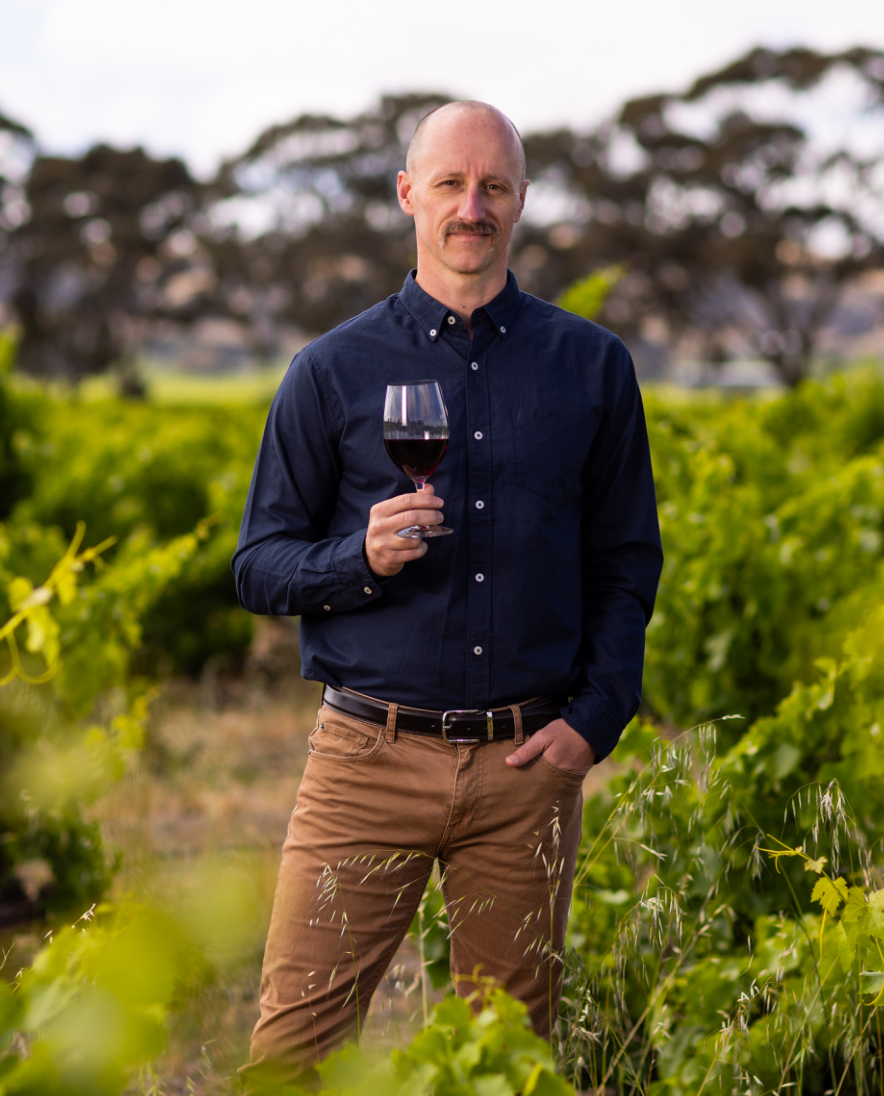
Sam Wigan now stands inside that problem.
He grew up in the Barossa in a winemaking family, worked his first vintage with his father, made wine in California and joined Yalumba in 2001. In 2023, after more than two decades with the winery, he became Head Winemaker, with The Signature among the wines now under his stewardship. His is therefore not an outside interpretation of an established Australian classic. He is working from within a place, a company and a body of knowledge that long predate his appointment.
That makes the conversation less about preserving a recipe than about judgement. What does a winemaker inherit when a wine already has a character of its own? Which parts belong to the wine, which to the season, and which to the accumulated decisions of the people who have made it? And when does respect for history become an obstacle to allowing a wine to remain alive?
Those questions have particular resonance at Yalumba, where the past is unusually close at hand. The winery’s own museum holds bottles that turn history into something rather more immediate than a date in a ledger: Place, people, vintage and variety preserved together in glass.
Wine has always had this strange capacity to make time tangible. A bottle can outlive the person who made it, the vineyard that produced it, even the fashions that once determined its reputation. Open it years later and history is no longer something to be read about. It is there in the glass.
The Signature has been accumulating that history for more than six decades.
What matters now is what happens next.
We spoke with Yalumba Head Winemaker Sam Wigan.
What, ultimately, must never change for a wine to remain The Signature?
Sam Wigan: The sentiment behind the wine. This is a wine that is born of culture, respect and appreciation.
Peter Sawrey has spent more than 30 years writing the stories of The Signature’s Signatories before becoming one himself. What does that say about the role of memory and storytelling in the wine?
Sam Wigan: It is extremely important. Storytelling allows us to share the history and authenticity behind a wine, as well as the people who shaped it. Doing this well requires rare sensitivity and skill.
Sawrey has that gift: An extraordinary ability to spin a yarn that brings both the people and the history of The Signature vividly to life.
When selecting the fruit for The Signature, what separates a merely excellent parcel from one that belongs in the blend?
Sam Wigan: The Signature is crafted from exceptional vineyard sites across the Barossa. Each selected parcel must express both its variety and its Barossa subregion, while also working in harmony with the other components.
Sourcing fruit from across the Valley gives the wine remarkable depth of flavour.
Ultimately, a parcel earns its place not through excellence alone, but through the distinctive role it plays in creating a blend greater than the sum of its parts.
What does Cabernet Sauvignon gain from Shiraz - and Shiraz from Cabernet - in The Signature?
Sam Wigan: Aromatically, Cabernet Sauvignon leads with cassis and classic leafy notes, while Shiraz contributes dark berry and chocolate characters. On the palate, Cabernet provides structure and firm tannins, while Shiraz adds plush fruit and mid-palate richness.
Together, they create layers of flavour, greater palate weight and depth of tannin than either variety could achieve alone. The result is a seamless wine defined by complexity, balance and harmony.
How do you reconcile the competing demands of expressing a vintage and preserving a recognisable identity?
Sam Wigan: Every year we craft The Signature, the focus is on balance and harmony while expressing the varietal characteristics and the Barossa terroir. So, no matter the vintage conditions, be it a warm, dry vintage or a cooler, wetter year, we work with the vineyard teams to grow the optimal fruit to reflect the season and the Signature style.
Has the wine changed more because the vineyard has changed, or because Yalumba’s idea of great wine has changed?
Sam Wigan: The Signature has continued to evolve over the years, somewhat due to changes in vineyard resources and practices, but mainly because our idea of a great wine has changed.
Picking decisions have a large impact on the style, and we have been seeking slightly earlier harvesting to retain varietal typicity and balance. We have moved to wild ferment, which helps contribute complexity and depth to the wine.
We have also been refining our approach to oak - not only in the proportion of new oak used, but also in the source of that oak and the toast levels of the barrels. Having our own cooperage gives us exceptional control over the barrels made specifically for The Signature.
What has tasting historic Signatures taught you that you could not have learned from making contemporary ones?
Sam Wigan: Tasting historic Signatures is always fascinating and provides an insight into not only the climatic conditions of the year, but also the winemaking styles of the time.
It gives us the framework to ensure The Signature remains true to style moving forward. It also provides insight into how the wine ages, helping us to refine the wine style we make moving forward while keeping the essence of the wine.
The fashion in fine wine has shifted towards purity, site and varietal expression. What does The Signature’s continued existence say about a distinctly Australian approach to fine wine?
Sam Wigan: The Signature’s continued existence reflects a confidence in blending. Rather than treating purity, site and single-varietal expression as ends in themselves, it brings them together to form a more complete wine.
When people drink The Signature, I believe they drink it because it is a delicious drink and not necessarily because of its varietal make-up.
How do you know when to leave The Signature alone - when restraint is more important than intervention?
Sam Wigan: Most of the time we try not to intervene. We work hard in the vineyard to ensure we have the best fruit to work with.
After that, it is about respecting the fruit in the winery during fermentation. Tasting often, not working it too hard, and then selecting the ideal mix of oak barrels in which to mature the wine.
If The Signature were to disappear tomorrow, what would Australian wine have lost?
Sam Wigan: If The Signature disappeared tomorrow, Australia would lose one of its great wines - a beautiful expression of the Great Australian blend.
With each release, the wine also honours a person or people who embody Yalumba’s spirit and culture. I do not know of another wine in the world that celebrates its people and heritage in quite the same way.
---
Words and questions by AW.
Answers courtesy of Sam Wigan.
Photo courtesy of Yalumba Family Winemakers.


