


Perfume as Philosophy - Time, Altitude and Ritual in Libertine Parfumerie’s Latest Olfactory Chapter.
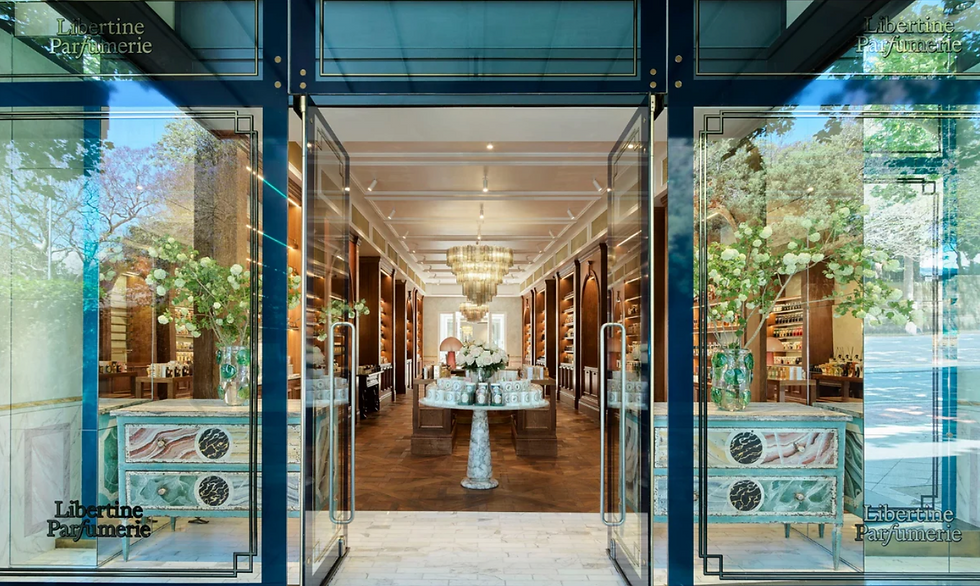
There are boutiques that sell perfume, and there are spaces that feel more like small, quietly radical salons. Libertine Parfumerie increasingly belongs to the latter category: a place where fragrance ceases to function as adornment and begins to operate as a mode of thought. Its newest arrivals suggest a discipline drifting ever further from the lexicon of “notes” and “wearability” toward something closer to aesthetics, philosophy, even historiography - scent as a way of reading the world.
The most intellectually ambitious of the recent releases comes from Amouage, where Chief Creative Officer Renaud Salmon has developed a habit of treating perfume not as a commodity but as a conceptual instrument. The latest Essences trilogy proposes that time itself possesses form - that duration can be linear, punctual, or cyclical, and that these structures can be apprehended sensorially. It is an idea that sits somewhere between Augustine’s meditations on time as an inner experience and Bergson’s notion of durée, and yet on skin it manifests not as abstraction but as rhythm.
Line 618, composed by Nathalie Lorson, takes the golden ratio, i.e. that ancient mathematical seduction underlying Parthenon façades and Renaissance canvases, and translates it into a kind of olfactory architecture. The progression feels measured rather than dramatic, each accord advancing with the inevitability of a columned nave drawing the eye toward its vanishing point. One is reminded of Alberti’s assertion that proportion governs not only beauty but harmony of the soul. This is perfume as spatial reasoning: less an aroma than a trajectory.
If Line 618 stretches outward, Remain, by Pierre NegrinThe House of, collapses inward. Its opening flash of citrus and spice behaves almost like the cosmological instant before expansion, after which incense and florals thicken the atmosphere and draw the composition toward something primal and bodily. The experience evokes Woolf’s dilation of a single afternoon into an entire interior landscape, or the famous madeleine in Proust - that sudden realisation that a moment can contain an archive. Here, scent performs the same feat: compressing time until it feels almost tactile.
Then comes Sequence, in which Julien Rasquinet constructs recurrence into the structure itself. Motifs reappear, leather resurfacing like a remembered phrase in a Bach fugue or a leitmotif in Wagner. The perfume does not so much progress as revolve, suggesting Nietzsche’s eternal return rendered in volatile molecules. One smells it and experiences not nostalgia but recognition - the uncanny sensation that something is happening again, and perhaps always has been.
Even the campaign imagery by Louise Mertens reinforces this metaphysical register. Her bronze monoliths, austere and almost archaeological, resemble relics from a civilisation that measured time through scent rather than clocks. They lend the trilogy the air of discovered artefacts rather than newly launched products.
If Amouage positions perfume as philosophy, The House of Creed continues to refine its own longstanding idiom: fragrance as atmosphere, almost meteorology. Silver Mountain Water has quietly evolved from bestseller to cultural fixture precisely because it does not attempt to describe mountains so much as to distil the sensation of altitude - clarity, thinness, distance. It belongs to that lineage of works in which landscape functions as interior state: Friedrich’s wanderer suspended before the fog, or the alpine stillness in Thomas Mann’s The Magic Mountain, where air itself becomes narrative.
Its recent collaboration with snow artist Simon Beck - whose vast, geometric inscriptions vanished with the next thaw - feels uncannily apt. Perfume and snow share a peculiar ontology: both exist most vividly at the moment they begin to disappear. Their artistry lies not in permanence but in trace.
Elsewhere, Xerjoff offers a counterpoint grounded in spectacle and ritual. TORINO25, created to mark the Nitto ATP Finals in Turin, captures not the athletic act itself but its ceremonial aftermath - that suspended instant when a crowd realises history has just occurred. Its brightness gives way to leathered warmth in a progression that mirrors the choreography of triumph: eruption, stillness, acknowledgement. It smells less like motion than like the narrative gravity that follows it.
The house’s champagne-inspired release, by contrast, drifts into quieter territory - less the roar of the stadium than the filtered luminosity of morning after celebration. If TORINO25 is public theatre, this one is private ritual: the echo of glassware, the soft discipline of cultivated pleasure, the knowledge that refinement itself can be a form of memory.
Taken together, these fragrances signal a broader shift within contemporary perfumery. Increasingly, scent behaves less like ornament and more like discourse. These works do not merely evoke materials or places; they articulate positions on time, ephemerality, craftsmanship, and the human appetite for meaning. They sit comfortably alongside literature, architecture, and music as forms capable of structuring experience rather than simply decorating it.
To leave Libertine with one of these bottles, then, is not unlike leaving a bookshop with a slim but demanding volume: something you suspect will reveal different arguments depending on when you return to it. The perfume fades, as all perfume must, but the conceptual afterimage lingers - and in that lingering lies its quietest triumph.
---
Words by AW.
Photos courtesy of Libertine Parfumerie.


