


White Rabbit Gallery's Black Myth: Why the Monsters Never Left.
White Rabbit Gallery doesn't run on the usual machinery of the art world. No acquisitions committee weighing trends. No real attempt to track a market or complete a period. Judith Neilson built the collection on Balfour Street in Chippendale by buying whatever stopped her cold, one purchase at a time, without much concern for whether the pieces would later agree with each other. It isn't a survey of contemporary Chinese art. It's closer to an argument that the category is too large to fit inside one coherent story.
The gallery's current exhibition, Black Myth, takes its cue from an unlikely source: Black Myth: Wukong, the 2024 video game that turned a four-hundred-year-old pilgrimage story into a global event almost overnight. That story is Journey to the West. The monk Tang Sanzang and three disaster-prone companions cross from China to India chasing sacred scripture, harried the whole way by demons who are often smarter than they look.
Hanging a gallery show on a video game sounds, on paper, like reaching for relevance. In practice this particular story has already survived opera, puppet theatre, comic strips and television without losing its shape. A myth that keeps working probably isn't the one told most reverently. It's the one that can take a bad adaptation and shrug it off.
Some of that resilience comes down to cosmology. In the Daoist and Buddhist frameworks the story grew out of, the miraculous was never filed away in some separate category from ordinary life. A fox might turn out to be an ancestor. A cliff face might double as a door. Enlightenment isn't stationed somewhere distant; it's sitting in the dirt under whoever's currently standing there.
Sun Wukong doesn't fit the trickster mould especially well once you take that literally. He's less a rule-breaker than someone who was never taught the rules applied to him: Born out of a stone egg on a mountainside, capable of almost anything by the time he's old enough to cause trouble, and mildly insulted by the suggestion that wisdom might take patience. Most of the novel is spent watching that lesson get beaten into him one demon at a time.
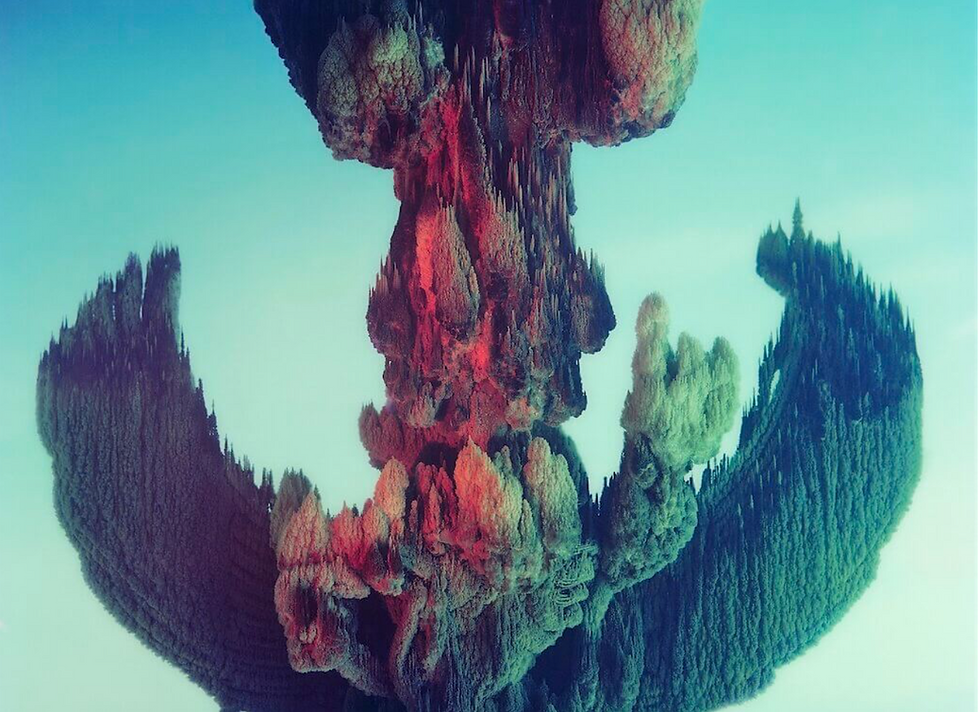
More than forty artists carry that question through the gallery. The show moves like a pilgrimage rather than an essay, a run of separate encounters rather than one argument steadily closing in on a conclusion. It opens with Zhu Jinshi's The Ship of Time, a hull-sized form woven from Xuan paper and bamboo. It looks abandoned mid-build rather than finished: Too large for furniture, too fragile-looking to float, sitting in the room the way a wreck sits on a seabed. Chen Chun-Hao, nearby, rebuilds Song-dynasty landscapes and zodiac animals entirely out of driven nails. From across the room they're calm and legible. Up close they're nothing but a record of repeated, physical impact. Inherited tradition, it turns out, never arrives intact. Someone has to keep hammering it back in.
Mountains recur constantly, more like a returning character than scenery: Kunlun, Zhongnan, the summits where immortals were said to keep their addresses. A run of pieces takes this up directly, Feng Yan's photographs of Zhongnan, Fu Xiaotong's oversized paper relief Spiritual Mountain, Tang Nannan and Yao Huifen's embroidered Oblivious Mountain, and in all of them the peak functions less as a destination than as a way of describing pressure held internally.
Western landscape painting tends to plant the viewer front and centre, with the mountain as a stage for human effort. Shan shui painting generally does the opposite. The human figure shrinks to almost nothing in a lower corner, so scale and impermanence register first.
Sun Xun does the heaviest philosophical lifting in the show. His woodblock scroll Magic of Atlas - Luocha: An Infinite Journey, paired with the animated film Tears of Chiwen, pulls classical ink technique, Cultural Revolution-era graphic design and pure invented folklore into a single, only half-explicable vision. It brings Borges to mind almost against your will: The writer who imagined a library vast enough to contain every possible arrangement of every letter, and cartographers so obsessive they built a map at a one-to-one scale with the territory it recorded. Sun Xun seems to be making a similar claim. History was never a stable record sitting underneath the stories built on top of it. It's made of exactly those stories, and it stays solid for only as long as enough people quietly decline to test it.
From there the show gets stranger, and frequently funnier. Lu Pingyuan casts an invented alphabet into monumental aluminium letterforms for God's Dictionary, writing that looks like it should mean something and stubbornly refuses to confirm it either way. Xu Zhen's Immortals' Trails in a Secret Land is built from feathers, ceremonial cloth and religious ornament, layered on with something closer to a jeweller's excess than a monk's restraint - the kind of piece that leaves you genuinely unsure whether you're looking at an altarpiece or an extremely expensive coat. Hou Chun-Ming paints the Eight Immortals with almost no reverence at all. Given that Sun Wukong wins about as many fights through mockery as through force, this feels less like a departure from the tradition than a fairly accurate reading of it.
Material does its own share of the arguing. Liang Shaoji lets actual silkworms spin their cocoons directly onto armatures, so his Heavy Clouds series is, quite literally, woven by another species working to its own schedule rather than his. Wu Chi-Tsung folds raw light into something with the physical density of landscape.
Elsewhere in the show, sheet steel gets bent into curves soft enough to look poured rather than cut. Paper keeps getting handed loads it was never engineered to carry, and somehow it holds anyway. None of this reads as decoration. The argument is happening in the object itself, not in whatever's printed on the wall beside it.
What accumulates across the floors isn't really a history lesson in folklore, however strong the individual pieces are on their own terms. It's closer to a working theory of what myths are actually for, at a moment that could probably use the reminder.
A myth was never meant to fully explain anything. It exists for the specific part explanation can't reach. Today's unruly spirits don't look like much on the surface: An algorithm nobody can properly audit, a coastline receding a little further each year, an image generated faster than anyone can decide whether to trust it. The job hasn't changed much. White Rabbit Gallery doesn't try to tidy that into something more comfortable. It just hands you a version you have to walk through yourself, floor by floor, on the assumption that getting a little lost on purpose is still, after a few thousand years, the fastest route anyone's found to actually seeing something clearly.
---
Words by AW.
Photo courtesy of Hamish McIntosh.


