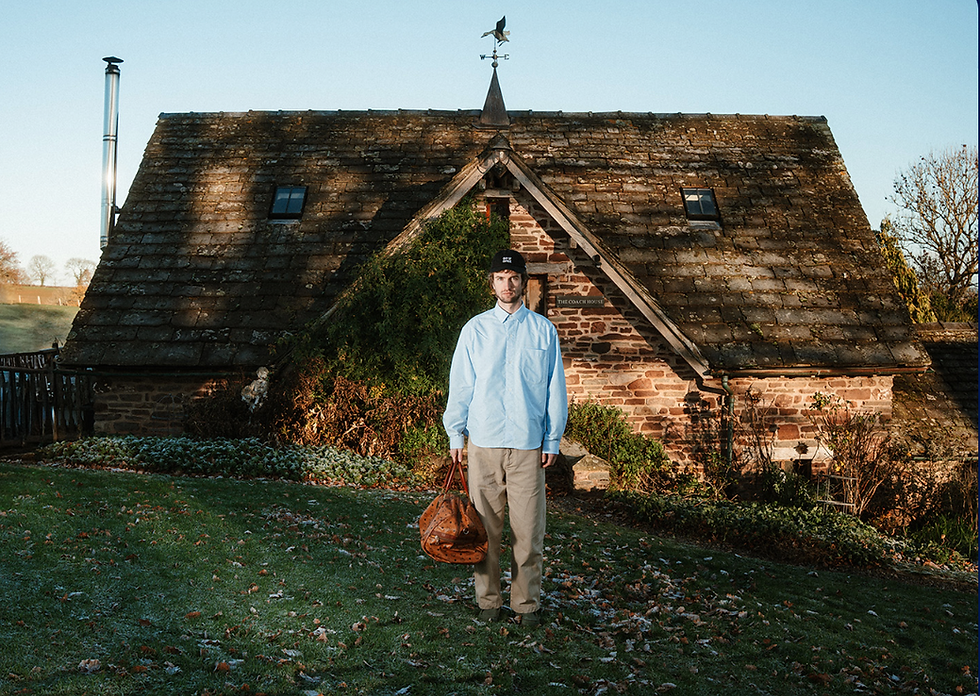
Alpe Piano: The Intelligence of the Mountain.
Some clothes seem to know the weather.
Not in the increasingly elaborate language of modern outdoor clothing, with its membranes, ratings and promises of technical salvation, but in the quieter way of things that have been used for a long time. A good wool coat does not need to tell you what it can do. You discover it when the temperature drops, the rain arrives or the afternoon turns colder than expected.
This is where Alpe Piano becomes interesting.
The brand comes from South Tyrol, where the Dolomites are not a distant source of imagery but part of the everyday geography. Its clothes draw on Alpine fabrics and familiar forms: loden, felted wool, substantial knits, the Joppe jacket. There is little interest in making these things appear futuristic. Their appeal lies partly in the opposite direction, in asking what might still be useful after fashion has moved on.
That question has a surprisingly long history.
Robert Walser understood walking as a form of thinking. His walks were rarely about arriving anywhere in particular. The movement itself allowed the world to come into focus. There is something similar in clothing designed around the realities of walking, weather and place. It begins with the body rather than the image of the body.
Traditional Alpine clothing was never conceived as lifestyle merchandise. It had work to do.
Loden, for instance, is remarkably undramatic. Wool is felted and treated until it becomes dense, resilient and resistant to the conditions for which it was intended. It regulates temperature, resists moisture and does not demand much attention. It can be aired rather than constantly washed. In an age of garments accompanied by instruction manuals, there is something almost radical about a material that simply gets on with it.
Alpe Piano seems to understand this distinction.
Its Alpine Jacket takes the traditional Joppe as a starting point, retaining something of its straightforwardness while making the form comfortable in less predictable circumstances. It can belong to a mountain path, but it does not look as though it has been sentenced to one. That matters. Much contemporary outdoor clothing has become so specialised that it can feel faintly absurd when worn anywhere other than the activity for which it was engineered.
The older garments were less fussy.
They accompanied people because people needed to go somewhere.

Perhaps this is why clothing with genuine regional roots often feels different from clothing merely inspired by a region. The difference is subtle but important. One borrows a visual language; the other inherits a set of practical decisions.
Alpe Piano works in that space between inheritance and adaptation. The materials retain their particular character, while the clothes are allowed to move beyond the circumstances that first gave rise to them. A loden coat can leave the mountain without leaving the mountain entirely behind.
There is a lesson here about permanence, too.
We tend to speak about longevity in clothing as though it were principally a matter of buying fewer things. It is also a matter of making things that become more convincing through use. A garment that can be worn across seasons, aired rather than endlessly cleaned, layered differently as conditions change, and eventually acquire the marks of its owner has a different relationship with time.
W.G. Sebald was fascinated by this kind of residue. His books are full of objects that seem to carry traces of places and people long after their original circumstances have disappeared. A coat can work in much the same way. It absorbs weather, movement, journeys, habits. Eventually it becomes difficult to separate the object from the life that has accumulated around it.
This may be the most compelling thing about clothes with a sense of place: they do not remain entirely themselves.
The Dolomites are present in Alpe Piano, certainly, but not as a picturesque backdrop. They are present in the weight of the wool, the usefulness of a collar, the decision to leave a fabric largely to its own capabilities. The landscape survives as a set of practical instincts.
That feels increasingly relevant.
Modern life has become exceptionally good at solving problems that previous generations simply accommodated. We have invented clothing for almost every imaginable condition, often at the expense of simplicity. There is nothing inherently wrong with technical innovation, but it has produced an odd side effect: we sometimes mistake complexity for intelligence.
A piece of clothing that quietly performs its job may be the more intelligent object.
Alpe Piano's achievement is not in making Alpine clothing look contemporary. It is in allowing something older to remain useful without turning it into costume. The distinction is small, but it is where good design often lives.
Perhaps this is also why the brand feels less interested in novelty than in continuity. The mountain does not need to be reinvented every season. Weather has a way of making fashion's deadlines seem rather arbitrary.
And wool, for all our technological ingenuity, remains very good at being wool.
There is something reassuring in that.
A garment made with an understanding of its landscape carries more than protection from the elements. It carries a memory of why it was made in the first place. Alpe Piano's clothes are at their most convincing when that memory remains visible, quietly, in the fabric and the cut rather than in the branding.
The mountain does not announce its intelligence.
It simply persists.
Perhaps good clothing should do the same.
---
Words by AW.
Photo courtesy of Alpe Piano.