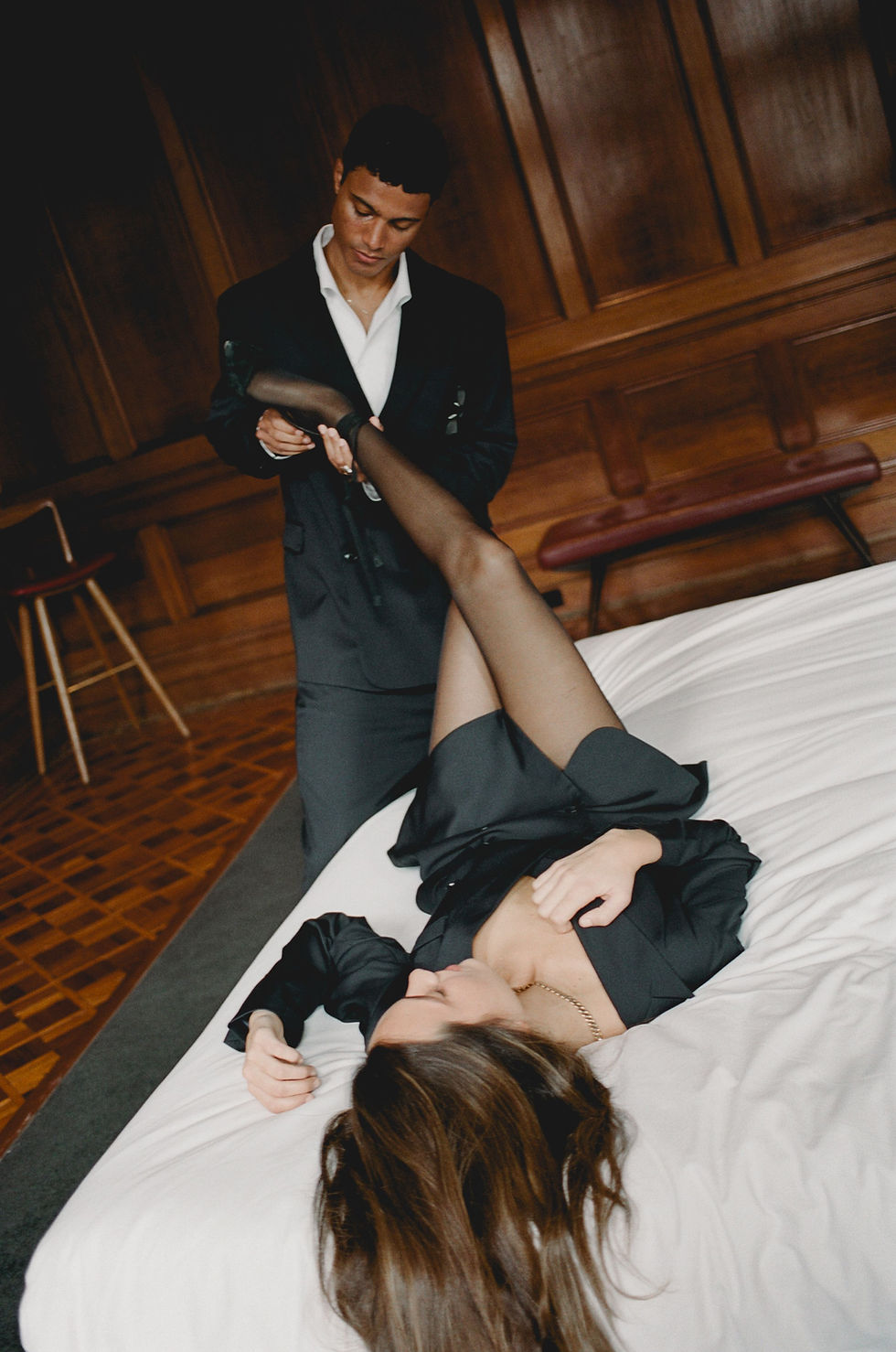
After Paros, Before Habit: Christian Kimber and the Slow Construction of Modern Menswear.
Christian Kimber’s Resort 2026 collection at Australian Fashion Week unfolded not unlike a reconsideration of what clothing is allowed to remember.
Not memory in the nostalgic sense, but something more structural - the way materials hold onto time, or resist it, or quietly reconfigure it. The show did not present resortwear as escape, but as recalibration: a wardrobe thinking through weather, geography, and the ethics of ease.
There is a tendency, especially in resort collections, to treat warmth as metaphor - a shorthand for leisure, for distance, for fantasy. Kimber avoids this entirely. Instead, Paros is not staged as idyll but as condition: light that behaves differently, fabrics that loosen their grammar, silhouettes that begin to negotiate with air rather than architecture. The Mediterranean is not aestheticised so much as processed - translated into cuts, tensions, and absences.
What emerged is less a seasonal offering than a continuation of a longer argument the brand has been making since its inception in Melbourne in 2014. From its earliest capsule of footwear and accessories through to its expansion into tailoring, ready-to-wear, and physical retail spaces in Fitzroy and Armadale, the label has moved with a kind of deliberate inertia - growth that refuses acceleration. It is fashion, but it behaves like sediment.

The production logic behind it reinforces this. Small family-run workshops in Italy and Portugal are not invoked as narrative flourish but as the actual infrastructure of the clothes. There is a restraint embedded in that decision that reads closer to Simone Weil’s idea of attention than to contemporary sustainability rhetoric. Care here is not an aesthetic claim; it is a method of making that quietly refuses disposability as premise.
On the runway, this philosophy becomes tangible without ever becoming declarative. Linen does not appear as summer shorthand but as a material negotiating its own softness. Cotton is weighted in such a way that it seems to hesitate between structure and air. Even tailoring - traditionally the most authoritative register in menswear - is softened into something more ambiguous: chore suits recut in coastal-weight fabrics, silhouettes that appear to have been relieved of their own certainty.
The palette works less like colour theory and more like environmental recording. Azure, mineral green, sun-faded neutrals - not chosen to signify the Mediterranean, but to behave like it. They read as conditions rather than hues, closer to atmospheric states than design decisions. At times, the effect recalls Gaston Bachelard’s sense that matter is never inert, that it carries its own imaginative charge before it becomes form.
What Kimber is building, then, is not a wardrobe in the conventional sense but a system of relations between body and environment. Clothing becomes a medium through which temperature, light, and movement are negotiated rather than controlled. Resortwear, in this framing, is no longer an invitation to disengage from work or structure, but a recalibration of how structure itself might soften without dissolving.
There is an understated intelligence in the way this was staged at Australian Fashion Week. The Museum of Contemporary Art, with its marble permanence and coastal luminosity, becomes an inadvertent counterpart to the collection’s internal logic: durability meeting ephemerality, stone meeting wind. Nothing is overstated, yet everything feels slightly re-registered in that encounter.
The casting reinforced this sense of permeability. Figures drawn from fashion, sport, film, and Kimber’s own orbit move through the show without being isolated into archetypes. The effect is not diversity as statement, but continuity across difference - a wardrobe that does not insist on a singular type of wearer, but rather a shared condition of wearability.
There is also something quietly philosophical in Kimber’s refusal of rupture. Contemporary fashion often depends on interruption - the new season as break, as reset, as declaration. Kimber’s work behaves more like Bergson’s durée: time as accumulation rather than segmentation. Nothing here feels like a departure. Instead, everything feels slightly more resolved than before, as though the system has tightened around its own logic.
Even the notion of resort - so often reduced to destination dressing - is reframed. These are not clothes for escape, but for inhabitation. They suggest travel not as fantasy but as continuity of self under different atmospheric conditions. A linen shirt becomes less an object and more a negotiation with heat. A bomber jacket in coastal camouflage reads not as styling gesture but as an attempt to reconcile protection with ease.
What lingers after the show is not spectacle, but consistency - a rare quality in a landscape often driven by volatility. Kimber’s work resists the theatre of novelty in favour of something more difficult to sustain: coherence over time. It is this coherence that gives the collection its quiet authority.
In the end, Resort 2026 does not attempt to redefine menswear through disruption. It does something more understated, and arguably more radical: it insists that clothing can be both useful and reflective, grounded and sensorial, ethically constructed and sensually experienced, without those categories ever needing to resolve their tension.
It is fashion that behaves as if attention still matters.
---
Words by AW.
Photo courtesy of Christian Kimber.