


A Grammar of Elsewhere: On Staying at Mandarin Oriental Wangfujing.
There are hotel groups that perfect a style, and others that refine a system. Mandarin Oriental Hotel Group belongs, unmistakably, to the latter - though even “system” feels too mechanical for what is, in practice, something closer to a philosophy of attention. What distinguishes it is not consistency alone, but a refusal to let consistency harden into formula. Each property behaves like a variation rather than a repetition, as though the brand were less a template than a set of constraints within which difference is not only possible but quietly encouraged.
Since The Mandarin, that tension has defined its evolution: a cultivated balance between recognisable grammar and local deviation. The result is a hospitality language that never fully translates itself, but instead learns the cadence of each city it inhabits. In Beijing, that cadence is shaped by sedimented time - imperial continuity interrupted by modern acceleration, memory laid against glass and steel.

At Mandarin Oriental Wangfujing, the location alone could overwhelm the experience. The Forbidden City is not a view so much as a presence - not staged, not framed into spectacle, but allowed to persist at the edge of perception. It resists interpretation. In the morning haze it appears as if unfinished; at night it becomes a darkened geometry of withheld narratives. One does not “look at” it so much as become aware of it, the way one becomes aware of time itself only when it shifts.
Walter Benjamin might have recognised something of the aura here - not in the object itself, but in the friction between proximity and irretrievability. The palace is close enough to be ordinary, yet distant enough to remain mythic. It behaves like history refusing to settle into documentation.
Inside the hotel, however, there is no attempt to compete with this density. Instead, there is a counter-proposal: clarity.
The interiors by Hirsch Bedner Associates are an exercise in controlled permeability. Space is neither closed nor open in any simple sense; it is modulated. Light is allowed to enter but never dominate. Materials are chosen not for their expressiveness but for their restraint under repetition - how they behave on the hundredth encounter, not the first.
There is something almost phenomenological in the way the rooms are composed. One thinks of Merleau-Ponty’s insistence that perception is not a window onto the world but an embodied negotiation with it. These rooms do not present themselves as objects to be viewed; they become environments that respond to use.
The scale is generous but never rhetorical. Instead, it is calibrated toward a peculiar kind of intimacy - not emotional, but spatial. Distances are measured so that movement feels neither compressed nor abandoned. Nothing requires negotiation. Even the air seems to have been arranged with intent.
The octagonal table, for example, is not simply a design gesture but a quiet intervention into behaviour. It destabilises the hierarchy of the room, refusing a single orientation. One does not sit “opposite” or “beside” so much as within a field of adjacency. It recalls Deleuze’s notion of the smooth space - not in its abstractness, but in its refusal to fix position.
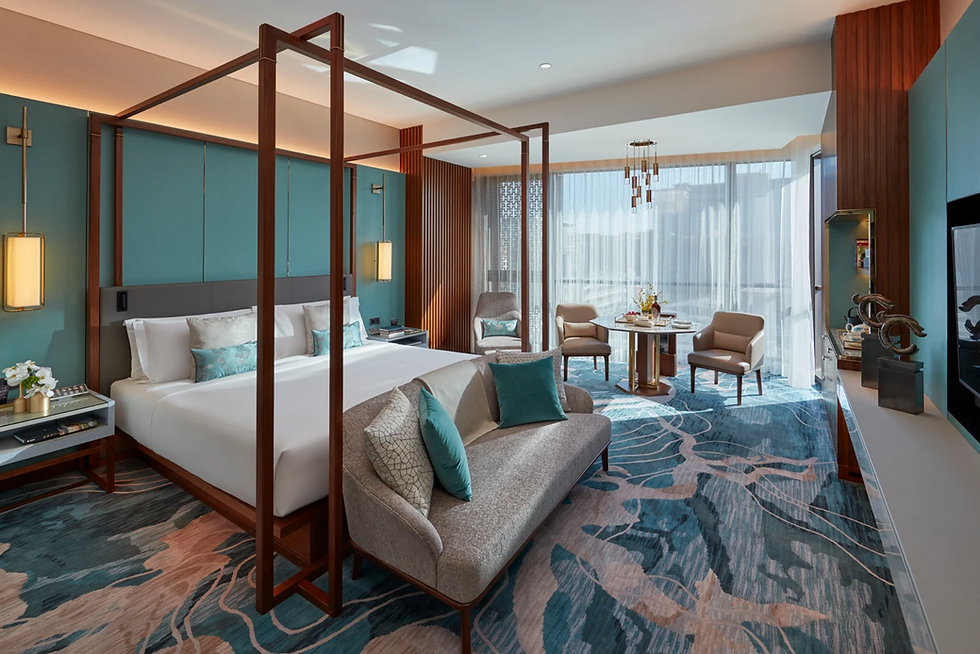
Elsewhere, storage disappears into architecture. Wardrobes are not thresholds but continuities. Surfaces remain clear not through minimalism as aesthetic doctrine, but through a deeper logic of deferral: things are always available, never intrusive. The valet closet, discreetly externalising service functions, removes the awkward choreography of hospitality from the guest’s immediate field. It is a small but profound act of spatial ethics.
The bathroom continues this grammar. Heated marble floors do not announce luxury; they erase interruption. The rain shower is not theatrical but atmospheric - an adjustment of conditions rather than an event. Even the lighting avoids hierarchy. It does not sculpt; it levels.
One is reminded of Jun'ichirō Tanizaki’s In Praise of Shadows, though here shadow is not romanticised but operationalised. Darkness is not aesthetic; it is atmospheric regulation. Gaston Bachelard wrote that the house shelters daydreaming. These rooms do something more specific: they discipline it.
Technology is present but receded. Screens, speakers, controls - all integrated to the point of visual silence. The result is not absence but absorption. The room does not foreground its intelligence; it disperses it.
Over time, something subtle occurs. The space begins to anticipate not desire, but habit. One’s movements become slightly more economical. Decisions feel already half-resolved. The room does not shape behaviour through instruction, but through reduction of friction. It is not telling you how to live; it is removing the resistance that prevents continuity.
This is where the design reveals its deeper ambition: not spectacle, but calibration.
That logic extends outward.
At Mandarin Grill, Christophe Riou works within the almost archetypal language of the steakhouse, but reduces it to structural clarity. Fire, meat, temperature, timing - each element is treated not as tradition but as variable. The result is not reinvention, but purification. The room itself follows suit: restrained, focused, without the usual density of luxury dining codes.
The wine programme is unusually articulate. It resists the encyclopaedic impulse common to hotel cellars and instead behaves like a curated argument. Old World and New World producers are not opposed but placed into dialogue. The selection feels less like accumulation than editorial thinking - as though each bottle has been asked what it contributes to pacing rather than prestige.
The inclusion of Michter's extends this temporal logic. Whiskey, unlike wine, insists on a different philosophy of time - slower, more subterranean, less legible in the moment of consumption. Its presence reframes the meal not as sequence but as duration. One moves from grape to grain, from immediacy to residue.
If Mandarin Grill is about reduction, Café Zi is about modulation.
In the morning, it operates as one of the most quietly precise breakfast environments in Beijing. The à la carte menu is executed with unusual seriousness: eggs, congee, and dim sum treated not as hotel obligations but as calibrated dishes with internal logic. Alongside it, a buffet unfolds that avoids the typical excess of range. Instead, it feels edited - selective rather than abundant, composed rather than displayed.
But what distinguishes the experience is not the food alone, but the rhythm of recognition. Staff begin to register patterns with almost imperceptible ease. Preferences are not recorded in any formal sense; they are absorbed. Coffee versus tea. Window versus interior. Light versus substantial. By the second morning, gestures begin to precede requests. By the third, language becomes almost optional.
This is hospitality approaching what Simone Weil might have called attention in its purest form - not vigilance, but receptive precision.
By evening, Café Zi undergoes a subtle transformation. It does not change identity; it deepens register. The space tightens acoustically and visually, and its Cantonese repertoire becomes more pronounced. Here, its much-acclaimed lobster preparations stand out - not as ornament, but as articulation. Lobster is treated not as luxury signal but as problem of texture, temperature, and restraint. Each iteration avoids excess, instead privileging clarity of flavour and restraint of gesture.
The result is a cuisine that feels less like interpretation and more like re-reading - the same text, differently understood under altered light.
Then there is the Mongolian yurt - an intervention that could easily have slipped into thematic excess, but instead achieves something closer to spatial condensation.
The structure does not simulate place; it intensifies logic. Warmth becomes architecture. Fabric becomes acoustics. The interior - with its deep reds, patterned textiles, and circular orientation - produces a sense of enclosure that is neither theatrical nor literal. It is closer to anthropological imagination than reproduction. Claude Lévi-Strauss might have recognised it as a structure of relations rather than objects.
The menu reinforces this: lamb, fire, smoke, grain. Everything is reduced to elemental conditions. One is not transported elsewhere; one is relocated within a different set of material priorities.
If the yurt is about concentration, MO Bar is about dispersal.
Its design references traditional Chinese medicine cabinets, introducing an epistemology of compartments. Reality is broken into drawers, each suggesting classification without finality. Cocktails follow this logic: layered, associative, slightly narrative without becoming literal. Ingredients behave like correspondences rather than components.
There is a subtle intellectual pleasure in this - not conceptualism, but adjacency. The drinks do not explain the city; they echo it obliquely.

As night settles, the terrace reasserts itself and the Forbidden City returns in altered form. It is no longer a monument but a shadowed mass of historical weight, present but unresolvable. The city becomes less legible, more atmospheric.
Across the hotel, other spaces continue this logic of calibrated experience.
The The Spa at Mandarin Oriental Wangfujing functions not as destination but as sequence - treatment rooms, pool, steam, rest - each connected through continuity rather than contrast. The skylit pool in particular feels almost metaphysical in its restraint: water suspended beneath controlled daylight, movement slowed into abstraction. The body is not transformed here; it is re-tuned.
Even fitness, often the most aggressively instrumentalised hotel space, is treated with unusual restraint. Machines exist, but do not dominate. The body is not corrected; it is recalibrated.
Threaded through all of this is service, which operates as the invisible intelligence of the building.
Under Richard Langonné, service becomes a form of environmental reading. Staff do not perform attentiveness; they distribute it. Preferences are not remembered as data but as continuity. Rooms are not reset to abstraction but to biography. One returns not to a standardised environment, but to a subtly reconstituted version of one’s own pattern of inhabitation.
What emerges is a form of hospitality that avoids both impersonality and intrusion. It does not simulate intimacy; it constructs familiarity through restraint.
In the end, what distinguishes Mandarin Oriental Wangfujing is not any single gesture but the coherence between systems - architecture, service, cuisine, rhythm, and attention all operating under the same principle: reduce noise until structure becomes visible.
This is the deeper achievement of Mandarin Oriental Hotel Group at its most refined. Not to design experiences that impress, but to construct conditions under which perception becomes clearer.
You do not leave with memories of things.
You leave with a slightly altered sense of how things come into view.
---
Words by AW.
Photos courtesy of Mandarn Oriental Wangfujing.


